A good friend of mine who is not particularly interested in cycling, but who is a history buff, recommended this book to me, knowing that while I too read a lot of history, I am also a cycling enthusiast. And this book is definitely a win-win for anyone who enjoys either or both of these pastimes.
The author, Kevin J. Hayes, a professor of English at the University of Central Oklahoma, tells the story of George W. Nellis, a 22-year old journalist from Herkimer, New York, and an avid wheelman–in the parlance of the 1880s for those who rode the high-wheeled bicycles–as he rode from his hometown to San Francisco. Nellis’s ultimate goal was to better the time for a transcontinental journey by similar conveyance set by Thomas Stevens three years earlier. This competitive aspect as described by the author of Nellis’s cross-country cycling venture provides a bit of tension throughout the story.
The author has left no stone unturned in his research as he addresses peripheral issues such as the history of the manufacture of the bicycle in the United States, the publicity campaign orchestrated in order to increase sales, considers other prominent wheelmen of the period whose publications documenting their exploits gave rise to the popularity of the bicycle as well as explaining little-known facts that the reader is likely to happen upon while reading the book.
The author follows Nellis as the latter makes his way doggedly across the country in the face of the main obstacle of extremely poor roads, the condition of which was much of the time in a deteriorated state because of the frequent rainstorms that seemed to plague him from the start. Any cyclist can readily identify with the discomfort of riding in heavy rain, even given the excellent roads we have today. The desolate countryside that encompassed him for miles offered no protection from the storms or a place to stop to eat. We feel Nellis’s weariness and frustration during these experiences.
The author describes Nellis’s adventures in each state or territory that he passes through: his contacts with the locals, his interaction with members of the League of American Wheelmen, a popular organization at the time, and those who befriended him along the way. Here too, anyone who has undertaken long-distance cycling trips can identify with being miles from a town with no place to eat or stay and being given these amenities by a total stranger.
A historical time capsule was provided by the author as he described events that Nellis was planning to attend along the way, as well as sporadic happenings in some of the towns where Nellis spent his time along his route. Also based on Nellis’s correspondences with the several newspapers, to which he had arranged to send updates, the author has given us a snapshot of a broad swath of the United States in the late 19th century, within 15 years of the turn of the century.
Hayes’ book transports the reader from the comfort of the 21st century to a bygone era, when–as Nellis found to be particularly true in the interior of the country–men and women were struggling to come to terms with the harsh realities of life, yet some still had the resources and found the time to enjoy that new, freeing invention, the bicycle.
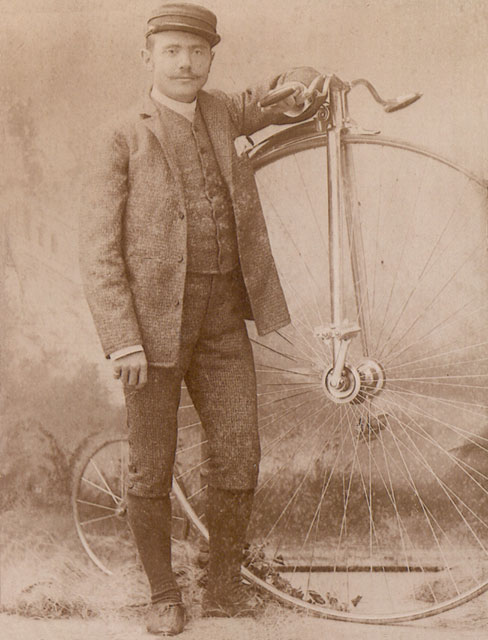
A photograph of George W. Nellis, Jr. in the Wheelmen magazine-1887
 The Dragon is Slain
Leave a comment