This is a translation, from the Russian, of a 3-part article by Vladimir Malyagin, an author and dramatist who serves on the publishing council of the Russian Orthodox Church. The reader is invited to engage in a critical review of the author’s commentary, remembering that it is the viewpoint of an apologist of Russian Orthodoxy, which I would suggest he sees as the only true representation of Christianity. I have highlighted certain opinions of Malyagin that point to this perspective.
In a previous post One Holy Catholic Church – Not! [https://wordpress.com/read/blogs/201293822/posts/1039%5D I stated that only the Roman Catholic Church is actually correct to identify itself as a ‘church.’ I did so in the context of the topic of that post. In a broader sense, however, one should also include the Russian Orthodox Church in this category, since it too treats the eucharist as an offering from an altar of the actual blood and body of Christ, the receiving of which is tantamount to salvation. [Please refer to Theoretical Reconstruction of the Derivation of the Conceptual Word ‘Church’ at https://wordpress.com/read/feeds/125354824/posts/4069473697].
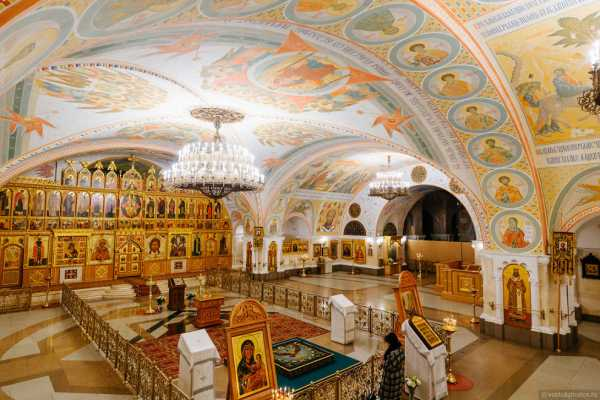
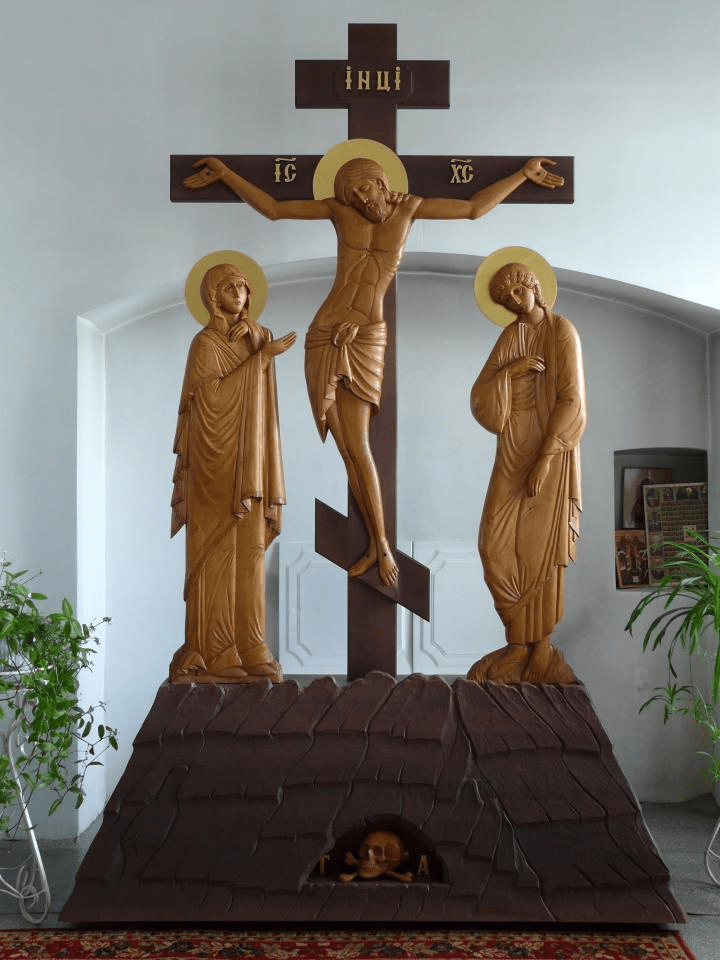
Malyagin’s article as translated by LOC follows:
It is hardly possible to name another writer, whose artistic fiction so categorically and sharply intrudes into real life, whose seemingly improbable prophecies are coming to pass after many decades with ironclad and detailed thoroughness. Questions, raised by Dostoevsky with great power in his literature, are essentially questions of the spirit and conscience – that is, important questions for each and every sincere human heart. Dostoevsky’s heroes always stand on the edge of an extremely important choice – between truth and lie, light and darkness, good and evil.
Dostoevsky is a realist, but the single reality that really concerns him is spiritual reality, the reality of the internal life of human existence that is not seen with fleshly eyes; because to us, people who know about spiritual life more by hearsay, Dostoevsky often is presented as a mystic and even a fantasizer. But everything that is seen is temporary, the unseen is eternal (2 Corinthians 4:18); Dostoevsky could have repeated this, following the apostle and the holy fathers of the Orthodox Church.
For each and every researcher of artistic creativity, it is obvious that the measure of an artist is determined above all by the scope of the questions and topics that disturb him. Dostoevsky never took on topics that were not foremost. To say more exactly, under his pen any topic of ordinary, everyday life became key. In every particular happening, he, as no one else, was able to see and to reveal the overall sense of what was occurring, the vicissitudes of the main battle of the Russian and general world historical process – the battle between faith and apostasy, Christ and Beliar. [Translator note: The author is quoting the first half of 2 Corinthians 6:15 from the Russian Bible, which uses the term ‘Beliar’ as does the original Greek. ‘Beliar’ is the same as ‘Belial’, which is the original Hebrew form meaning ‘worthlessness’ or ‘wickedness’ and is used as a name for Satan. The liquid phonemes ‘l’ and ‘r’ (Hebrew: ר/ל; Greek: λ/ρ – respectively) are easily interchanged depending on the language or even a dialect of a given language that is being spoken.]
For the Russian and the Russian heart, Dostoevsky is particularly close. Indeed, namely the topic of Russian and Russianness as well as the topic of Russia was a theme that cut through his works, and Russian pain was his eternal pain. Together with this, Dostoevsky was never, even slightly, a writer-ethnographer, chanting sarafans [translator comment: apparently the musical compositions that accompanied traditional dances during which women wore eponymous costume dresses, i.e., sarafans] and round dances; nor was he a writer-“populist,” extolling the life and customs of the people, no matter what. On the contrary, he approached the people and their spiritual reality strictly, making no allowances, with the same moral principles that he followed in his personal life.
This scope of the creativity of Dostoevsky has predetermined the great and indisputable fame of the Russian writer. In the one-hundred-plus years that have passed since the day of his death, hundreds of books and thousands of articles have been written about him. Of course, they will be writing about him going forward, as long as human society, even if in small part, succeeds in maintaining the human image.
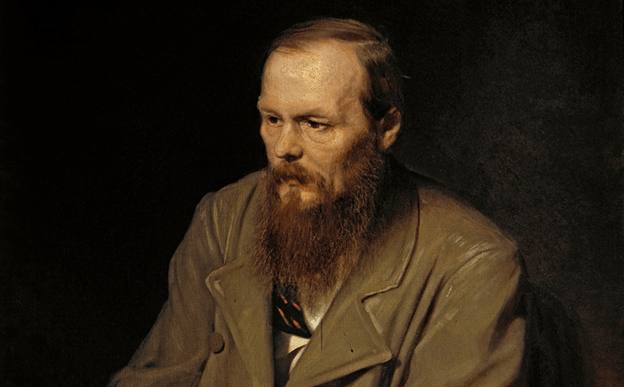
Portrait of Fyodor Mikhailovich Dostoevsky
And, although, in spite of the huge, almost incomprehensible quantity of critical literature about Dostoevsky, a theme exists that up to now is being illuminated sparingly, indistinctly, and contradictorily by researchers of his work. This theme is “Dostoevsky and Orthodoxy” or more definitely and specifically, “Dostoevsky and the Church.” Yes, in the relations between Dostoevsky the artist and the Orthodox Church it is not that there is inconsistency and incompatibility, but rather a reticence and lack of clarity in some questions.
This is evident, above all, in the private assessments of his person and creativity from people well-known in church history. Actually, on the one hand, we hear the sincere words, coming from the depths of the heart, of the Russian Orthodox priests and bishops, contemporaries of the writer, who conducted the funeral service “for our great writer and devout Christian Fyodor Mikhailovich Dostoevsky;” on the other hand, we read in the book of Orthodox thinker Konstantin Leontiev, Our New Christians, accusations against Dostoevsky of inventing “pink Christianity” [translator note: a ‘Christianity’ devoid of commitment], of the implausibility of the image of Russian Orthodox monasticism, drawn by the writer in his last, and his final, novel Brothers Karamazov.
In the 20th century, they became accustomed to mentioning the opinion of Leontiev as curious – and nothing more than that. Even such a well-known Orthodox critic of Dostoevsky’s work as metropolitan Antoniy (Khrapovitsky), mentioning Leontiev’s assessment, explained it “as an unwillingness by the extreme right-wing elements of our literature to understand our great writer.” However, today the definition of “right-wing” is not at all a pejorative assessment for the present Orthodox consciousness. And the accusation of an “unwillingness to understand” at least demands justifiable evidence. Therefore, a similar situation of reticence and indistinctness in such an extremely serious question as “Dostoevsky and the Church,” is abnormal and unacceptable today.
Without making a claim, of course, to a final decision on a question of such scope, we will attempt to identify those reference points that are necessary for evaluating the works of Fyodor Mikhailovich Dostoevsky from an Orthodox Church point of view. [Italics mine]
I. Fate
For the believer, artistic creativity, no matter how exceptional it might be, can never have an absolute, self-sufficient value. Not the artistic images of the writer go to paradise or to the abyss of hell after his death and private trial of ordeals; but he himself, his person, his countenance, his soul. Therefore, any attempt to understand and know the writer presupposes above all an attempt to understand and to know him as a person and to learn his fate.
Dostoevsky was born in 1821 in Moscow, in the family of a doctor, in an apartment of the Mariinsky hospital for the poor, better known under the name Bozhedomki (God’s houses).
In the Dostoevsky line, well-known since the 16th century, there were landowners and monks, warriors, and bishops. The writer’s grandfather was a priest in the Podolsk province.
Young Fedya’s qualities, such as being easily hurt emotionally, heartfelt identification with the suffering of the stranger, being quick-tempered, being drawn to the miraculous, and having a religious frame of mind, turned on him the attention of those around him. In that life, by which the Dostoevskys lived, there was no lack of suffering, so that self-restraint was demanded for the sake of others. Here is just one such occasion: When the Dostoevskys’ village of serfs, which the father of the writer had bought after acquiring for the family line hereditary nobility, burned down, the Dostoevskys sacrificed all their money to help serfs who were victims of the fire. The future writer grew up on just such examples. Already, his first novella, which brought him brief, but clarion literary renown, was named “Poor People” and in an organic form flowed out of the things he lived through in his childhood and youth.
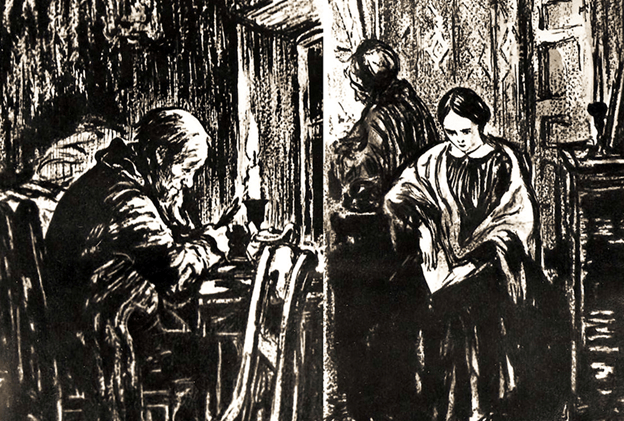
A scene from Dostoevsky’s novella “Poor People”
From earliest youth, Dostoevsky’s most important book became the Gospel. His short friendship with Belinsky [translator note: Vissarion Belinsky, an influential 19th-century Russian literary critic] did not shake the writer’s foundational love – for Christ. Here is how Dostoevsky later remembered that time in “Diary of a Writer”: “On that evening we were not alone, present was one of Belinsky’s friends, whom he [Belinsky] respected very much and to whom he tended to listen; there was also a young writer just starting out, who afterward gained renown in literature.
– It touches me even to look at him – Belinsky suddenly interrupted with his furious exclamations, turning to his friend and pointing at me – every time, when I remember Christ just so, his whole face changes, he wants to start crying… Yes, believe me, you are a naive person – he pounced on me again – believe me that your Christ, if he were born in our time, would be the most unnoticed and usual person, so that he would make himself inconspicuous in the face of today’s science and movers of humanity.
– Well, no-o-o! – Belinsky’s friend picked up. (I remember, we were sitting, but he was going back and forth in the room.) – No; if Christ appeared now, He would join the movement and would become its head…
– Well, yes, well, yes – Belinsky suddenly agreed with surprising haste. – He would exactly join the socialists and go after them.
These movers of humanity, whom it was foreordained for Christ to join, were, at that time, all French…” [Translator note: A reference to Charles Fourier, a French thinker who advocated utopian socialism, in the footsteps of whom Mikhail Vasilievich Petrashevsky (cf. next paragraph) followed.]
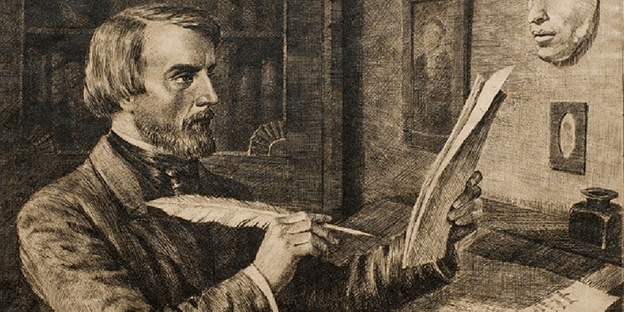
Vissarion Grigorievich Belinsky
Participation in the Petrashevsky circle was, of course, the most radical left and revolutionary period in the biography of Dostoevsky, but it is striking that even being a conspirator, not for a second did the writer shrink back from his main Ideal. Just before the execution, when the last preparations for it were in process, Dostoevsky, according to the memoirs of Prince F. Lvov, walked up to Speshnev, his co-participant in the Petrashevsky circle, and said, “We will be together with Christ!” – “As a handful of ash,” – Speshnev answered.
In this short dialogue both phrases are remarkable and characteristic. Dostoevsky believed that participating in a secret society with the goal of freeing the serfs, he was doing Christ’s work [Translator note: more literally, ‘a Christ thing’]. Speshnev, possibly against his will, said words almost prophetic for the conspirators: should the rebels die at that moment without having repented of their crime, they probably would become only “a handful of ash” for Christ.
But their lives were extended. The years of hard labor became years of great spiritual upheaval for the writer: having gotten to know, accepting, and truly deeply and sincerely loving the Russian people, he became aware of and accepted the thousand-year faith of his people – Orthodoxy.
Together with that, the hard labor did not crush him, but rather developed in him his main qualities – compassion, mercy, and love.
“The forbearance of Fyodor Mikhailovich toward people was as if not of this world,” his friend, A. Vrangel, remembered concerning the years of Dostoevsky’s Siberian exile after hard labor, “Everything downtrodden by fate, the unfortunate, the ailing, and the poor found in him special participation. His completely out-of-the-norm excelling kindness is well-known to all who knew him closely… He is a person altogether devout, sickly, but even so, with an iron will…”
By the way, in this period the full churching of Dostoevsky still had not happened. According to Vrangel’s memoirs, Dostoevsky “more to the point was devout, but seldom attended church, and the priests, especially those in Siberia, he did not like. He spoke about Christ with delight.”
Dostoevsky’s marriage to M.D. Isaeva, which occurred in the winter of 1857 (he was then still an exile), was based to a large extent on those same human premises: compassion, the desire to save, to sacrifice himself. True, to sacrifice himself “for the sake of the happiness of the woman he loved,” who, essentially, did not love him. This maximalism of the will upon achieving a rather fantastic goal – is also one of the characteristic features of Dostoevsky’s personality. This marriage, which lasted seven years, did not bring peace and happiness, but for all his life Dostoevsky received a new, heavy load in the form of his stepson, Pavel – a fop, loafer and liar, who demanded from his stepfather only one thing – money.
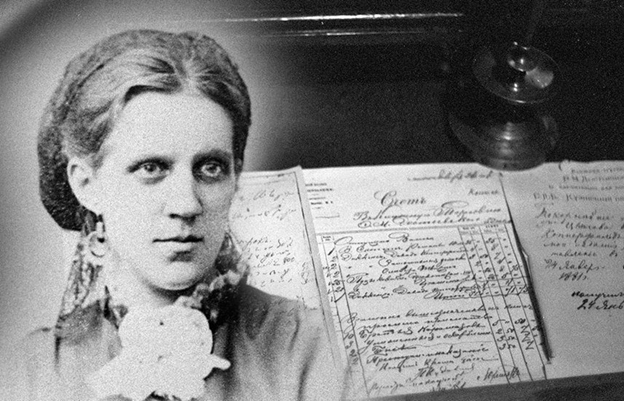
Maria Dmitrievna Isaeva
By the way, to the end of his life Fyodor Mikhailovich also carried another heavy financial burden: he actually maintained the multitudinous family of Mikhail Mikhailovich Dostoevsky – his older brother who died early. Given this, one should note that his stepson, Pavel, and his brother’s family perceived these sacrifices of Dostoevsky, who already had his own sizeable family and who constantly lived in poverty, as their due, as his responsibility toward them.
Like everyone, Dostoevsky was overwhelmed in life by various passions: jealousy, for example, or a passion for roulette during life abroad, but, at the same time, he suffered long decades, beginning in Siberia, the extremely severe physical affliction of epilepsy.
Dostoevsky died a Christian death. Here is how the writer’s wife, Anna Grigorievna Dostoevskaya, remembers this:
“When the doctor began his examination and tapped the chest of the patient, he began to bleed again, and this time, so profusely that Fyodor Mikhailovich lost consciousness. When he regained consciousness – his first words, which he directed to me, were:
‘Anya, I beg of you, invite the priest immediately, I want to confess and take communion!’
Although the doctor began to assure that there was no particular danger, but in order to calm the patient, I fulfilled his wish. We lived near the Church of Vladimir, and the invited priest, Father Megorsky, in a half-hour was with us. Fyodor Mikhailovich calmly and good-naturedly met the father, confessed for a long time, and took communion. When the priest left and I and the children entered the office in order to congratulate Fyodor Mikhailovich on receiving the Holy Secrets, he blessed me and the children, asked them to live in peace, to love one another, and to love and care for me. Having sent the children out, Fyodor Mikhailovich thanked me for the happiness I had given him and asked me to forgive him if he had saddened me in any way…
Then he spoke words to me that only a rare husband could say to his wife after fourteen years of married life:
‘Remember, Anya, I have always passionately loved you and never cheated on you, even in thought…’.”
Dostoevsky’s burial was transformed into a surprising demonstration of Christian feeling on the part of the unbelieving, it would seem, youth. Thousands of people, accompanying him, sang: “O Holy God, The Holy Strong [One], The Holy Eternal [One], have mercy on us!” Many sincere speeches were given at the burial service and at the dirge for him. Here is one of such words, spoken by priest I. Petropavlovsky:
“Just who was Fyodor Mikhailovich? Not a titled, important personage of state, but rather simply a man and a Christian. Christian! In this is the unraveling of the mystery of his soul.
We highly honor him. In what manner have this respect and honor been acquired by him? Not by rising to the pinnacle of state life, but rather by descending to the lowest levels of the life of the people and by serving humanity. This is a poor and selfless toiler, working much for the welfare of humanity by means of talents entrusted to him by God; this is a deeply-believing Christian, a husband of Christ’s Cross… The entire path of his life was sown with thorns. The cup of life’s sorrows and adversity was drained by him to the bottom, but it did not embitter his heart and only ignited in him the fire of holy love for his people and for all of humanity. And he was a true son of his people and a friend of all of humanity.
He opened to us the life of our people in its lowest, outcast levels and here together with terrible ulcers of the soul he found and pointed out to us this shining spark in the human soul, on the basis of which we are all related to our Creator, the Father of lights…
The rich content of his spirit was not acquired easily by him; it came through suffering, out of the crucible of the painful feelings of his heart. Whether [this content] is high – we do not know, whether it is close – we will not decide beforehand, but, undoubtedly, he is the likeness of a righteous man.”
Dostoevsky’s death in truth was a death “painless, shameless, and peaceful” – the kind of death, which the Church requests in its prayers to the Lord for all its faithful vessels.
II. Works of Art
Beginning with Notes from the House of the Dead (1861-1862), which returned to Dostoevsky his former clarion literary renown that had faded because of his arrest and exile, every new major work of the writer turned out to be at the epicenter of the literary and societal war of that time. But if Notes from the House of the Dead all the same had more of a social and journalistic meaning, then Crime and Punishment (1866), Dostoevsky’s first great artistic novel, directly raised questions of a spiritual-moral order. Namely, with Crime and Punishment Dostoevsky becomes, by virtue of his convictions gained through a life of suffering, one of those who consciously resists in Russia’s societal life the spreading liberal-democratic “moral progress” that is leading Russia toward a future catastrophe.
In his drafts for the novel, the writer notes: “An Orthodox view, what Orthodoxy is not is happiness in comfort; happiness is bought through suffering. Such is the law of our planet, but this immediate consciousness that is being felt by the day-to-day process of living produces the kind of great joy, for which it is possible to pay through years of suffering. Man is not born for happiness. Man earns his happiness, and always through suffering…”
In these same drafts, Dostoevsky also formulates his understanding of socialism:
“The main idea of socialism – it is a mechanism. There man is made man by mechanics. There are rules for everything. Man himself is eliminated. They have removed the living soul.”
It is exactly with the removal from man of his living soul that the writer was not about to make peace.
The main idea of the novel Crime and Punishment is simple and clear. It is the incarnation of the Sixth Commandment – “Do not kill (i.e., murder).” But there would be little use from this well-intentioned striving if the writer simply declared once again one of God’s commands. The strength of his great artistic talent was namely in showing the reader the inevitability of paying for an evil committed and he gives witness concerning this inevitability. Exactly because Raskolnikov also has a living soul (although he tried to imagine himself as a cold and sensible mechanism), he carries within himself the punishment for his crime. Because, as Tertullian says, “the human soul – by nature is Christian” and does not tolerate spiritual violence on itself.
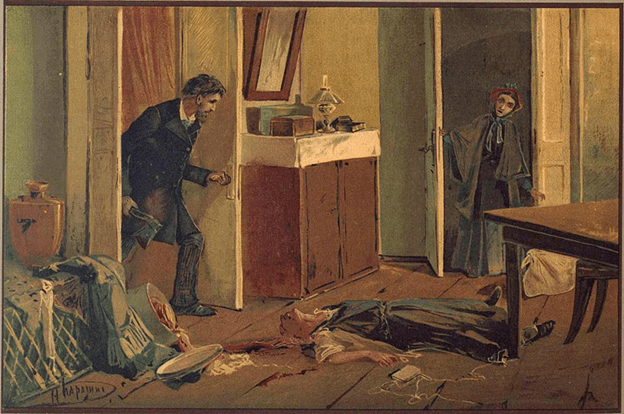
Raskolnikov has committed his deed
By the way, Dostoevsky the thinker could not, of course, stop at the idea of revenge, even one fully deserving – by man. If in the world there is only justice, but not mercy, then such a world would never satisfy Dostoevsky. Let us add from ourselves – in such a just world a living man would simply suffocate from the coldness, mechanicalness, and dislike of people one for the other.
The hue and cry about our mercy toward the “humiliated and insulted,” toward all “poor people” is a theme that cuts through the works of the writer. But this is not enough for him. As Christ rose, so can every human soul rise again – rise again and rise out of the condition of its sinful fallenness. And without exactly this resurrection there is not the faith of Dostoevsky; more truthfully – this possibility of resurrection, through human love, of the soul, no matter how deep it has fallen, is the basis of his faith.
“How this happened, even he himself did not know, but suddenly something grabbed hold of him and somehow threw him to her legs. He was crying and hugging her knees. In the first second, she was terribly frightened, and her entire face deadened. She jumped up from her spot and, shaking, looked at him. But, in that very moment, at the very second, she understood everything. In her eyes began to shine eternal happiness; she understood, and for her, there was no longer any doubt that he loves, eternally loves her and that at last, this minute had arrived…
They were about to speak, but they could not. Tears stood in their eyes. They both were pale and thin; but in these pained and pale faces the dawn of a renewed future was already shining, full of resurrection to new life. Love had resurrected them and the heart of the one carried the eternal sources of life for the heart of the other.
They proposed to wait and endure. They still had seven years; and until then so much unbearable torture and so much eternal happiness! But he had risen again, and he knew this, he felt it completely with all his renewed being, and she indeed was living only by his life!
On the evening of that same day, when the barracks had already been locked, Raskolnikov lay on his cot and thought about her. On this day it even seemed to him as if all the prisoners, his former enemies, were already looking at him differently. He even began speaking with them himself, and they answered him affectionately. He was remembering this now, but indeed so it should have been: really should not everything change now…?”
Crime and Punishment is perhaps Dostoevsky’s most harmonious and artistically perfect novel. Its structure relates it with classical tragedy, but with tragedy not antique, but rather permeated with the light of Christian faith in the renewal and resurrection of man. Another reason for the artistic harmony of the novel, most likely, is that the author still has not set for himself the task in this work – a task almost unbearable for art – to portray a “positive-beautiful” person.
This was exactly the task set by Dostoevsky in the novel The Idiot. The image of the main hero crystallized gradually. At the beginning of his thoughts, Dostoevsky makes these sorts of rough sketches:
“The main characteristic in the character of the Prince: Downtrodden, Frightened, Humiliation, Humility. He is completely convinced that he is an IDIOT.”
The Prince talks about sinful people: All are sick, they need care…” “Humility is among the greatest of strengths.”
How to make the person of the hero likeable to the reader? If Don Quixote and Pickwick succeeded as virtuous persons likeable to the reader, it was by the fact that they are strange.
The hero of the novel, The Prince, if not strange, then he has another likeable trait: he is innocent!”
And finally, Dostoevsky writes down several times in the course of one day, 10 April 1865: “THE PRINCE – CHRIST…”
As we see, a really grandiose task had been set. Was it carried out?
Without argument, in no way can one call the novel The Idiot a creative failure of the writer. The portrayal of the struggles of the human soul with its passions, as always with Dostoevsky, is incisive and deep. But the beautiful person is a humble person, who is drawn into the whirlwind and whirlpool of these passions and will in the end perish, going out of his mind. In this way, the sea of life, which rises up as a storm of passions [translator note: the author of the article is quoting from the Old Testament book of Job as rendered in Old Church Slavonic], drowns in its abyss the one who, according to the writer’s design, must have become if not equivalent to, then like Christ. This important “symptom” in the work of Dostoevsky will be developed in the future and will become a stumbling block for many readers and critics of the writer. For the time being, we will only note this symptom to ourselves.
The novel Demons, published in 1871-1872, finally led Dostoevsky into the camp of the “reactionaries.” Liberal-democratic and socialist terrorists against literature, who had already blamed the writer for the image of Raskolnikov, in whom they did not see sufficient piety and admiration for the “young (nihilistic) generation,” rather they had observed “slander directed at the Russian revolutionary,” after Demons refine their wit concerning Dostoevsky’s backwardness.
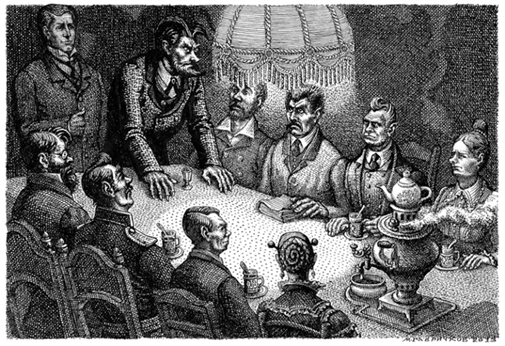
A scene from Dostoevsky’s novel “Demons”
D. Minayev, for example, uniting in his reviews the names of Dostoevsky and Leskov (the latter had recently published the anti-nihilistic novel At Daggers Drawn), writes that both writers “to such an extent rolled around that in the latest novels, they came together in some sort of single type, a homunculus, having been born in the famous inkwell of the redactor of “Moscow Statements” (M.N. Katkov – B.M.), into one work of Leskov-Dostoevsky-Stebnitsky, Demons – At Daggers Drawn.”
In a similar spirit of mockery were written other “revolutionary” reviews. The novel Demons, in left-wing critiques, acquired forever the label of an odious, slanderous, “reactionary,” artistic failure of Dostoevsky. For these critics, the issue was not that exactly in these weeks and months, when the novel was being written and published, in Moscow the “matter of Nechayev” was being heard, and in many ways echoed the plot of Demons. But much, then, still unknown, Dostoevsky simply guessed at, being founded on a deep understanding of “the psychology of the revolutionary.”
The main service of the writer was that, with his novel, he was tearing from the conspirators-revolutionaries the attractive mask of noble actors “in the name of freedom and progress,” and was showing to the readers the true guise of these destroyers of faith and morality, these demon-like executioners of humanity. Within a half-century of the Russian revolution, he saw all the mercilessness of that battle, which would unfold on Russian land at the beginning of the 20th century. He had seen – and told the world about it.
Now we know that if Dostoevsky did make a mistake in the portrayal of revolutionaries, it was not at all that mistake of which they accused him. Reality proved still more terrible and bloody, and revolutionary demonism took hold of Russia with such power that waking from the nightmare lasted for long decades.
Moreover, the writer was not expecting any other reaction to his novel than condemnation from the “liberators.” In a letter to the successor to the throne, Aleksander Aleksandrovich (future emperor Aleksandr III) from 10 February 1873, Dostoevsky writes:
“We have forgotten that all great nations have manifested their great strengths by the fact that they were so ‘arrogant’ in their opinion of themselves and it was namely by this that they became useful to the world, and by this introduced into it, each, if only one beam of light, that they themselves remained proudly and steadily and always arrogantly independent.
For us to think thus now and to be expressing such thoughts, means to doom ourselves to the role of a pariah. And, in the meantime, the most important preachers of our national lack of originality would have been the first to turn away with horror from the Nechayev affair. Our Belinskys and Granovskys would not believe it if they were told that they are the direct fathers of Nechayev. It is this relatedness and continuity of thought, which has been developed from the fathers to the children that I also wanted to express in my [novel].”
But besides the prophetically faithful spiritual anatomy of the whole Russian revolutionary movement, in Demons Dostoevsky tried to create something principally new for himself. This was the writer’s first novel, in which the Russian monk Tikhon was supposed to appear “on the stage” as the spiritual and moral judge of Nikolai Stavrogin.
As what sort of person was Dostoevsky seeing the Russian monk-elder at this time?
“…A bishop who, having lived in peace, whether because of weakness of character or ‘because of an unforgivable, and uncharacteristic for his rank, absent-mindedness,’ he was unable to instill for himself, in the monastery itself, particular respect.”
“The library too, they said, was compiled much too varied and contrary: right next to compositions of saints and devoted Christians were found theater compositions and perhaps even worse still…”
“The quiet awakened (Stavrogin), and suddenly it seemed to him as if Tikhon in embarrassment lowers his eyes and even with some kind of unnecessary ridiculous smile.”
“I will not be ashamed of Your Cross, Lord – Tikhon almost whispered, some kind of impassioned whisper and bowing his head even more. The corners of his lips suddenly began to move nervously and quickly.”
Having read Stavrogin’s horrible confession about raping an underaged girl, “Tikhon took off his glasses and began first, with some carefulness. – And are there not other corrections you should make in this document?
– Why? I wrote sincerely, – answered Stavrogin.
– A little in the style.”
“I will tell you glad tidings for this, – Tikhon said with tenderness – and Christ forgives if only you reach the point that you forgive yourself… O no, no, don’t believe [that], that was nonsense: even if you don’t reach the point of reconciling with yourself and forgiving yourself, even then He forgives for the intention and your great suffering…
The corners of his lips twitched as they had just moments before, and a hardly noticeable spasm passed over his face.”
In the end, when Tikhon predicts to Stavrogin a new crime, Stavrogin, if only not to make public his printed confession, calls him a “cursed psychologist” and walks away…
In essence, the designation “psychologist” has a basis. Dostoevsky clearly considers the main quality of Tikhon to be his psychological insight, endowing him thereby with nervousness, sensitivity, and spiritual refinement. But the essence of being an elder is entirely about something else: an elder is not an insightful psychologist, but rather a spiritual leader having power and strength. Dostoevsky clearly does not allow himself this understanding, and for that reason, Stavrogin’s meeting with Tikhon ends, essentially, without result. [Translator comment: I disagree with Malyagin’s interpretation of this exchange between Elder Tikhon and Stavrogin. One of the essentials to being a successful writer of fiction is to portray the various characters created by the author as true to their intended personalities. As an unregenerate pagan who had committed an utterly craven and despicable crime, Stavrogin would not, nor could he, have attributed Tikhon’s perceptive and incisive prospectus of Stavrogin’s future to anything other than to a secular humanistic approach to the mind as opposed to spiritual insight into the heart of man. As regards Elder Tikhon’s tendency to lower his eyes and, at one point, to pray under his breath, I would suggest, indicates Dostoevsky’s acute awareness of the power that absolute evil can project, even in the presence of a man of God, and therefore has Tikhon behave, not as someone who is intimidated but who realizes his strength resides humbly in Christ alone.]
A detail of no small importance: the writer several times calls Tikhon a bishop [Translator note: literally, ‘arch priest’ – “the general title for the highest ranks of the clergy (bishop, archbishop, metropolitan”); Malyagin is making a distinction regarding the ecclesiastical title Dostoevsky assigned his character Tikhon] (although in reality, such a person we actually call a bishop or metropolitan) and even a saint (so the Church calls Orthodox saints from among the ‘archbishops’ after their death), and at the same time, Stavrogin addresses him: “Father Tikhon” – as to a rank-and-file priest.
It is completely obvious that during his work on Demons, the writer was still very superficially representing to himself monastery, and, in general, church life. Therefore, the publisher (we will remember, it was M.N. Katkov) co-served Dostoevsky a good service, by not agreeing to include the chapter “At Tikhon’s” in the final text of the novel.
His next novel, The Adolescent /or/ Raw Youth, certain researchers of literature define as a one-of-a-kind educational novel. Its plot consists of the debunking of the Adolescent’s idea “to become Rothschild” and with the help of huge riches “to rule the world.” There is a believer-hero in the novel. This is the former serf, Makar Ivanovich Dolgoruky, who was appointed to serve as a father to the Adolescent. He wanders about innumerable Russian monasteries, preaching repentance, and pronounces not long before his death words, full of deep faith in man: “The atheist…I, perhaps, will fear now; only here’s the thing: not once have I ever met an atheist, but instead, someone who is always running around [Translator comment: so as to avoid giving any thought to the existence of God – my assumption]…”
But the time of the writing and publishing of The Adolescent/Raw Youth was a time of preparation of Dostoevsky for the work on his main book – the novel Brothers Karamazov.
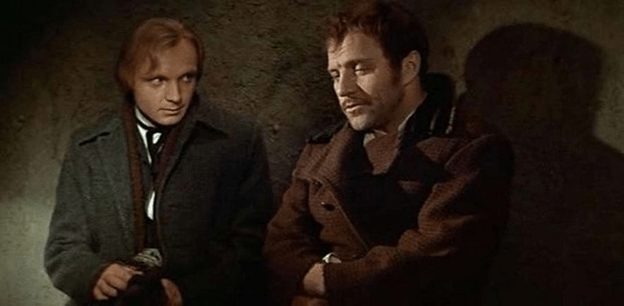
Most likely Alyosha Karamazov (on the left) with his eldest brother, Ivan
Namely Brothers Karamazov, this last and grand (although, in essence, it was only half-written) novel of Dostoevsky, also summoned the main arguments on the question concerning the writer’s worldview. The theme of belief and non-belief, guilt and responsibility, freedom and slavery of man is decided on many levels and planes. In this final novel, the writer, as earlier, demonstrates deep penetration into the soul of each of his heroes and reveals genuine, and not imaginary, motives for their actions.
Again, as in Crime and Punishment, the problem arises concerning the possibility of crime and the conscience permitting the crime. The conflict is sharpened by the fact that in this instance the victim is Fyodor Karamazov – a man in the highest degree debouched, cynical, and disgusting, but – the father.
The brothers Karamazov carry a heavy cross – the Karamazov nature. And it, as the prosecutor says at the trial, is unrestrained: it needs simultaneously both the feeling of the baseness of the Fall and the feeling of the highest nobility. “Two chasms, two chasms, sirs, at one and the same moment – without that, we are unhappy and unsatisfied and our existence is incomplete. We are wide, wide like all our mother Russia and we all fit and get along with everything!”
But the theme of responsibility for the crime is resolved by Dostoevsky in Brothers Karamazov on another if it is possible to say, more evangelical level than in Crime and Punishment. Not only and not so much is the act itself judged by the author as are the thought and the desire. The actual murderer, Smerdyakov, the illegitimate brother of Dmitry, Ivan, and Alyosha, who raises his hand against his father, in essence, does not even stand before the court. He has already been convicted earlier, from the very beginning, since he also ends his life – like Judas – in a noose. Ivan and Dmitry stand before the court as the inspirers of the idea and the ones who wanted the murder; Ivan – as the witness and Dmitry – as the accused and sentenced. For not only the deeds but also the intentions of man are subject to the real court.
You heard that it has been said of old: do not kill, indeed whoever kills is subject to trial. But I say to you that anyone who is angry at his brother to no purpose is subject to trial; whoever says to his brother, “senseless/empty-headed”1 is subject to the Sanhedrin; and whoever says, “fool”2 (is subject to the fires of hell (Matt. 5: 21-22)
[Translator comments: 1Jesus uses the Aramaic/Hebrew derivative transliterated into Koine Greek as ‘raka’, which, according to Thayer’s Greek-English Lexicon of the New Testament, was ‘a term of reproach used by the Jews in the time of Jesus.’ A tertiary meaning, according to the Analytical Hebrew and Chaldee Lexicon, is ‘worthless/wicked.’ 2The word used by Jesus in the Greek New Testament is ‘moore΄’ (the ‘e’ is pronounced short as in ‘pet’), a slang word taken from the verb meaning ‘to be/act foolish(ly)’; however, there is also a biblical Hebrew word that is a phonetic homonym for the Greek – ‘mooreh’ (the active participle from the Hebrew triliteral root ‘m-r-h’ meaning ‘to rebel’, hence…) ‘a rebel’ -, which, Thayer’s points out was “expressive of condemnation” and primarily, I would suggest, against God. I admit that this comment is a departure from the thrust of this article, but it proved to be an opportunity to look deeper into this well-known verse by getting behind the keywords. It seems to me that there is not much of a gradation of severity from ‘being empty-headed’ to ‘acting foolishly’, while there is certainly such a progression from ‘being empty-headed’/’worthless’ to ‘being a rebel’ (against God). I also question why Jesus would have used a Greek word when He was obviously speaking in either Hebrew or Aramaic. This translation also fits well in the major theme of three of Dostoevsky’s novels under discussion in this article, those being: Demons, Crime and Punishment, and Brothers Karamazov, in the case of each the chief protagonists are rebels against God.]
But the novel, as always with Dostoevsky, speaks also about the purifying power of suffering. And Mitya [translator note: a nickname for Dmitry], who is sentenced to hard labor [though] legally innocent, realizes that spiritually his guilt before his slain father is indisputable and that it is exactly for his guilt, unseen to the world, God is punishing him in a visible manner.
And although the novel breaks off as if in mid-sentence with the plans of Ivan and Katerina Ivanovna to free Mitya from this stage [of hard labor] and together with Grusha head off to America, the reader clearly feels that these hurried and petty plans will not be destined to happen. And, yes, Mitya Karamazov is too much a Russian person to find his happiness in America. “I already hate this America now!… I love Russia, Aleksey, I love the Russian God, even though I am no good!” – he says to his brother at a meeting after the trial.
And in reality, Mitya Karamazov had not been destined to escape from the hard labor camp. In a second, unwritten part of the novel, according to the memoirs of Anna Grigorievna Dostoevsky, “the action was transferred to the (18)80s. Alyosha [Alexey’s nickname: Translator comment] was already appearing not as a youth, but a mature man, having lived through a complicated emotional drama with Liza Khokhlakova and Mitya, was returning from the hard labor camp.”
In point of fact, Mitya Karamazov is the hero, who consciously offers himself as a sacrifice. Or, in any case, who consciously agrees to such a sacrifice, who consciously goes the way of atonement for his own sin and the sin of his brothers. In our opinion, it is exactly in the image of Mitya Karamazov that the Christian thematic is embodied in the novel with the most fullness and power.
But the writer was not restricted by this image for conducting his Christian ideas in Brothers Karamazov. The Orthodox monk and – more broadly – the Orthodox monastery emerge as the full hero of the novel, the first in the writer’s works. [Translator comment and my personal interpretation from my reading of the novel: In my opinion, Malyagin has presented a biased perspective with this evaluation of Dostoevsky’s representation of the Orthodox monk in the person of Zosima together with the monastery. Zosima dies shortly after sending Alyosha, who had entered the monastery in service to Zosima, away out into the world, I would suggest, from the influence of the leading monks there. Dostoevsky intended Alyosha to be the hero of the novel as an agent of reconciliation and a force for influencing changed behavior in his brothers. This Dostoevsky has Alyosha quietly working to accomplish at strategic points in the progression of the novel. Dmitry goes off to hard labor to execute penance for his complicity in his father’s murder in the form of his deep-seated hatred that stemmed from money lust in his effort to recover his inheritance, which he was convinced had been stolen by his father. On the other hand, the eldest brother, Ivan, while attempting to tell the truth on the stand under oath, has a mental breakdown, which is actually the culmination of the spiritual battle that he has been waging with the Devil. Dostoevsky leaves the outcome of Ivan’s condition in limbo; however, the expectation is that good will triumph over evil.]
III. Teaching
Namely, in the characters of the people who believe (and who confess consciously their faith) Dostoevsky embodies the system of his Christian views, which, although with reservations, it is possible to call his teaching. The main image, important for understanding these views, is, of course, the elder Zosima.
In the chapter “Elders,” the author, having briefly retold the history of the office of elders in Russia and having summed up that now, despite persecution, the office of elder had been confirmed and is settled in Russian monasteries, suddenly adds:
“True, perhaps, also is that this tested and already thousand-year-old tool for moral rebirth of a person from slavery to freedom and to moral perfection can turn into a two-edged sword, so that, perhaps, it brings another – instead of humility and ultimate self-control – to the contrary, to the most satanic pride, i.e., to chains, rather than to freedom.
What sort of phrase is this and what is its meaning? How can the leadership of elders lead to satanic pride, if this is a spiritual institution, established by God exactly for the salvation of the human soul from being darkened by pride?
What is this phrase (by the way, rather awkward in and of itself, in a literary sense)? A sign of the unbelief of Dostoevsky himself in the eldership as an appearance of grace or a fearful equivalence just in case for unbelievers? Or is this an habitual psychological paradox for the master, by which he wants to surprise the reader? But in any case, such a phrase cannot produce a good impression on a churchly man exactly thanks to its craftiness.
But this phrase in the novel is not accidental. Lower we will read the page of the author’s reasoning concerning hysterical women being demon-possessed, who initially were being characterized to him as “pretenders, in order not to work.” “But afterward,” writes Dostoevsky, “with surprise I found out from medical specialists (obviously, these are also higher authorities in the spiritual realm? – B.M.) that there is no pretending here, that this is a terrible female illness … stemming from exhausting work too soon after a difficult and improper child delivery without any medical aid…”
Such medical explanations of complicated spiritual phenomena also, of course, cannot summon the sympathy of a man who is a believer.
Here in the descriptions of the monastery, we find a portrait of Father Ferapont, a monk-recluse, who lived a strict fasting regimen. He “sees devils” surrounding the monastery’s monks, he judges the eldership and Father Zosima, and he hates (in the literal sense of the word) every one of the world. And here is Father Ferapont’s reasoning concerning the fast:
I, for one, go away from their bread (i.e., of the monastery – B.M.), I don’t need it at all, at least I go into the woods and there I’ll live on milk mushrooms or berries, but they here will not go away from their bread, that is, they are joined to the devil.”
Such a level of thought and such an understanding of the essence of the fast speaks, of course, concerning one thing: we see in front of us a caricature. The caricature is the scene of the scandal of Father Ferapont over the grave of Elder Zosima, from the body of whom “earlier than presently” had emitted for some reason a pestilent spirit. But why only the recluse, painted by Dostoevsky, is caricatured? Really only because the writer did not understand and rejected the path of reclusion?
However, we repeat, the image of Elder Zosima himself occupies the central place in the theme that interests us.
In the novel’s sixth book, dedicated wholly to the elder and titled “Russian monk,” unarguably there are beautiful pages. This, for example, is the description of the death of Markel – the older brother of the future elder Zosima. His penitential feeling before death, his feeling of guilt toward people close to him, toward his servants, even toward God’s little birds, touches and softens the heart of the reader.
But, on the whole, the image of Zosima, of course, is far from the image of the Orthodox elder, known to every believer. Here is how Konstantin Leontiev wrote about this theme of the novel in his article, “Concerning love that encompasses the whole world”:
“Orthodox monks play an extremely significant role in the novel Brothers Karamazov; the author relates to them with love and deep respect… To elder Zosima even the mystical gift of ‘insight’ is attributed … True, in Brothers Karamazov the monks do not say entirely that, or, expressing it more exactly, at all that which in reality very good monks say, and ours, on Mount Athos… True, and here somehow little is said about worship, about monastery obedience; not one church service, not one prayer service… The hermit and strict faster Ferapont, who has little concern for people, for some reason is portrayed unfavorably and derisively… From the body of deceased elder Zosima for some reason proceeds the smell of decay… In this novel, feelings that are actually mystical are, all the same, expressed weakly by Mr. Dostoevsky, but feelings of humanitarian idealism, even in the speeches of monks, are expressed fervently and extensively…”
Later in his memoirs, Leontiev wrote:
“Only those who are unfamiliar with true Orthodoxy, with the Christianity of the [Mount] Athos and Optina [Monasteries’] holy fathers and elders are able to consider the Brothers Karamazov an Orthodox novel.”
Again, as in his previous attempt (Demons, the chapter At Tikhon’s) to portray an Orthodox elder-leader, Dostoevsky clearly lacked an understanding of the essence of spiritual authority and spiritual power. In elder Zosima’s confessions, left by him to his disciples, there are such words:
“Before any other thought, you will stand perplexed, especially seeing people’s sin, and you will ask yourself: ‘Whether to take by force or by humble love?’ Always decide: ‘I will take by humble love.’ You will decide thusly once and for all and you will be able to conquer the whole world.”
In this thought there is a certain misunderstanding: what kind of force is implied here? Indeed not physical? So, it means, spiritual! But it is exactly spiritual power that is the really important indication of the spiritual authority of the elder, given to him by God Himself.
Dostoevsky’s “elder” is too enthusiastic, by any stretch, too occupied with understanding the world and human psychology, and he even somehow is somewhat mentally enfeebled. For some reason, as he is dying, he considers his most important matter to once more see and talk with his closest monks: “I will not die until I again revel in discussion with you, beloved of my heart, I will look upon your pleasant faces and I will pour out my soul to you again.”
How dissimilar this is to the lives of the Orthodox saints, great ascetics, even just before death, considering themselves unworthy of salvation and thinking about repentance! And, indeed, can anyone living on earth (besides the rarest of saints) really be absolutely sure that he has completely pleased God with his life and has merited His mercy? And although Dostoevsky, together with V.S. Soloviev, traveled to Optina to visit elder Ambrose, in order to gather real impressions about monasticism, these impressions, it seems, were too short and superficial to become the foundation of positive teaching.
The writer’s mistake is that out of two of the most important characteristics of God’s relationship to us, sinful people – mercy and justice – Dostoevsky absolutizes mercy, somehow forgetting about God’s justice, about God’s truth, without which, as also without mercy, the world cannot stand.
It is possible for elder Zosima (that means, also Dostoevsky) to make the completely well-founded objection that brazen, unrepentant crimes (with which the world is overfilled in our time) cannot be covered by God’s mercy forever: sooner or later justice must come. God’s love for man is demanding – but Dostoevsky never spoke about this.
There is also one more characteristic feature in the novel: the writer somehow is embarrassed to confess the real existence of demons. “The Devil,” who comes to Ivan Karamazov, is a product of a morbid imagination. Again, everything is explained by psychology and this absolutization of psychology also inflicts not a little damage on the novel and its creator. Spiritual life and the psychology of man are areas not at all equivalent and often not even linked. In any case, spiritual events are unable to be explained on a psychological level, such an “explanation” is a profanation of the spiritual life, and this is well-known to every believing person.
***
Dostoevsky did not create positive Orthodox teaching in his books. More exactly to say, he did not express it in the way that the teaching itself already long ago was created and is preserved by the Church. Dostoevsky traditionally did not succeed in presenting images of monks – he did not know enough for this nor did he understand the structure of monastic life. And we, his Orthodox readers, regret this.
But, fortunately, these natural imperfections of any and all human labor is not the main thing in the creativity of Dostoevsky. These are only isolated and annoying, of course, failures of the great writer. However, not only, and not as many as, his. Reflected in such concrete failures was the whole depth of the atheistic impotence of the 19th century, the entire weight of unbelief accumulated by Russian educated society and the self-assured, arrogant insolence in relation to the Russian Church.
But in every novel of Dostoevsky, there are heroes, who consciously choose suffering as the path to spiritual resurrection, who consciously take their cross and go after Christ. These people know that in sacrifice for the sake of their neighbor, there is great happiness, that “blessed is the one who lays down his life for his friend.” Meaning, these people have genuine Christian experience, as had the writer himself. And even about “Brothers Karamazov” one cannot repeat the words of Konstantin Leontiev with full-hearted agreement: no, this, all the same, is an Orthodox novel, although not in that section, which Dostoevsky himself was supposing to be especially Orthodox.
Compasison toward one’s brother, mercy, love, the ability even in fallen man to see the unclouded and shining image of God – these are for us genuine lessons of Dostoevsky the writer, Dostoevsky the Christian, Dostoevsky the son of the Russian Orthodox Church. And the meaning of these lessons is imperishable for the Russian mind and the Russian heart.
And indeed, we will not forget that impression, which Father Ambrose took away from his meeting with Fyodor Mikhailovich. After the writer left his cell, the elder said concerning him to those near him: “This one is penitent.”
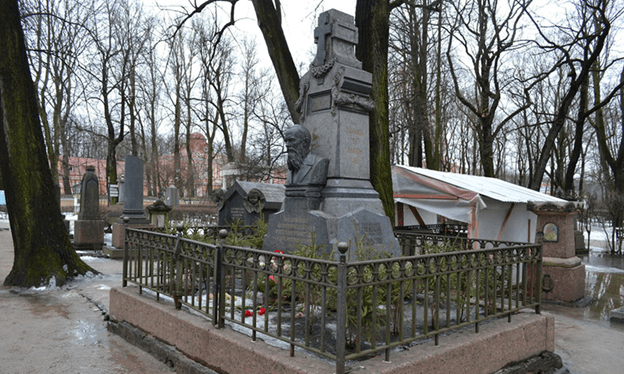
And, following after the Orthodox priest, a contemporary of Dostoevsky, who was conducting the funeral service for the just-deceased servant of God, Fyodor, we too today are able to repeat:
Brother Christians! In joint veneration of the deceased, let us join in one spirit and in one heart and request of the Lord eternal memory to the one resting there, in Heaven, and here – on earth. Amen”
 The Dragon is Slain
Leave a comment