This post is supplemental to my post, Dostoevsky and the [Russian Orthodox] Church, in order to add context and a partial raison d’etre for Dostoevsky’s writing the novel Demons. It is a translation of an article published by A.I. Rakitin in 2014 at ©”Загадочные преступления прошлого” (Mysterious Crimes of the Past).
The translation by LOC follows:
The history of the creation by Sergey Nechayev of the revolutionary organization “The People’s Reprisal” and the subsequent murder by its members of Ivan Ivanov, a student at the Academy of Agriculture, in general terms is known from school history classes. However, most literary sources obviate the details of what happened, and as it seems, not without intent.
Ivanov was killed savagely on 21 November 1869 in Moscow in the Agricultural Academy’s Park, where, in order to hide the crime, his corpse was sunk a little more than three feet in a pond there. The body was discovered on 25 November. “They inform us that yesterday, 25 November, two peasants, walking through in a remote place in the Petrovsky Academy’s Garden, near the entrance into a grotto, noticed lying about a cap, a hood, and a cudgel; from the grotto bloody tracks led straight to the pond, where, under the ice was seen the body of the murder victim, bound with a black belt and in a hood. Also found here have been two bricks tied with ropes as well as the end of a rope. (…) The murder victim, named Ivan Ivanovich Ivanov, turned out to be attending lectures at the Petrovsky Academy. The money and watch, which were on the person of the deceased, have been found intact, while the cap and hood turned out to be those of someone else. The legs of the deceased had been tied with a hood, as they say, taken by him from one of those attending lectures at the Academy, Mukhartov; the neck had been wrapped with a scarf, in the corner of which a brick had been enfolded; the forehead had been cracked open, as it is possible to think, with a sharp tool” (the newspaper Moscow Statements of 26 and 27 November 1869.).
The victim appeared in the records of the Moscow gendarme directorate as a “revolutionary” and this immediately attracted the attention of the political police to what had happened. The fact that the murder victim was not robbed immediately demanded suspecting a “settling of accounts” within the “r-r-revolutionary gang.” [Translator comment: The “r-r” is assumed to mean the “ranks of the Russian revolutionary gang.” Coincidentally, the word meaning ‘rank(s)’ in Russian also begins with an ‘r’.] The chief of the Moscow gendarme directorate, Colonel Slezkin, on 27 November reported to Chief of Staff of the Corps of Gendarmes Mezentsov: “(…) the corpse of Academy student Ivan Ivanovich Ivanov has been found with all the indications of violent death – head smashed and, in addition, was penetrated from behind by a bullet that exited in the left eye; neck strangled by a scarf, to which was attached a brick; legs at the knees and near the feet tied by a whip, to which also a brick had been attached. No robbery.


From left to right: I. Pryzhov, S. Nechayev, M. Negreskul, P. Tkachev – revolutionaries from the end of the 60s – to the start of the 70s of the 19th century
Political detective work rather quickly came out on those guilty of the murder. Good analytic work enabled this – checking the victim’s connections, tying his movements according to place and time in the last 24 hours of life, studying correspondences, etc. Already on 20 December, newspapers named Sergey Nechayev among those involved in the crime, and on 25 December he was named the “murderer.” The detectives quickly decided on the circle of accomplices, whom they arrested without delay. Nechayev himself fled to Switzerland, from where he was subsequently turned over to the Russian authorities.
The history of this repulsive crime, its hidden motivation and portraits of the individual personages are altogether fully and graphically set out in F.M. Lur’e’s book, Nechayev: Creator of Destruction, M(oscow), Publisher – Molodaya Gvardiya (Young Guard), 2001, 434 pp.
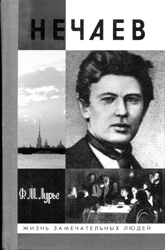
F. Lur’e’s book, Nechayev: Creator of Destruction, not only sets forth a sufficiently intricate detective intrigue of the ‘Nechayev Affair’, but is an excellent sketch of the life and temper of the “ideological” revolutionaries of the final third of the 19th century.
It is impossible not to note the especially juicy description in the book of the mores of the “r-r-revolutionary gang” in migration, for which the author did not spare color. In it, there are scores being settled with the participation of Gertsen and Ogaryov because of money [Translator comment: Apparently a reference to the disagreement between Tsarist oppositionists Aleksandr Ivanovich Gertsen and Nikolai Platonovich Ogaryov over the use of a monetary fund under the control of Gertsen, who refused to allow its allocation for producing the radical journal, Kolokol (The Bell), one of the main contributors to which was Nechayev], and Bakunin’s famous “deception for money,” who, having taken an advance for the translation of Karl Marx’s Kapital, refused to engage in its translation, and… much more. In order not to retell the book, we recommend reading it – it is really worth it. It is impossible to understand the true background of the “Nechayev affair” from the books that were published before 1991 because the wonderful Communist Party was strenuously censoring everything that somehow “denigrated” the “revolutionary struggle with autocracy,” but because of that, books similar to the one written by Felix Lur’e are more valuable.
From the point of view of murders.ru, “the matter of Nechayev” is special for us, since we try not to concern ourselves with political crimes. All the same, it is impossible not to recognize the murder of the student Ivanov by members of the Nechayev group as quite interesting in a certain sense. Besides the purely detective canvas, this story is noteworthy in its psychological aspects. Indeed, the murdered student himself was a member of the revolutionary group and yesterday’s comrades actually killed him. The simultaneous transformation of yesterday’s friends and those of a like mind into ruthless killers leads to rather interesting reflections about a “collective unconsciousness,” about the nature of making decisions, and about the methods of manipulating people. Extremely interesting is the psychological profile of Nechayev himself; indeed, his is an obvious pattern of a swindler, such as “Khlestakov from the revolution.” [Translator note: The hero of Gogol’s 1835 eponymous comedy, whom Gogol caricatured as an inveterate liar and boaster.] Pryzhov, a well-known writer who described everyday life at that time and who was 20 years older than Nechayev, wholly subordinated himself to Nechayev. Nechayev, when compared to Pryzhov, was simply an ill-bred boy with little education and not very smart. And all the same…
An interesting coincidence – if someone believes in such a sort of coincidence – Nechayev died on 21 November 1882, on exactly the 13th anniversary of the murder of Ivanov (he was killed on 21 November 1869!)
In general, what has been written can be summed up by expressing the “Nechayev affair” as such: it is a rather interesting episode of the criminal history of Russia that the readers of murder.ru should be aware of, if only to broaden their horizons.
 The Dragon is Slain
Leave a comment