The Russian-language newspaper, Каскад/Cascade, published in Baltimore, Maryland, on February 16, 2023, featured an article on its internet site entitled, Greece – Where There Is Everything. Everything, according to the author, includes the Jewish presence in Greece, and specifically, in Thessaloniki/Salonica. Within its eclectic content that ranges from the dilatorious effects of the pandemic and Russia’s war on Ukraine on Greece’s already weak economy to the geopolitical issues of Cyprus and Macedonia, the article proceeds to incorporate a comparison of the similarities between the State of Israel and Greece that have come into view by virtue of the souring of Israel’s fledgling relationship with Turkey. The author of the Cascade article is Pyotr Lyukimson, a Russian-speaking Israeli writer and journalist, whose article was published under Cascade‘s internet site’s rubrics of ‘Interesting’/’History’/’Culture.’
Lyukimson’s article follows, as translated by LOC:
It is no secret that after a sharp cooling of relations with Turkey, Israelis en masse reached out to Greece and discovered for themselves anew this country that, in essence, is located “the distance of an outstretched arm” from them. A country, with which, we will note, so much is connected with our history, and in which, as in a mirror, all the problems of contemporary Europe are reflected. And when you begin to take a closer look at the problems, you involuntarily understand, how similar they are to Israel’s.

A history with a geography
No one today will answer you exactly when Jews appeared in Greece. Communities living on its territory are mentioned in the book of the Prophet Isaiah – and this in the 8th century B.C! In any case, in the 4th century B.C., when Greeks begin the period of formation as a single people, they were certainly numerous there, and one of the largest Jewish communities was situated in Salonica, or, more exactly, in Thessaloniki. Settlers from Alexandria got it started and it took off from there.

Jews living in Greece, who were under the enormous influence of Greek and Roman culture, comprised the basis of the community, but in the period of the Crusades, Ashkenazi Jews, who had fled the pogroms in Germany and France, and later in Hungary, showed up here. However, pogroms were occurring at various times even in Salonica itself, as well as epidemics, fires, wars, etc., holding back the growth of the city’s population.

Pictured above is the Jewish Museum in Salonica
The blossoming of Jewish life in Salonica only begins in the 15th century, after Turkey gives asylum to thousands of Sephardic Jews who had been driven out of Spain. Thus, Greek-speaking Jews, and Sephardic and Ashkenazi Jews meet in the city; and at first did not get along very well with each other, even refusing categorically to enter into “mixed” marriages. But, in the end, they become completely intermixed and merge into one community, in which the Sephardic Jews always set the tenor. Later, thousands of Marranos [Translator note: Spanish and Portuguese Jews who were forced to convert to Christianity during the Inquisition, but continued to practice Judaism secretly – multiple sources] from Portugal, who had decided to return to Judaism, were added to them. Thus, in principle, a new community arose, which historians, therefore, call – Salonica Jews.
And the city blossoms. In it, the Jews create a textile industry that produces all the famous types of cloth at the time; are actively engaged with growing tobacco; fused together trade relations with their brethren in almost all the countries of Europe, thereby turning Salonica into one of the main trade and financial centers of the Ottoman Empire. Simultaneously, Salonica becomes one of the centers of Jewish learning – in the city will appear Talmud-torahs and yeshivas (schools teaching Judaism), many outstanding rabbis of the Middle Ages and Renaissance eras, Jewish typographies are operating, etc. In order for the reader to get some idea of what Salonica represented at that time, I will say that according to the data of a 1613 census, more than 30 thousand Jews lived in the city, which comprised 64% of the population. Turks comprised another 24% and Greeks, 12%.
The city itself literally crawls from the hill, on the summit of which at one time was the Turkish quarter, and below – the Jewish and Greek quarters that bordered with it. Already centuries ago at the Jewish cemetery there were more than 300 thousands tombstones, and pilgrims who came to Salonica hired a special cemetery guide, so that he would lead them to the grave of this or that famous rabbi.

And there are enough memorial graves here: the great Shlomo Abarvanel studied in one of the yeshivas here; kabbalists Iosef ben Shlomo Taytatsak, Shlomo Alkabets and Shlomo Molkho lived here; as did great Torah scholars Yitzhak ben Shmuel Adarbi, Moshe Almoznino, Shmuel ben Moshe de Medina, Iosef ben David Ibn Lev, and Avraam a-Koen; as well as many great Jewish poets and musicians.
My guide around Salonica was Panayiotis Tsatsanidis, in truth considered one of the best (and then the best) Russian-speaking guide concerning Greece. Its very fate – this is also part of our common history.
Panayiotis was born in a suburb of Batumi [Translator note: In the Caucasus country of Georgia], in a family of Pontic Greeks that over the course of centuries carefully guarded its native language and customs and avoided entering into mixed marriages. The old generation of Tsatsanidis’ had to endure an exile in Kazakhstan and various persecutions, but none of this managed to break any of them. Panayiotis himself, after serving in the army, finished his coursework in the history department of the university, and brilliantly defended his Ph.D. thesis, after which, in the beginning of the 1990s, after the USSR authorities permitted Pontic Greeks to travel abroad, together with tens of thousands of his people, returned to his historical homeland. Here they observed that the Pontic dialect that most of them spoke from childhood differed somewhat from modern Greek, and, before finding work in his specialty, he would need to study up a little on his native language.
Panayiotis still remembers how, in the first months after being repatriated, he was agreeable to any work, how he wandered into some sort of building in search of it, and there an unfamiliar old man said that he himself did not have work, but extended to Panayiotis several bills of money so that he could get by until he found work. Panayiotis was about to refuse, but the old man all but forcefully put the money into his hand and said that he was not to return it.
“Just do the same sometime for someone who is in a similar situation,” he added.
When I remarked that in faraway 1991 an old Jewish man from Poland had told me the same thing, my new friend smiled understandingly.
“Our peoples in general are alike in many ways, and the more I spend time with Israelis, the more convinced I am of that. Both we and you have managed to preserve ourselves in history, and for you, and for us national self-identification is very important and assimilation unacceptable, even our mentality is similar.
By the way, in the 17th century on the border of the Jewish and Turkish quarters, yet another quarter arose, the “Dönme” – of several hundred followers of the false messiah, Shabtai Tsvi, who afterward accepted Islam. [Translator note: The Turkish meaning of ‘Dönme’ is ‘turning’; here it is used metaphorically to mean ‘converting’ (from Judaism to Islam). Therefore, the Russian translation given in the article is ‘apostate’].
There are many rumors and riddles connected with the faith and way of life of the Dönme, but it is certainly well known that the founder of the contemporary Turkish state, Atatürk, traced his origin from them. So too did members of the Young Turks’ government that came to power in the country in 1908. They began the transformation of an empire that was stuck in the late Middle Ages, into a modern, dynamically developing state.
“Ataturk’s European roots became Türkiye’s salvation,” Panayiotis notes, as if in passing. “A native-born Muslim would never have decided on those worldly reforms that he introduced. Ataturk – like the great Turkish poet, Hazim Khikmet – was born in Salonica, and his museum is now operating in his father’s home.”
Panayiotis leads me around one-time European Salonica – past the luxurious building of the former Talmud-Torah school, situated not far from the boulevard; the “European bath” (apparently, a mikveh [Translator note: a Jewish bathing pool used for ritual immersions]); and also, a whole series of luxurious buildings stretching along the shore, which even today belong to the city’s European community, which allows them to be rented as offices and every kind of store. And once, the warehouses of European merchants (in order to be closer to customs), European banks, hotels, restaurants, synagogues, etc., were situated here.
“On Saturdays, the streets of the European quarter, needless to say, were cordoned off and through traffic was prohibited. On this day, all business life in the city came to a standstill,” says Panayiotis. “In general, Salonica was a unique city, in which there were immediately three days off per week: Friday for the Muslims, Saturday for the Jews, and Sunday for the Christians. There were a lot of synagogues in the city – a portion of them burned down during the great fire – but the majority of them were robbed and destroyed by the Germans. So that for all of Salonica there remained only one building [designed to be] a synagogue, but it is open only on Saturdays and holidays. And on weekdays, Jews pray in a synagogue, arranged in one of the rooms of a large building in the center of the city that belongs to them.

Thus, without noticing, we arrive at the memorial not far from the boulevard, erected to the memory of the Jews of Salonica, who had died in the Catastrophe [Translator note: meaning the Holocaust].

The Holocaust Memorial in Salonica
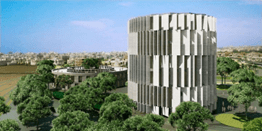
The Holocaust Museum in Salonica
It is necessary to note that relations between Greeks and Jews in the city also were not the rosiest. After the liberation of Greece from Turkey [Translator note: assumed to mean the Greek War of Independence of 1821-1829], a pogrom swept through the city, with close to 5000 Jews being killed. The Greeks had accused the Jews of being tightly connected with the Turks.
But all this is in the past and it shouldn’t be forgotten that in many places in Greece, the local population and the Orthodox clergy saved Jews. In many [places], but not in Salonica. In Panayiotis’ words, at the moment of the Nazis’ entry into the city, there remained approximately 50,000 Jews in it – around 30,000, sensing the existential dangers of the Germans, had managed to relocate to Egypt or Palestine before the occupation.
“The Jews lived close together, so that the Germans had no problems creating a ghetto [Translator note: the meaning of ‘ghetto’ here is that of ‘an ethnic enclave’] in the city, isolated from the rest of the population,” recounts Panayiotis. “Attempts to enter into contact with Jews were prohibited under penalty of death. And yes, people were afraid to render any sort of help to them! And the Germans worked out a truly satanic plan of first the total looting and then the annihilation of the Jews. It started by requiring them to do humiliating forced labor, but then hinted that they could be redeemed – and the Jews collected the required astronomical sum. Then they announced to the Jews that they were going to be deported to Poland – to Auschwitz, and most of them perished.”
After the war, around 2,000 Jews returned to Salonica, but since then their number in the city continuously declined, and at the beginning of the 1990s it fell to 1,000. But what is most interesting is that in recent years it has once again begun to grow. Above all, on account of the Israelis who actively invest money in local real estate, and above all in hotels and other facilities of the tourist business. So that in the city one hotel is in operation with a kosher kitchen and several kosher restaurants.
And right here is the very time to talk about what is happening in Greece today…
Myths and reality in contemporary Greece
To the question about how life is for them today, most Greeks honestly answer: it’s difficult.
In order for the reader to understand just how difficult, I will say that the minimum salary in Greece today is set at 700 euros and the average is 900 euros. At the same time, there is high unemployment in the country, and many are able to find work for the minimum wage only part-time (more exactly, employers offer working almost fulltime for half the minimum salary, and many, because of hopelessness, agree). Many work on the black market: according to Greek sources, the turnover of black money comprises not less than 20% of all of the country’s money operations.
In line with that I looked for a long time in the supermarkets for the prices for the vaunted cheap European products – and wasn’t finding them. The prices were clearly of the same order that they are in Israel, well maybe, 10-15% cheaper, but even our average salary doesn’t compare with Greece’s!
“Recently, prices have noticeably risen absolutely for everything,” Panayiotis states. “But first and foremost, for gas and electric: approximately tripled. And for the one and the other we pay once every four months, including an advance, and the total that some pay for this period is now at times equal to their monthly salary. This is while the state is partially subsidizing the rising prices for gas and electric.
It is asked very often, how Greeks are relating to the war between Russia and Ukraine. What would you answer here? It goes without saying that our sympathies are with Ukraine, and all the more that there are dangers that this war will untie the hands of Erdoğan and he will start aggression against Greece. But for the most part, the man on the street is following the course of the war very superficially and doesn’t think too much about what’s happening there: the war – it’s somewhere far away, and people need to be occupied with problems of survival.
However, the war in Ukraine brought about not only soaring prices for energy resources, but also hit tourism, which comprises the fourth most important branch of the country’s economy. In order for the reader to understand, what exactly is happening, we will say that in 2018, 33 million tourists visited Greece; the following year, in connection with the beginning of the epidemic, their number was drastically lowered and at the peak of epidemic, fell to almost zero. As a result, millions of people wound up without sources of income.
Now the industry is gradually starting to recover, and this is understandable: in Greece, as a matter of fact, there is something to see. What is it worth just [to see] the Athens Acropolis! Or, let’s say, the unique museum that has been created inside the mound, in which the grave of Philip of Macedon, his wife, and grandson was discovered (this, perhaps, is the most significant archeological discovery of the 20th century, really comparable in importance with the discovery of Tutankhamen’s tomb.) Or the ‘Meteora’ (literally: “hovering in the air”), i.e., monastery castles, built on rocks, sheer, rearing up out of the earth like giant fingers?

One such monastery at Meteora taken from the Wikipedia article on the Meteora (https://en.wikipedia.org/wiki/Meteora)
But one shouldn’t forget that Greece is an Orthodox country, and therefore most pilgrims, heading, let’s say, to Athos or to other monasteries, belong to this confession. As it is not difficult to guess, the number of such pilgrims also noticeably diminished and it will hardly recover while in Ukraine missiles will be flying and, on its territory, military operations are ongoing. Pilgrims from Serbia, Romania, and Bulgaria, alas, are not replenishing the losses of religious tourism from Ukraine and Russia.
By the way, one of Greece’s problems, given birth by the epidemic, became the unseen surge in the reproduction of wild boars, which began to roam the streets of the cities, with all the ensuing consequences, including automobile accidents. In answer, the country’s authorities canceled the ban on shooting boars outside city limits. But here, animals’ rights advocates interfered, declaring that they would not permit such barbarism. As a result, the rights of boars were reestablished and everything is back to normal.
If to talk about Greece’s other severe problems, then local residents are attributing to it, among the first, the severe shortage of doctors. No, unlike Israel, local universities are preparing a sufficient quantity of medical cadres, given that, as far as I remember, training is free for citizens of the country. To get into medical school, it goes without saying, is incredibly difficult, selective competition, and therefore, all understand that medical students are the golden gene pool of the nation.
The problem is, that having passed the exam, this golden gene pool leaves for the U.S. or other countries in Europe, where a doctor’s salary is several times higher. The solution to this problem could be a sharp increase in doctors’ salaries, but where to get the money for this?
As a consequence, in Greece, a huge gap arose between the two systems of medicine – private and public. In addition, as has been explained to me, in order to receive the right to public medicine in the current year, it is necessary to work at some sort of official work for not less than two months and pay the corresponding tax for health care. However, even if such a tax is not paid, they will all the same render you aid at a public hospital, but only the most essential…
So already for several years in a row in Greece, negative population growth is being observed, and the average number of children per family is steadily declining. In this way, in Greece, as in all of Europe, the process of the aging of the nation is clearly being observed, and together with it also…not enough hands in the national economy as well as caregivers for caring for the elderly.
The paradox here is obvious: on the one hand, Greeks complain about unemployment and low income, but on the other hand, as it has turned out, there are more than enough worker vacancies in the country. For example, on the backdrop of the revival of the tourist sector an acute lack of maids has arisen, and they are being transported in from abroad.
The natural decline of the population is replenished in the first instance owing to legal and illegal migrants from the Arab and African states – like, however, also in many other European countries. There are plenty of those Arabs in the center of Salonica so that local residents do not recommend carrying valuable items in backpacks and watch out for your pockets more attentively. The Israelis say of themselves that in this regard they are especially careless and therefore rather often become the victims of street thieves.
By the way, since the spring, thousands of Ukrainian refugees have shown up in Greece. They initially receive the right to reside in the country for 90 days, at the expiration of which they have the right to receive refugee status for a one-year period. But no material aid is offered to the refugees – the status presented to them gives them the right to work and to emergency medical aid, but nothing more than that. However, the refugees do not starve – while they are in search of work and in the process of arranging for work, food and a roof over their heads are provided to them in special refugee facilities that have been constructed by various human rights organizations. Besides that, humanitarian aid distribution points have been established in various cities for refugees from Ukraine.
I had the chance to bump into refugees in Veroia [alternate spelling: Veria] – a small city, where at one time there was a small, but clearly very prosperous Jewish community, which was almost completely destroyed by the Nazis.
In connection with the aging of the nation, the retirement age in Greece for both men and women was raised to 67. The latter can, in a number of cases, retire at 62, but the size of the pension will be noticeably lower than the usual pension.
The social security system for the elderly in Greece, in principle, is the same as in Israel, with the only difference that there are neither social allowances nor required deductions from one’s salary into a pension fund – what they have saved is what they have. The exceptions are civil servants, who do have required deductions. But, according to Panayiotis Tsatsanidis, most of the country’s population has such a miserly pension that it’s better when reaching retirement age, immediately head to the cemetery.
But, in spite of this – once again according to my observations – Greeks love their country selflessly, are proud of its history, are completely convinced that the fruits and vegetables that are grown on Greek land – are the best tasting in the world, and…it seems, they are ready to fight for this land.
“A [powder] box” remains “a [powder] box”
Defense expenditures comprise a significant portion of Greece’s budget – maintenance of an army, purchase of new types of arms, etc. Military service in Greece is obligatory for young men, and, moreover, whoever evades it, practically speaking, all roads in life are blocked – even applying for entrance into a university requires attaching a certificate of military service.
As a consequence, the impression can be formed that Greeks live in constant expectation of the start of the war, and it’s exactly for this reason that not only an economic but also a military union with Israel is so important for them. So, Israel’s recent playing around with Erdoğan greatly alarms them.
When you begin to find out, with whom indeed they might fight, it turns out that they have more than enough smoldering conflicts with neighbors.
They, of course, see the main enemy in Türkiye – and as a matter of fact, they have sufficient historical reasons for hatred toward the Turks, and besides that, up to now they have come to terms with the occupation of part of Cyprus, and for any Greek, this is a burning issue that is better not to touch. But, too, besides Türkiye, the Greeks have reciprocal territorial claims against Bulgaria as well as against Northern Macedonia, since, in their opinion, no such Northern Macedonia exists, nor does a separate nation of “Macedonians.” There is one Macedonia, which is an inalienable part of Greece, its territory, history, and culture. And, if considering that neighboring Albania is actively carrying out the Islamization of Northern Macedonia, all of this, someday, may explode. And explode big time.
In a word, the powder box of Europe as before remains a powder box, and may it not be that, as a result, the war in Ukraine detonates in the Balkans.
And so, in Greece too, in fact, there’s everything.
 The Dragon is Slain
Leave a comment