This study of Psalm XI is based on my translation reflecting the Psalm’s syntax and punctuation. Franz Delitzsch’s commentary on the Psalms has been used as a reference.
ביהוה |חסיתי איך תאמרו לנפשי נודיו הרכמ וצפור In Yahwah | I have trusted how will you (pl.) say to my soul flee* your (pl.) mountain bird[s collective] :
V1 David is addressing more than one person since ‘you’ is plural. The verb commonly translated as ‘flee’ is glossed as such in The Analytical Hebrew and Chaldee Lexicon, but Koehler and Baumgartner‘s Hebrew and Aramaic Lexicon of the Old Testament (KB) suggests ‘aimless,’ ‘homeless’ as the proper translation. Could context, comparison with other verses where ‘flee’ would seem to fit, or assuming one of the proper verbs meaning ‘flee’ – נוס – be the reason for translating the verb נוד as ‘flee’?
The suffix ‘your’ mountain is plural, meaning that those addressing David are including others in David’s entourage. There is no ‘ha’ [ה-] suffixal particle showing motion toward or, as has been suggested, the ‘min’ [מן] prepositional prefix indicating departing, nor is the accusative marker ‘eth’ [-את] connected to ‘mountain.’ So, despite the majority opinion being ‘flee to…like a bird,’ my conclusion is that ‘min’ is understood as is the accusative marker so that the translation would read: How will you all say to my soul, you all flee your mountain, birds. [Was ‘bird’ a derogatory term in the way we use ‘chicken’ or ‘turkeys’?] An alternate translation, based strictly on the syntax and applying KB’s gloss, would be: “Be homeless, birds, [away from] your mountain.” In this case, David, et. al., have fled Zion as a result of the coup orchestrated by Absalom against David.
כי הנה הרשעים ידרכון קשת כוננו חצם על-יתר For behold the wicked bend the bow they fix their arrows on the string > The plan of the wicked is to commit violence with the intent of murder. Murder is truly in their heart because of their hatred of Yahwah’s people.
לישרי-לב: כי השתות יהרסון [*כמו עוף K&B* ] לירות במו אופל to shoot in the darkness at the upright of heart. Because/When (Delitzsch) the foundations shall be pulled down/destroyed > The wicked act in the shadows in order not to be seen or their evil intentions discovered. Their plan is to ‘pull down,’ to ‘destroy’ the foundations based on Yahwah’s precepts and laws and in the process dispose of the righteous. Their eyes are on gaining power by replacing Yahwah’s influence as exercised through the righteous with their own self-serving laws and regulations. The unredeemed are at the mercy of Satan’s machinations to be employed in his efforts from the beginning to overthrow the Son of Righteousness and usurp His birthright. This unrighteous errand of folly, with which the Evil One has been engaged since before the beginning, in Heaven, appears to have reached a deafening crescendo.
צדיק מהי-פעל: יהוה |בהיכל קודשו what [will] the righteous do? Yahwah | in [His] holy temple > In this case, as David asks when he was affected by the plans of evil men, what can the righteous do? He immediately supplies the answer by reminding himself that Yahwah is above it all, acting as his and our High Priest
יהוה בשמים כסאו עיניו יחזו Yahwah on His throne in the heavens His eyes will see > and King; Yahwah is both Savior and Protector. From His vantage point, He sees all with ever-observant eyes. While the eyes of the wicked aim at the destruction of the righteous, Yahwah’s eyes are on preserving His people.
עפעפיו יבחנו בני אדם יהוה צדיק ורשע יבחן His eyelids test the sons of man. Yahwah will prove the righteous > We are assured that Yahwah’s eyes are perpetually open to the affairs of men, His fiery gaze testing the hearts and intents of His ultimate creation, man. On the one hand, the chaff of the righteous it will burn away, as by the refiner’s fire, leaving only the pure gold of a redeemed soul.
[I have interpreted ‘His eyelids’ as ‘fiery gaze’ based on an entry in KB that this phrase is “in parallel with ‘eyes’ above; ‘beaming eyes.’ It occurred to me that this must be the Psalm that inspired the Russian icon ‘Christ of the Burning/Fiery Eye’ ~ “…очи Его зрят; вежды Его испытывают сынов человеческих.”]
ורשע ואוהב חמס שנאה נפשו: but the wicked and lovers of violence His soul hates. > On the other hand, the fire of His gaze will destroy the wicked, those “lovers of violence (חמס HAMAS).” Just as the wicked wreak violence on the righteous to destroy them, they themselves will be destroyed because of Yahwah’s deep hatred of them.
ימטר על-רשעים פח’מי אש וגופרית ורוח זלעפות He causes ruin/snares to rain upon the wicked fire and brimstone and a poisonous wind (called a Samoom; violent heat, famine, anger) > Vengeance, which belongs to Yahwah, will be ferocious and total.
מנת כוסם: כי צדיק יהוה צדקות אהב the portion of their cup. For Yahwah is just/equitable (in the administration of justice); righteousness He has loved.
ישר יחזו פנימו. The righteous/upright will see His face. > The wicked will be separated forever from Yahwah in their condemnation, but the righteous will enjoy eternal life in His presence because of His great love for them, the ultimate expression of which is the gift of His son, Yeshua haMoshiach.
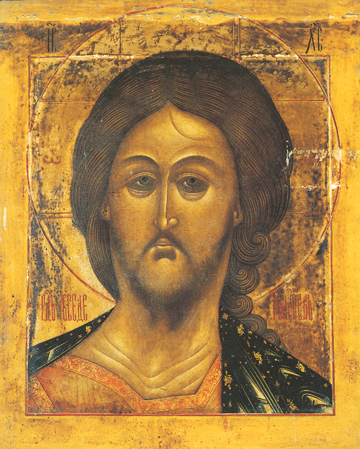
“There is an old Orthodox Christian saying that “in the icon, the body is simply the support of the face, the face but a setting for the gaze.” This is definitely true in the case of this icon. In Russia, icons that portray Christ as He appears from on high, with His Face threatening and severe as He is the Lord and Judge of the Universe, have been called the “Savior of the Burning Eye.”
“In Christ’s halo or nimbus, in the faded cross are the words in Slavonic for “I AM” as He is the same Lord Who spoke to Moses and told him to tell the Israelites when they asked what is God’s name, “I AM THAT I AM” and He said, “Thus shalt thou say unto the children of Israel, I AM hath sent me unto you.” God is not just wise, eternal, and all-powerful as we understand these things from our own human point of view, but the Ever-Existent One, and the very ground of existence itself. It is this existence that God Himself invites us to participate more fully in our loving relationship with Him and the Truth that He shines forth.
“We see both justice and Divine Mercy in His Face as He is both human and Divine in nature.”
The paragraphs under the icon are taken verbatim from the website below:
https://skete.com/product/christ-of-the-burning-eye-moscow-17th-c-j42/
 The Dragon is Slain
Leave a comment