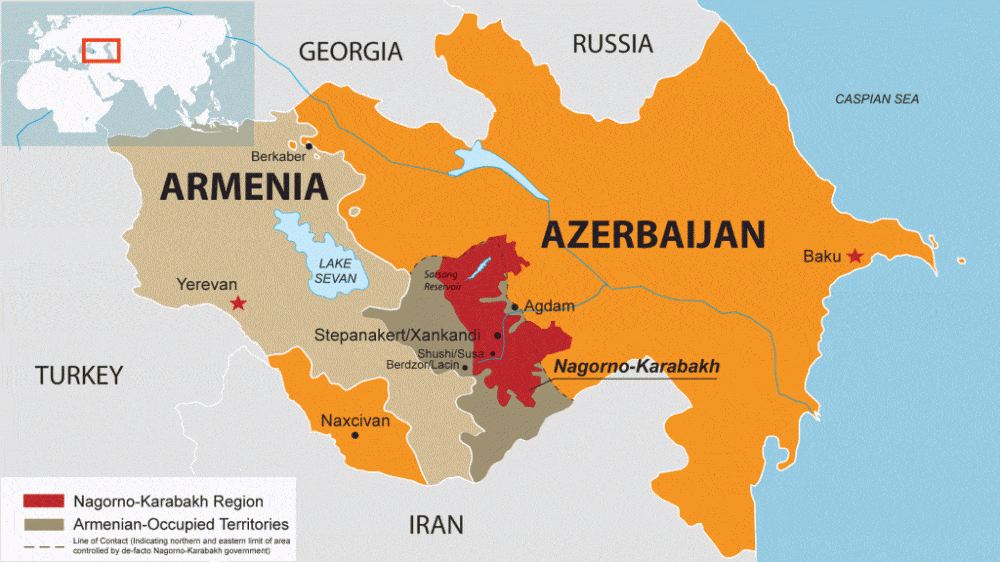
Armenia, a majority of whose population belongs to the Armenian Apostolic (Orthodox) Church, finds itself the recipient of an unenviable piece of real estate that is squeezed between the two overwhelmingly Muslim nations, Turkey and Azerbaijan. This tension led to the 1915 genocide against the Armenians by the Turks of the Ottoman Empire, and more recently, to the various armed conflicts between Armenia and Azerbaijan. Armenia has not been only the victim; the Khojaly massacre in Nagorno-Karabakh was committed by Armenians against Azeris. Recently there have been rumblings from Armenian leadership about aligning with the West. It is this context that the two articles on Armenia’s military cooperation with Greece are presented. The article concerning Germany’s efforts to bring Armenia and Azerbaijan together for peace negotiations is about the West’s recognition of the urgency to stave off the potential of a conflagration in the region of the South Caucasus.
The Azerbaijani Russian-language internet news site, Caliber.AZ, on March 1, 2024, reported that Greece’s Minister of Defense, Nikos Dendias, will visit Armenia next week.
The bulletin follows [translation by LOC]:
Quoting Armenian mass media sources, Caliber.AZ is reporting that Dendias messaged concerning his visit on his X social media page at the end of his meeting with Armenian Ambassador Tigran Mkrtchyan.
“Today I received the Ambassador of Armenia, Tigran Mkrtchyan, in connection with my upcoming visit to Armenia,” Dendias wrote.
For his part, Mkrtchyan messaged that the visit would take place next week to discuss the agenda for military cooperation between Greece and Armenia.
We will note that in December Armenia’s Minister of Defense, Suren Papikyan, visited Greece and with Dendias signed an agreement on military-technical cooperation.
In the context of military cooperation between Greece and Armenia, Skai News Greek language news service reported on December 19, 2023, concerning agreements in this sphere for 2024. The source of the article, which follows, is the Athens News Agency (APE)-Macedonia News Agency (MPE) [translated from Greek by LOC]:
“As announced today by the Hellenic National Defense General Staff (GEETHA), the program will encompass 26 activities out of which 23 will take place in Greece and 3 in Armenia.

The program for military cooperation in 2024 between Greece and Armenia was signed [on] December 18, in Yerevan by the head of the Directorate for International Relations of the Hellenic National Defense General Staff (GEETHA), Brigadier General Vasilios Tsamis, and head of the Office for Defense Policy and International Cooperation of the Ministry of Defense of Armenia, Levon Ayvazyan.
Among others, the activities concern:
● Cooperation in Operational Training Activities
● Special Forces Joint Training – Special Forces Operations
● Joint Training in Electronic Warfare Devices
● Participation in Multinational Peace Support Operations Center Training (ΠΚΕΕΥΕ/MPSOTC) [According to the MPSOTC website, the Center was founded in November 1998 after a directive of the Hellenic Ministry of Defense. Since 19 May 2000, it has been officially recognized by NATO as a Partnership for Peace (PfP) Training Center.]
● Participation in Greek Armed Forces Training on Electronic Warfare Devices and Cybersecurity.
● Exchange of Experiences and Lessons Learned from the Use of Air Defense Systems
● Exchange of Personnel and Visits to Schools and Multinational Schools as well as Seminars
● Exchange of Hospitality of Military Personnel at Facilities of the Two Countries’ Armed Forces
● Visits of Armenian Officials to Greek Military Hospitals for Information on the Mode of Operation of the Military Health Facilities
● Staff Meetings and Discussions on Subjects of Mutual Interest, with Special Emphasis on the field of Military Intelligence
The signing of the program confirms the strong military ties of the two countries and strengthens further the operational capabilities and leveling the interoperability of their two Armed Forces, contributing to the enhancement of the role that Greece and Armenia play in securing the stability and security in the broader region, the announcement added.
The following article, “Armenia and Azerbaijan Began Peace Negotiations in Berlin,” written by Olga Lebedeva for Deutsche Welle‘s Russian language service, appeared on its February 28, 2024, internet website. [Translated by LOC]
Two weeks after [Armenian Prime Minister Nikol] Pashinyan and [President of Azerbaijan Ilham] Aliyev met in Munich, Germany, the heads of the Ministry of Foreign Affairs of Armenia and Azberbaijan are conducting negotiations. [German Minister of Foreign Affairs Annalena] Baerbock announced the bold steps of the two countries.
Armenia and Azerbaijan began peace negotiations in Berlin at the invitation of the government of the Federal Republic of Germany. On Wednesday, February 28, Minister of Foreign Affairs of Germany, Annalena Baerbock received the heads of the foreign political departments of both countries, Ararat Mirzoyan and Dzheykhun Bayramov, within the framework of efforts to resolve the decades-long conflict around Nagorno-Karabakh.

Baerbock: The Possibility Has Appeared for Establishing a Lasting Peace
Baerbock announced that the possibility has now appeared for establishing a lasting peace in the region. In her words, both countries had already taken bold steps to leave the past behind. “I applaud you and your governments for the boldness you are displaying to achieve this goal,” she told her Armenian and Azerbaijani colleagues. Opening the two-day negotiations, Baerbock stressed that necessary for moving forward are “real commitment and decisiveness,” with the achievement of an agreement between the two Caucasus states will have “a positive effect beyond the limits of the two countries” and “will open the way to a better future and prosperity in the south Caucasus.
The head of the German MFA noted as well that the negotiations in Berlin must continue the “productive discussions” begun two weeks ago in Munich. She also indicated that Berlin wants to offer an “appropriate platform for progress” in the negotiations. “Germany is making efforts so that unresolved problems between Armenia and Azerbaijan are resolved peacefully without the use of force,” Baerbock said just before the negotiations began. “For this, it is important that the peace negotiations of the two countries are completed as soon as possible.”
Agreeing to peace negotiations in Berlin was achieved at the meeting of German Chancellor Olaf Scholz, Prime Minister of Armenia Nikol Pashinyan, and President of Azerbaijan Ilham Aliyev during the Munich conference on security in mid-February. Summing up their meeting, Scholz reported that Yerevan and Baku were ready to settle their differences without the use of force. He welcomed the readiness of both sides to search for a solution to existing differences and open problems “by exclusively peaceful means and without the use of force.”
The Conflict Around Nagorno-Karabakh
Nagorno-Karabakh is a rancorous and disputed region of Azerbaijan that until recently had been settled primarily by ethnic Armenians. On September 2, 1991, within the borders of the Nagorno-Karabakh autonomous region and part of the territory of the Azerbaijan SSR (Soviet Socialist Republic) adjacent to it was declared the ‘Nagorno-Karabakh Republic’ (Artsakh [in Armenian]). Not one member country of the UN recognized it. Since that time, the conflict around Nagorno-Karabakh has not ceased. Several times, it transitioned into armed confrontations and full-scale military actions (1992-1994 and 2020).
Azerbaijan, on September 19, 2023, announced the conduct of “antiterrorism measures of a local nature” in Nagorno-Karabakh with the goal of reestablishing constitutional order. On the very next day, an agreement was reached concerning a cease-fire. One of the conditions of the agreement was the disarming of the Nagorno-Karabakh army and the withdrawal of the Nagorno-Karabakh army from the unrecognized republic. As a result of Baku’s military operation in Nagorno-Karabakh, almost the entire Armenian population left the region.
In December 2023, Armenia and Azerbaijan confirmed “the intention to conclude a peace agreement, founded on the respect for the principles of sovereignty and territorial integrity.” On January 1, 2024, the ‘Nagorno-Karabakh Republic’ officially ceased its existence. Despite the political will to settle the conflict, the situation remains tense. In particular, a typical exasperation occurred in mid-February, when Baku claimed artillery shelling from the Armenians, while Yerevan claimed an attack on an Armenian post with artillery fire, the result of which was four Armenian soldiers being killed.
 The Dragon is Slain
Leave a comment