This post contains an abbreviated chronology of the development of the ‘Vertical Corridor,’ a means of supplying natural gas to the countries of Central and East Europe that have been impacted by Russia’s invasion of Ukraine. This energy delivery route is being made possible in large part thanks to the efforts made by Greece to become an energy supply hub in Southeast Europe and to the commitment of Azerbaijan to join the project.
What resounded with me as I prepared this post were the efforts being made to maximize the resource of natural gas reserves in the Caspian Sea through the cooperation of the countries of the South Caucasus and Southeastern Europe in order to provide a reliable source of energy extending to Central and Eastern Europe. In contrast, the United States President has allowed himself to be co-opted by the radical, progressive wing of his party to drive a ‘green energy’ program, which has led to oil and natural gas drilling and pipeline construction being curtailed at the expense of depleting the country’s strategic oil reserves. The former is a policy based in reality, applying technological solutions for peoples’ economic and civilian welfare; the latter is based purely on ideological premises that beg any chance for real-life solutions for the economic and civilian welfare of the U.S. population. It is part of a distorted worldview, the ramifications of which are leading pall-mall to the destruction of the economic stability and moral superiority of the nation whose providential destiny has been to lift the downtrodden and provide for the welfare of the poor, but within the parameters of a legal system promising justice and security for its citizens, with the full brunt of law enforced for the punishment for those who break the law, whatever the ostensible reason may be. The present administration, together with its radical, progressive cohort has arbitrarily demanded that nationally and personally, we abrogate our responsibility to continue to fulfill that destiny.
The two articles follow [as translated by LOC]:
On October 1, 2022, CNN’s Greek language internet news service carried an article entitled, Bulgaria: The IGB is Changing the Energy Landscape – the Work in Numbers, which described the linkage between pipelines that will contribute to the Vertical Corridor, and to a large degree because “Greece is becoming an energy gate with the natural gas Interconnector Pipeline Greece-Bulgaria (IGB).
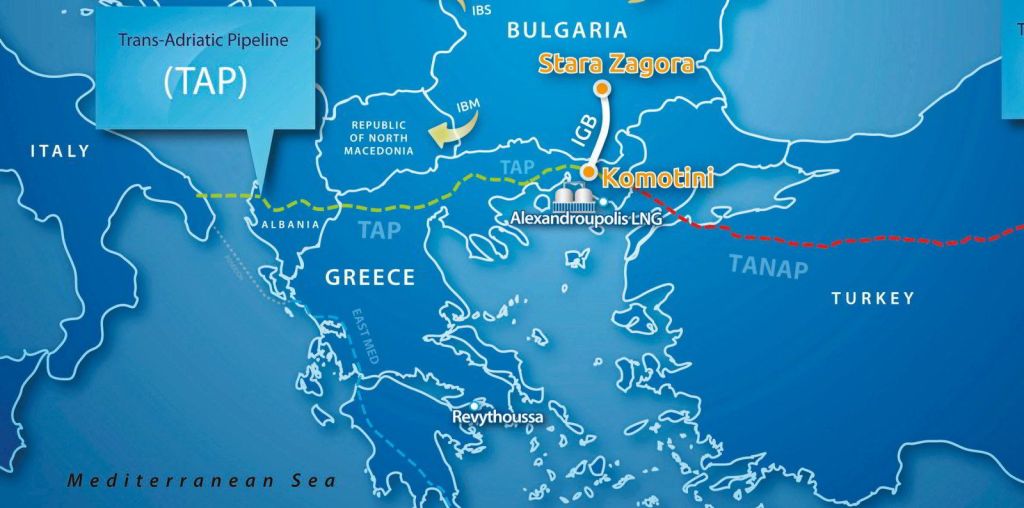
“The IGB connects Bulgaria with the Trans-Adriatic Pipeline (TAP) and allows the transport of natural gas from Azerbaijan via Greece to Italy and southeastern Europe.

The map above shows the route of the Southern Corridor Pipeline which is made up of the Shah Deniz natural gas field in the Caspian Sea delivering gas via the South Caucasus Pipeline Extension (SCPX) over Turkey via the Trans-Anatolian Pipeline (TANAP) which connects to the Trans-Adriatic Pipeline (TAP).
“It will carry Azeri gas via the Southern Corridor to Bulgaria, diversifying its market supply sources, meaning the data changes for the Bulgarian energy market with its ability to increase the competition and lower the prices for consumers while ensuring diversified and staggered natural gas deliveries.
“As such, its strategic importance is more far-reaching since it is expected to constitute a key link in the chain of the Vertical Corridor – a system of pipelines that will connect Greece, and besides Bulgaria, with Romania and Ukraine, serving additionally with the planned floating terminal station of regasification of liquefied natural gas (FSRU/Floating Storage and Regasification Unit) at Alexandroupolis.”
The project, which the AVAX company constructed, is recognized as most important for the CESEC (Central and South-Eastern European Gas Connectivity) initiative and has excellent cooperation with other large projects such as TAP and TANAP.
On the occasion of today’s ceremony in Sofia, the managing director of the AVAX Group, Konstantinos Mitzalis, who finds himself in the Bulgarian capital for the commencement of the commercial use of the IGB, in his statement to the Athenian-Macedonian New Agency, stressed that the day’s event has special meaning for the Group.
“On the one hand,” he explains, “because we are looking with joy and satisfaction to start up its commercial service, a complex project, during the construction of which we experienced the limitations of an unprecedented two-year pandemic, the significant increase of the price of fuel and the raw materials, disturbance of the worldwide logistics chain and more recently the war in Ukraine. We are, however, happy and at the same time proud because this conduit, combined with TAP and the Revithoussa infrastructure, which the AVAX Group also constructed, guarantees energy autonomy not only for Greece but for all of SE Europe.”
The IGB Identity
The project consists of a conduit approximately 182 kilometers [around 115 miles] long, of which approximately 31 kilometers [around 20 miles] are within the territory of Greece – as well as the necessary support facilities (2 metering stations, 8 natural gas valve stations, and 2 service centers).
The conduit has a diameter of 32 inches and a thickness that fluctuates from 11 to 20 millimeters, with its annual capacity initially being 3 billion cubic meters of natural gas with the possibility of reverse flow thereby increasing capacity to 5 billion cubic meters of natural gas annually with the construction of a compression station.
The conduit connects to Komotini via the Trans-Adriatic Pipeline (TAP) – which AVAX had also constructed – and the National Natural Gas System Operator S.A. (DESFA) [of Greece], while at its termination in the Bulgarian city of Stara Zagora, it connects with Bulgaria’s natural gas operator, Bulgartransgaz.
The Project in Numbers
The construction of the project required hiring approximately 450 workers for more than 4 million hours of work. Around 100 kilometers [62 miles] of the pipeline were welded with automated welding machines, with the highest point of the pipeline at 800 meters [2625 feet] in the Rhodope Mountains and the lowest point of the pipeline around 50 meters [164 feet] below sea level [as it passes under] the Kladenets Dam.
Concerning safety and quality, the project received a Safety Milestone Achievement award for one million man-hours without time lost due to injury. At the same time, more than 20,000 segments were welded with a world-class percentage of repairs of less than < 5% (for which a Quality Award was received), 182 kilometers [115 miles] of 32″ diameter pipeline (12,000 welded segments), 16 of 32 kilometers (50%) in very difficult terrain with steep inclines in Greece, 45 of 151 kilometers (30%) in very difficult terrain with steep inclines in Bulgaria with the use of explosives.
It is a project with high demands and specifications within the framework of which eight natural gas valve stations and two horizontal directional drilling (HDD) apertures (Maritsa/Maritza – 500 meters [1640 feet] and Studen Kladenets Dam – 1500 meters [4921.26 feet] were constructed. The implementation of the Kladenets HDD is considered the third largest in Europe.
AVAX construction company managing director Mitzalis listed the infrastructure projects that were included in the overall pipeline construction: Constructing two metering stations – GMS1-KOMOTINI & GMS2-STARA ZAGORA; boring 46 pipeline connections; installing fiber optics for a total length of 32 kilometers [20 miles] in Bulgaria for supervisory control and data acquisition (SCADA) and telecommunications; installing an independent center for monitoring and distributing information to Haskovo [a city in the northern Thrace province of Bulgaria] to serve SCADA and materials storage; installing a SCADA system for training all technical personnel of the customer in the operation of the new system; and, performing gasification/activation of the system before its becoming commercially operational via the same means (personnel and technical).
A Project of High Requirements but also Challenges
The challenges in constructing the project were many, which, besides the heavy winter and the occasionally severe weather conditions, necessitated facing the Covid-19 pandemic and its consequences, the disruption of the global supply chain, the lack of important construction materials, and, naturally, the war in Ukraine and the energy crisis in Europe.
As such, the great experience of the AVAX construction company in the construction of projects with high requirements made possible its completion within the time schedule and, most importantly, with absolute safety and maximum possible quality, as the building company points out.
Since the pipeline was constructed in two different countries, it was necessary to keep in mind the differences in legislation and tax-related services, insurance matters, licensing, residency, accessibility, movements, etc. During the preparation of the study and construction phase it was also necessary to keep in mind the technical requirements imposed by the regulations of two different nations (Greece and Bulgaria) as well as there being four different carriers (ΙCGB [Interconnector Greece-Bulgaria], BULGARTRANSGAZ [Bulgarian Natural Gas Transportation and Storage Company], DESFA [National Natural Gas Transmission System Operator in Greece] and ΤΑΡ [Trans-Adriatic Pipeline). These are only a few of the challenges that had to be successfully overcome.
The procedures, the requirements, and the carriers for the oversight and inspection of the project were different in each of the two countries. Different also were the level of preliminary study and the study criteria given by the IGB for each of the two countries (Greece and Bulgaria).
Concerning the technical aspect of the project, it should be stressed that the pipeline route, for a great distance, went through mountainous regions with steep grades, with many tasks executed in difficult weather conditions (heavy snows and rains, low temperatures, etc.).
The technical aspects also included filling with natural gas, activating and implementing the IGB exclusively by human power and equipment of the company as well as training the personnel of the IGB in operating the system after being transferred and put into implementation.
The Pandemic, the War, and the Stakes of Completing the Project
The incursion of Covid into our life affected, as was natural, the project as it was necessary for [the following] to be developed and implemented: new procedures for the safety and health of the personnel; application of controls and the various national laws dealing with confronting the pandemic; assurance of access of sick personnel to health services; and, procedures for the care and support of quarantined personnel.
However, it wasn’t only personnel management that was a challenge for the construction company. There were also serious consequences because of delays owing to great changes in the supply chain of equipment and materials.
The geopolitical developments owing to the condition of war in Ukraine followed on the tails of the huge issue of managing the consequences of the pandemic. [The situation in Ukraine] made the political leaders and the citizenry of the two countries increase significantly their awareness in relation to the construction and completion of the project.
As is being stressed by the construction company, however, despite the challenges, the tasks were fulfilled in complete conformity with the agreement’s demands for quality.
“Greece has achieved energy independence thanks to the Trans-Adriatic Pipeline (TAP) and Azerbaijan, according to the head of the Greek Ministry of Foreign Affairs (MFA), Giorgos Gerapetritis.
“‘In recent years, Greece has turned into a key energy center. We have strengthened our energy security and helped neighbors with deliveries of both natural gas and electricity. We have achieved energy independence thanks to TAP and Azerbaijan. Greece has rendered significant aid to Bulgaria in deliveries of natural gas. As soon as the flow stopped from Russia, we launched the Interconnector Greece-Вulgaria (IGB). We send gas to Moldova and we are developing a floating regasification reservoir in Alexandroupolis. We are building a pipeline to Northern Macedonia as well as expanding the TAP and IGB pipelines. In the electricity sector, we have established a new connection with Bulgaria and we are studying the possibility of expanding this network to Italy as well as constructing a new line to Türkiye. Thanks to these initiatives, we are rewriting the region’s energy map, placing Greece at its nucleus.’”
CNN Greece on October 1, 2022, issued a second report concerning the cooperation between Greece and Azerbaijan on the transport of natural gas from the Caspian Sea to southeastern Europe:
Greek Prime Minister Kyriakos Mitsotakis met with Azeri President Ilham Aliyev in Sofia before the ceremonial launching of the Interconnector Pipeline Greece-Bulgaria (IGB).
The two leaders conducted a complete overview of bilateral relations and analyzed the prospects of further development of economic and trade cooperation, with an emphasis on the area of energy.
Stressed was the importance of the TAP Pipeline that passes through Greece for diversification of the sources of Europe’s energy supply, the role of the “Southern Corridor” in the policy of the European Union for strengthening energy security, promoting the energy “green transition,” and the strategic cooperation of the two countries.
The prime minister stressed the pivotal role that Greece can play in the energy security and power supply of the Balkans and Europe given its position, as much with the infrastructure at its disposal (Revythousa [the small island that provides for the energy security of Greece and the Balkans (Euronews)], Alexandroupoli [the small port that became a strategic hub of NATO]) as with the joint ventures in which it is participating as a bridge with Africa such as the electric interconnector Greece-Egypt.
Regional and international developments, emphasizing the Eastern Mediterranean and Ukraine, were discussed during the meeting.
 The Dragon is Slain
Leave a comment