[Analytic summary: Although the author uses the assassination of Iranian nuclear scientist Mohsen Fakhrizadeh as the springboard for his article, its thrust is rather the predicament that Turkey is finding itself in by virtue of its apparent rapprochement with Israel and growing tension with Iran. This web of tri-lateral relations has become stickier by seeing an up-tick of Iranian intelligence operations in Turkey, which has necessitated cooperation between the Turkish and Israeli intelligence agencies to thwart those Iranian activities that have targeted Israelis. As a result, Turkey’s ruling party finds itself between a rock and hard place: on the one hand, it is having to defend its territorial integrity from these Iranian intrusions aimed at “wearing down” Turkey’s relationship with Israel; and, on the other hand, its rapprochement domestically, in the face of criticism coming from its Islamic base.]
Yildiray Ogur, in his February 21, 2022, article at the online media site Serbestiyet, cites sources on opposite ends of the political spectrum to argue that Turkey is suffering the consequences of its incipient rapprochement with Israel on two fronts, both of which want to “wear down” and “derail” the relationship. To illustrate his argument and to support his case, the author draws from recent events in Turkey, while citing the perspectives of his sources.
Those making these charges are the newspapers that are “close to power” [i.e., the ruling Justice and Development Party (AKP)] and claim that Iran is conducting intelligence operations in Turkey “to derail Turkey-Israel relations…,” “to try to wear down Turkey-Israel relations.” At the same time, on the other end of the political spectrum, are the Islamists, such as Saadet (Felicity) Party parliament member Abdülkadir Karaduman–opposing the trip of Israeli President Isaac Herzog and recalling the Palestinians whom settlers in the East Jerusalem Sheik Jerrah neighborhood removed from their homes. They too want to “derail Turkey-Israel relations…,” to “try to wear down Turkey-Israel relations,” according to these newspapers.
The author implies that a popular sentiment in Turkey is that everything happening in Turkish domestic politics has to do with a Jewish plot, with the Israeli intelligence agency Mossad, or with foreign powers. He concurs that Turkey’s National Intelligence Agency (MIT) and Mossad are doing joint operations against Iran in Turkey.
Of course, the author had in mind the assassination of Iranian scientist and architect of Iran’s nuclear program Mohsen Fakhrizadeh by Mossad in November 2020 by a sniper using an artificial intelligence-supported, remote controlled weapon.
To take revenge for the assassination of Fakhrizadeh, the Iranian Intelligence Service chose Yair Geller, a 75-year-old Israeli businessman and Turkish citizen, who lived in the Istanbul area and owned the CNC Forward Technology and Engineering company, which produces aviation-defense industry technology, software and CNC stands. (The author informs us that CNC stands for Computer Numeric Control, the goal of which is for the machine tools to be controlled with digital commands and the aid of a computer. Two areas in which CNC stands are being used are aeronautics and defense-related equipment.)
In the scenario described by the author, although the Iranian spy network was observing Geller’s every move, so MIT’s field agents responsible for counterintelligence activities were tracking the Iranians. When MIT determined that the Iranians were preparing to strike, this information was shared with Mossad. The author further notes, “At a high-level secret meeting that the two organizations carried out in Ankara, it was assessed that the assassination attempt against Geller had been planned in order to wear down Israel-Turkey relations, strained for 13 years, but starting to be developed again recently and to take revenge for Mohsen Fakhrizadeh.”
[Analyst note: It seems that Geller was a target of opportunity, although an extremely appropriate one, since, as the author clarifies, Iranian Intelligence “had gone on the hunt for the Iranian opposition in Turkey for some time.” This implies that MIT was already aware of the Iranian assassination team’s presence in Turkey.] In the end, all of the assassination plots were foiled.
In fact, the author refers to an Israel Channel 12 news report that “the Israeli Intelligence Agency (MOSSAD) has aided in hindering 12 terrorist attacks against Israeli citizens in Turkey.” So, he asks, “is it a coincidence for this many operations, back-to-back, of Iran intelligence activities in Turkey in such a short period of time? More to the point, is it a coincidence that these operations are coming at a time when Turkey is experiencing a rapprochement with Israel and tensions with Iran?” He answers his own questions by stating, “Becoming closer to Israel and the United Arab Emirates in foreign policy and distancing itself from Iran, Turkey has been conducting back-to-back operations against Iranian intelligence in Turkey.” Turkey has been fighting fire with fire.
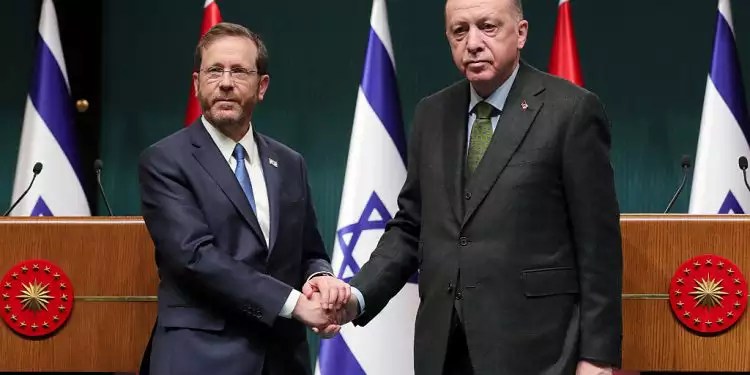
As examples of Turkey’s rapprochement with Israel, the author noted that “Israeli President Herzog [would] be coming to Turkey on March 9. Beforehand, a delegation headed by Presidential Spokesperson Ibrahim Kalin went to Israel to meet with their Israeli counterparts in Jerusalem, faces smiling. The invitation was made by Herzog. In Israeli newspapers concerning the visit, positive articles even appeared regarding chats about Ibrahim Kalin’s music career. It was reported that Israel had foregone mentioning prerequisites such as ending the activities of Hamas in Turkey. President Erdoğan even said that Israeli natural gas would be able to be used in Turkey, in fact, the transit of gas to Europe would also be able to be provided.”
[Analyst note: Apparently attempting to explain a possible reason for the rapprochement in economic terms, the author notes that “while relations with Israel relate directly to the level that [you] use your natural gas, on the other hand, the increased tense relations with Iran will be the reason for Iran decreasing the natural gas going to Turkey in the middle of winter.” In other words, tensions with Iran are fueling the need for another source of energy.]
Another Iranian provocation that increased the tension with Turkey, the author cites, was an incident “[a]t the beginning of February, [when] an unknown organization called ‘Free Sinjar’ attacked Turkey’s Bashiqa base in Iraq with 18 rockets. It is estimated that this organization is a screen for the Shia Haşd El Şaabi (People’s Mobilization Forces) organization with ties to Iran. For a long time, fighting between the PKK (The Kurdistan Workers Party) and Turkey has been heavy in Sinjar province, which is under the control of Shia militia, and it is known that the PKK is using this as a new Qandil. [Analyst note: According to a July 5, 2017 analysis piece in the Fikra Forum by Raed al-Hamid, “Sinjar…represents an important ground link between [PKK] fighters in Sinjar, the PKK’s main fortification in the Qandil Mountains, and the areas held by the PKK-linked People’s Protection Units in Syria.”]
Thus the analogy of changing the dance step according to the music being played.
The author indicates that Erdoğan and the AKP have accepted the eventuality that the “supreme interests of the state” must prevail over a bias such as antisemitism and have therefore resolved to ‘dance to the music.’ He then suggests that “this pragmatism can perhaps be an awakening and enlightenment” for those who prefer not to.
A link to the original article and its translation can be reached here.

 The Dragon is Slain
Leave a comment