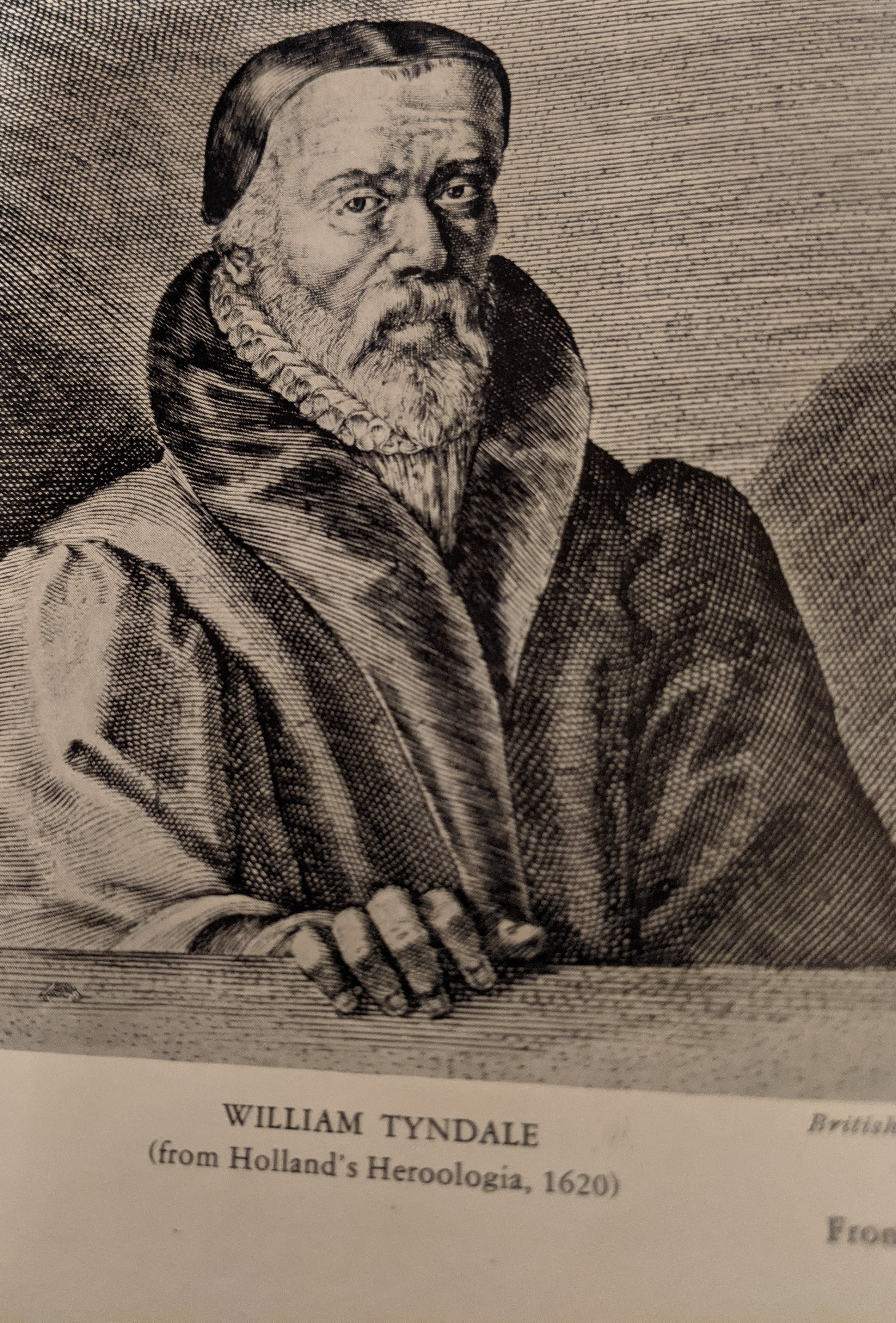
by J. F. Mozley
This is the last of a trilogy of biographies I have read on William Tyndale. There is a
fourth biography, written by Robert Demaus in 1886, which served as one of the
main sources of the present volume, written by Mozley in 1934. I decided to
read Mozley’s biography of Tyndale because just as Brian Moynahan[1]
had referred to David Daniell’s biography of Tyndale[2], so Daniell had to Mozley. It seemed that with each biography, I was getting closer to the initial attempt to convey to the general readership the life of English Reformer and Bible translator, William Tyndale.
In writing his biography of Tyndale, Mozley opted to quote heavily from his ‘authorities’ and then to comment. I found his observations to be insightful and apropos of his subject, with one exception. In my opinion, Mozley was too quick to acquiesce and justify the retention in the authorized version of the English Bible, which eventually came to fruition, of the word ‘church’ as the correct translation for the original Greek ‘ekklesia’ (εκκλησια). His appeasement is startling in view of the fact that his stated opinion that the abuses of the ‘Church’–because of which, Mozley intimated, Tyndale refused to translate the Greek word as such–had been rectified, remains inherently false. Indeed, without a doubt, Tyndale would have betrayed his linguistic sensibilities as executed through his translation had he not translated ‘ekklesia’ as ‘church’ simply from a rejection of its abuses when, whether or not he had delved into the actual meaning/derivation of the English word ‘church,’[3] the Greek strictly means ‘assembly’/’congregation.’ In fact, Tyndale may have been influenced by Jerome and Erasmus, both of whom, at times, Mozley notes, had translated ‘ecclesia’ – the Latin transliteration of the Greek – into Latin as ‘congregatio.’ Tyndale may also have taken a cue from Luther, who insisted on translating ‘ekklesia’ as ‘Gemeinde,’ meaning ‘community’/’congregation.’ There were other words too with which Tyndale disagreed as to how the Greek words had been translated into the Latin.[4]
Discounting Demaus’s because of its relative inaccessibility, Mozley’s biography of Tyndale should be considered authoritative, upon which the more recent books have relied. Of course, as a result of internet access to a huge amount of applicable data, evangelical scholarship in the area of Reformation history as regards the struggle to translate the Bible into native languages has grown exponentially. This, in turn, has allowed the more recent authors to fill in a hole here and there, but Mozley’s work should still be considered a piece d’ resistance. In fact, having worked back from the most recent Tyndale biography to the earliest (that was readily accessible), I would suggest that anyone aspiring to read the various biographies of Tyndale begin with Mozley and work forward. This approach would give the reader insights as to what extent and on which topics the later biographers chose to use Mozley’s account.
One interesting tidbit regarding Tyndale’s approach to his translating of the Greek New Testament that I found in Mozley which I do not recall having read elsewhere implies that it was Tyndale’s belief than many of the writers of the New Testament spoke Hebrew as their first language and therefore often transferred Hebrew syntax and verb tenses into their Greek sentence structure. Tyndale offered, “If aught seemed changed, or not altogether agreeing with the Greek [as regards his translation], let the finder of the fault consider the Hebrew phrase or manner of speech left in the Greek words: whose preterperfect [action complete in the past] and present tense are oft both one, and the future tense is the optative mood also, and the future tense oft the imperative mood in the active voice, and in the passive ever. Likewise person for person, number for number, and interrogation for a conditional, and such like, is with the Hebrews a common usage.”[p. 284]
Mozley observed concerning the time of inquisitions, when the established ecclesiatical hierarchy with the pope at its pinnacle was accusing to be heretics those who did not conform with practices that it had declared to be consistent with the teachings and, more so, with the traditions of the ‘Church’: “The first twenty years of the century had seen many English martyrs. Only eleven years ago, in 1519, six men and one woman had perished in the same fire at Coventry. At any moment such scenes might be repeated, the news might come that a victim had been offered in sacrifice: and so it proved. Early in March 1530, within two months of the publication of Genesis, Tyndale’s friend and ally, Thomas Hitton, went to the stake at Maidstone… . Are men to be made of stone? Is it any wonder that those who were suffering under this cruel tyranny, upon which today we look back with the mild interest of historians (italics mine), burst into cries of anger and denunciation? Harsh words are not so terrible to bear as exile, or the dungeon, or the sword, or the flame.”[p. 160] William Tyndale himself suffered all these with the exception of the sword; rather, he was strangled before being set ablaze.
With the realization that his calling to translate the Bible from its original languages would require him to know Hebrew as well as Greek, Tyndale came late to the study of the former, yet, by all indications, mastered it well. After being betrayed, arrested, and eventually imprisoned for approximately one-and-one-half years before his execution, during the fall of 1535, with the approaching of winter, he requested some warmer clothes. “But most of all,” Mozley quotes, “I beg and beseech…kindly permit me to have the Hebrew bible, Hebrew grammar, and Hebrew dictionary, that I may pass the time in that study.”[p. 334]
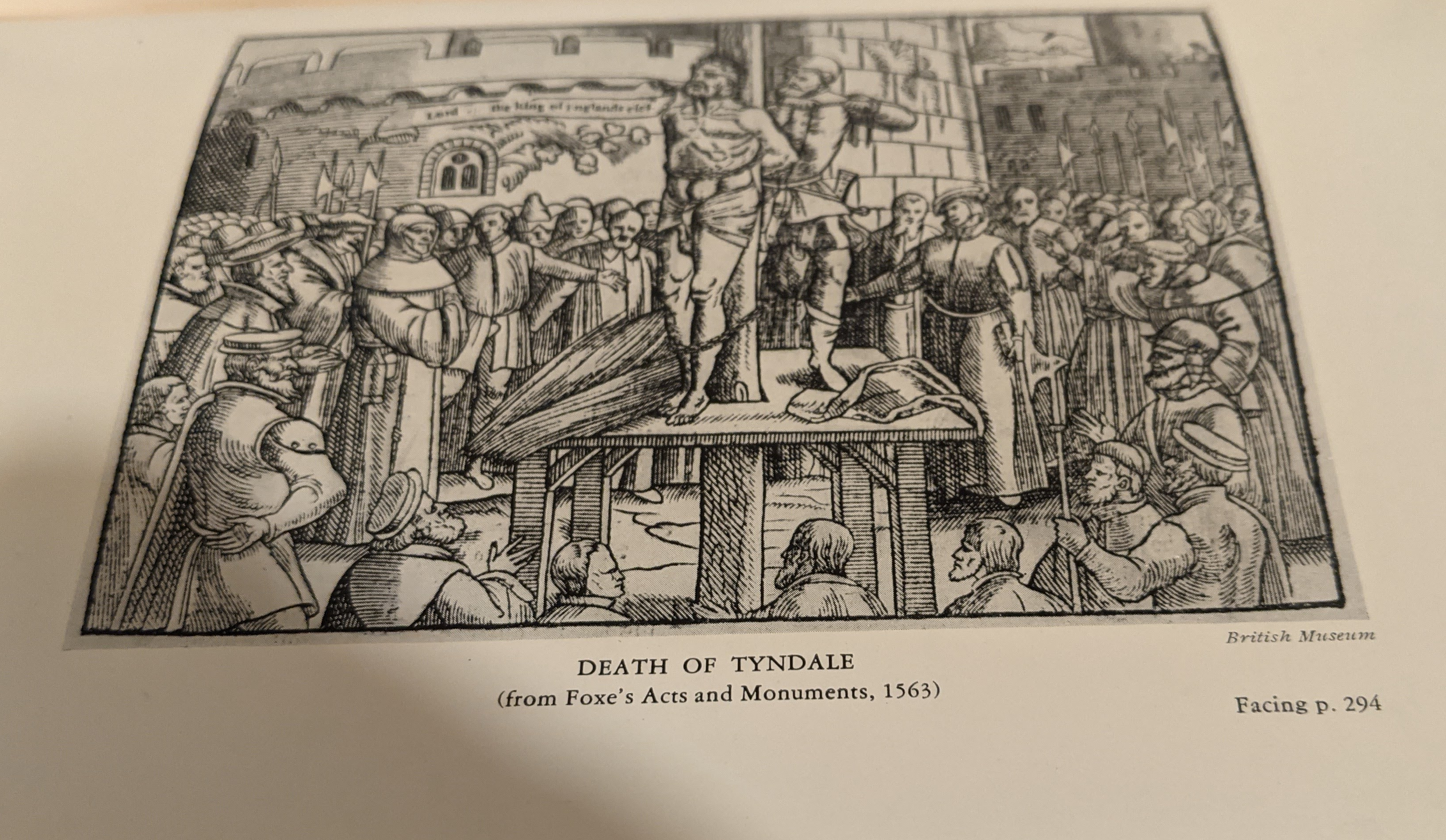
In early October 1536, William Tyndale was lashed to a stake, strangled to death, then burned; one of the main reasons for his being accused of heresy that he would not translate the Greek word ‘ekklesia’ as ‘church.’ They are still present today, yet the word ‘church’ lives on – for better or for worse.
[1] https://thedragonisslain.wordpress.com/2022/04/06/book-review-of-gods-bestseller-william-tyndale-thomas-more-and-the-writing-of-the-english-bible-a-story-of-martyrdom-and-betrayal/
[2] https://thedragonisslain.wordpress.com/2022/05/24/book-review-william-tyndale-a-biography/
[3] Please see https://wordpress.com/read/feeds/125354824/posts/4069473697 Theoretical Reconstruction of the Derivation of the Conceptual Word ‘Church.’ Mozley claims that “‘church’ (kuriake in the Greek) …was Christian from the start…,” a statement with which I disagree. It is not known whether Tyndale held this view.
[4] Https://thedragonisslain.wordpress.com/2022/05/24/book-review-william-tyndale-a-biography/ Daniell has a more concise list than Mozley.
 The Dragon is Slain
Leave a comment