The Russian newspaper, Novaya Gazeta (New Gazette), on its 25 April 2023 internet site edition featured an article in which free-lance journalist, Irina Kravtsova, explained how she came to create the graphic reporting endeavor Street People. As an example of her work, Novaya Gazeta included a snippet from the Street People project.
[Kravtsova’s article as well as the graphic illustrations follow, as translated by LOC.]
In February 2021 in Moscow, there was heavy frost – somewhere close to -4 degrees F. I was rushing around the city; out into the street, into a store, out into the street, to work, out into the street – and hurry home. During one of these dashes out of warmth into warmth, I thought: My Lord, how do the homeless survive in such frigid temperatures?” So, the idea was born to talk with them and to report on how they live in the cold.
I went to Saint Petersburg and conversed a lot with various people. One married couple showed me how they live in a canvas tent. The owner of this dwelling said that he and his wife heated it so that at -15 degrees F., they sleep “in a t-shirt and shorts.”
Another man also showed me his home, in which he has been living 11 years already – this home turned out to be two blankets: one he spread right on top of a snowdrift, with the other he covered himself. This is when -5 degrees F. with 80% humidity in Petersburg feels like -33 degrees F.
“In the evening, I lie down here, shake for 15-20 minutes, then I fall asleep,” he said.
Still another heroine of my text, Zhanna, said that in the winter, when she has to spend the night outside, she tries to stand under someone’s balcony in order to create for herself the illusion that she is indoors. She said, “At least when some walls are surrounding me, it is more peaceful.”
They all suffered humiliation and all kinds of adversities every minute of their lives.
That was by far not the first time that I wrote about the homeless, but the more I listened to them, the more interesting it became to me:
Why are people, who apply such superhuman efforts to survive on the street in the fierce cold, unable to apply these same efforts to get off the street and never again to experience these torments?
While I was searching for an answer to this question, I learned much that changed my conception regarding the homeless. And, as it seems to me, I found the answer. In short, at the time I very much liked how Igor Antonov, a volunteer for [the charitable NGO] “Nochlezhka,” [that provides overnight shelter for the homeless], formulated this answer. He said, “Seldom does one succeed in grabbing someone by the scruff of the neck at the moment they are just starting to slip: they become sick, lose their job, begin taking loans from online loan companies and assuage their heartache with alcohol. And it is extremely difficult to help someone get off the street who for a long time already has lived on the street. A person changes tremendously there. But we do not see this and continue to approach these people with our usual ‘home’ yardstick of normalcy.”
That’s how the reporting, which was issued by Meduza* [an online publishing enterprise headquartered in Riga, Latvia] (recognized in Russia as an undesirable organization -editor), was born. Soon, an illustrator from Kazan, Albina Shaykhutdinova, wrote to me. She said that the stories of the people from my reporting had gripped her and that, being on maternity leave, evenings she would sit and draw the heroes of the reporting and their stories as visual narratives. Albina succeeded in doing this very talentedly: in them, the stories of my heroes literally took on a deeper meaning.
Meduza also published the visual narratives.
Soon, the publisher [of Children’s and Young Adults literature] КомпасГид/KompasGuide contacted Albina and me and proposed that we put out graphic reporting on the basis of my material concerning the homeless and her illustrations. At the publishing house, they believe that our work will help children, who are just beginning to think about how everything is arranged in our world, to form a humane regard for the homeless. Albina and I agreed. Thus was born our visual narrative Street People.
Take a look.
Graphic Storytelling/Visual Narrative
Text: Irina Kravtsova
Illustrations: Albina Shaykhutdinova

STREET PEOPLE – Irina Kravtsova and Albina Shaykhutdinova
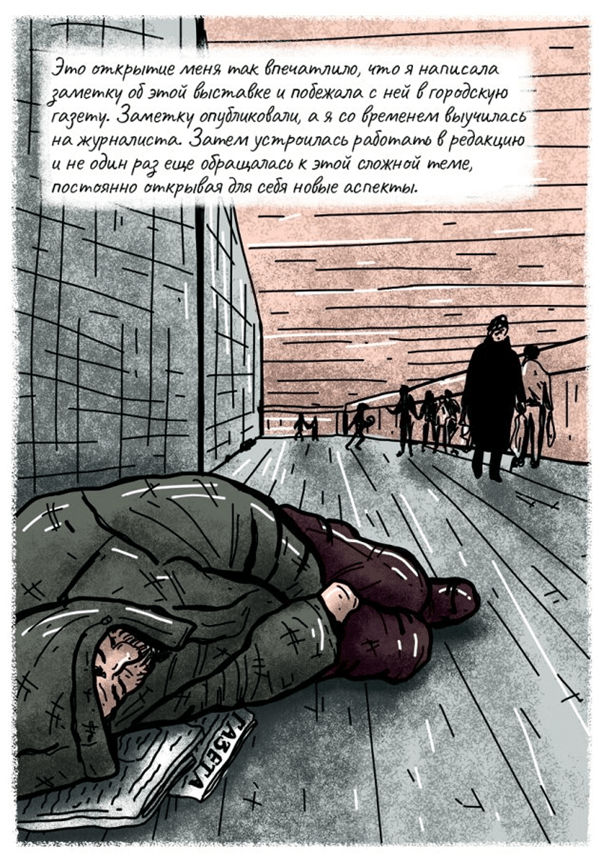
The discovery so impressed me that I wrote a note about this exhibition and took off running with it to the city newspaper. They published the note and, over time, I studied to be a journalist. Afterward, I arranged to work for the [newspaper’s] editor, and not once did I turn my attention to this difficult topic, as I constantly opened for myself new vistas.

More than anything, “streeties” fear the onset of winter, which in Russia last more than 120 days a year. Winter cripples and takes away their lives by the hundreds. Many apply superhuman efforts in order to survive and once again meet spring.

Once, in the 9th grade, friends and I went to the trade center of my hometown, Rostov-on-the-Don.
And there, right in the corridor near the clothes stores, I was walking past a photo exhibit, dedicated to the homeless. It was called, “They are people.”

In dark frames stood large, black/white portraits of men and women. In the wrinkles, bulbous noses, and child-like expressions of helplessness of their faces there was so much depth and sorrow.
At the age that I was then, I couldn’t completely understand [the exhibit], but I felt something. And beneath every photograph there was literally written several lines about the person in it- about how they wound up on the street.
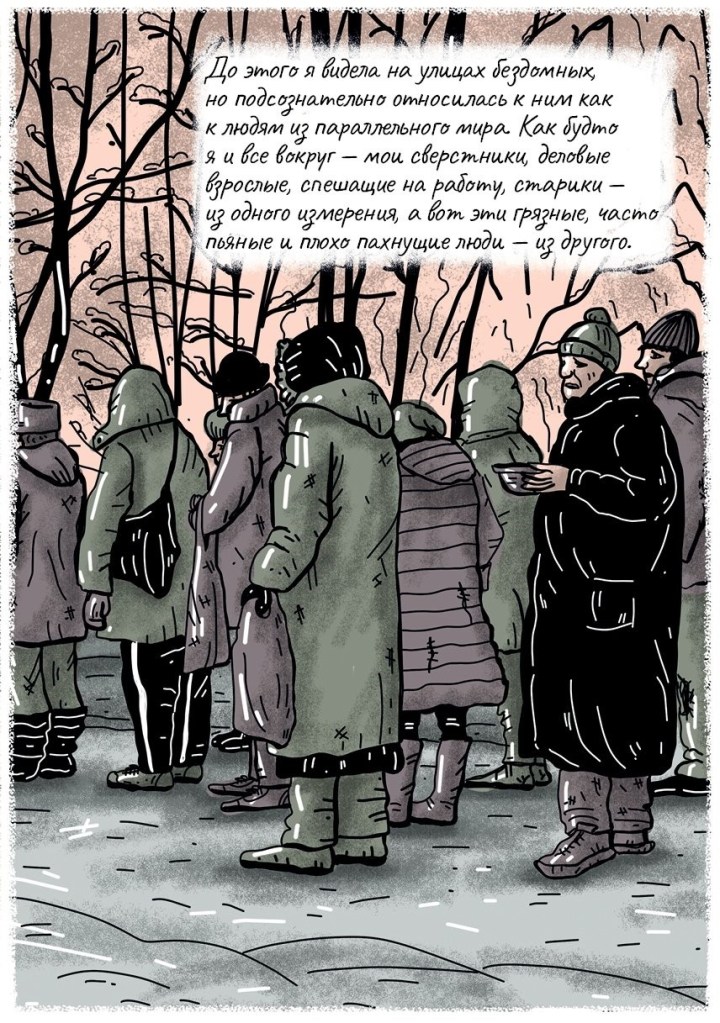
I had seen the homeless on the streets before this, but subconsciously had related to them like people from a parallel world. As if I and everyone around me – my peers, adults engaged in business, rushing to work, the elderly – were of one dimension, but these dirty, often drunk and stinky people – of another.

As if we – goal-oriented, smart, and strong; and they – lazy and weak-willed, who, themselves, had chosen to drink, beg, and do nothing. I, obviously, considered that they had already been born as such.

I, as a 15-year-old, was shaken by the realization that all the homeless, whom I often see on the street, at one point, were just like me – people with homes. Mornings, they drank tea, went to school, took car trips to the river, dreamed about a new dress and bicycle, went to bed in a soft, clean bed, and liked to eat cake.
But then, something broke and they couldn’t regain control – and wound up on the street.

Terrible things happen to certain people, and they just are not able to fight back and resolve the problems that have arisen.
They should be drinking tea with a poppy seed roll and watching serials in their house slippers, but life is crashing down on them.

Seldom is there success in restraining someone, destined for homeless, at the moment, when he is only beginning to fall: he becomes sick, loses his job, begins taking out loans from online loan companies, and allays the heartache with alcohol.
How to help
There are many ways to support the “Nochlezhka” project and to become better acquainted with what it is doing.
*Recognized in Russia as a foreign agent and undesirable organization.
We do honest journalism together with you.
Every day we tell you about what is happening in Russia and the world. Our journalists are not afraid to get to the truth, in order to show it to you.
In a country where the authorities constantly want to ban something, including speaking the truth, there must be publications that continue to be engaged in real journalism.
Your support will help us, Novaya Gazeta (New Gazette), to continue to be such a publication. Make your contribution to independent journalism right now.


 The Dragon is Slain
Leave a reply to Rick Cancel reply