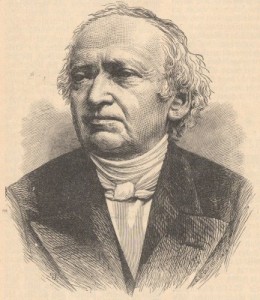
As my studies in Biblical Hebrew progressed from language study, involving grammar, syntax, and linguistic ‘rules of the road’ peculiar to the language, to applying this knowledge practically, I began to study the Psalms exegetically. During the initial stages of studying the Scriptures in Hebrew, in my search for detailed explanatory exegesis of the text, I became acquainted with the Old Testament commentaries of Franz Delitzsch. Although I do not always agree with his conclusions, his commentary dealing with difficult Hebrew words and/or passages is consistently instructive.
The following is a short biography of Delitzsch that I found on the Deutsche Biographie website at https://www.deutsche-biographie.de/sfz9597.html#ndbcontent_werke .
Most books of Delitzsch’s Old Testament commentaries can be found at: https://archive.org/details/BiblicalCommentaryOldTestament.KeilAndDelitzsch.6 . A separate file contains the Book of Job and can be retrieved at: https://archive.org/details/biblicalcommenta01deli/page/n11/mode/2up .
The short biography of Delitzsch follows as translated from the German by LOC:
Delitzsch studied theology, philosophy, and oriental languages as well as being trained in Hebrew at Nikolai High School in Leipzig with the support of his father’s friend, Levy Hirsh.
Having become a Doctor of Philosophy in 1835, he dedicated himself to various scholarly endeavors, among which were the collection and description of the Hebrew manuscripts of the Leipzig Council Library.
Connected with Pietist circles through study friends, he led such a circle for years. During these years he himself operated the Mission among Israel on the occasion of the Leipzig Fair and had connections with missionaries Goldberg and Becker. In 1842, he qualified in Berlin as a university instructor and in 1844 was named the associate professor there, but a call followed soon afterward, in 1846, to Rostock, and then, in 1850, to Erlangen.
His lectures encompassed Old and New Testament exegesis and salvation history (interpretation of history emphasizing God’s saving acts and viewing Jesus Christ as central in redemption www.merriam-webster.com/dictionary/Heilsgeschichte ). He was called to Leipzig in 1867, where he unfolded a fruitful scholarly and practical ecclesiastical activity (expansion of the Mission among Israel). His importance lies – apart from his rabbinical research – in the area of Old Testament exegesis, of which he at his time was the most important Lutheran representative. Because he strived, as a decided opponent of Rationalism, for a discerning working out of the historical sense of the individual passage as well as to enhance the theological content, his commentaries (Bible Commentary on the OT, in 1861 and following with F. K. Keil) continue to be used for reference, although they are partially outdated in historical criticism. [LOC comment: Please bear in mind that this view is that of the article and not of this translator.] With respect to contemporary Biblical criticism (Julius Wellhausen), he was open-minded enough as a truth-seeking historian to recognize its fundamental authority and partially also its results (Servant figure of the Scriptures!) [LOC comment: The “Servant figure in Scripture” is most likely a reference to the ‘suffering servant’ passages in the Old Testament prophetic book of Isaiah.] He created the decisive requirement for the Mission among Israel through a widespread translation of the New Testament into Hebrew (1877, 1890). He had unusual success as an academic teacher, preacher and lecturer, and not least as a brave fighter against the emerging modern antisemitism. One of his last students was the theologian Wolf Graf Baudissin († 1926).


 The Dragon is Slain
Leave a reply to Labhrais O’Coileain Cancel reply