At some point in pre-history war was waged in the spiritual realm, which, although the outcome was preordained from eternity-past, has affected all of creation and will continue to do so until the last full measure of Yahwah’s wrath has been poured out on His created order that has been co-opted and turned against its Creator by the Evil One.
We first meet this disruptive presence in the Garden of Eden, where, as a walking and talking serpent, Satan immediately created tension between Yahwah’s supreme creation, the man Adam, and the woman Eve. While we will touch on the theological implications of the process whereby sin entered the world, the purpose of mentioning this encounter in the Garden with Adam and Eve is to introduce Satan as the anti-Yahwah agent whose hatred of The Most High has brought about the slow but inevitable destruction of an initially perfect world.
This begs the question: Where did Satan come from? Has there always been an Evil Force that has from the beginning attempted to defeat The Good? This does not seem to be the case, according to the Bible. As the Creator of all things Genesis 2:4+, Yahwah Elohim, together with the participation of His Spirit Genesis 1:2, in the person of Yeshua John 1:3, Whose Triune character alone is good, could only create that which is good, as the Genesis account of creation testifies that “everything was very good.” While we have not been made privy to the creation of the angelic realm, it too would have been very good. However, it would seem that the angels were originally created with free will, which led to the heavenly rebellion that produced Satan.
It might be most instructive to start with Yeshua telling the 70/72, when they reported that “even the demons submit to us,” that “I saw Satan (שׇֹטׇן = accuser, adversary) as lightening falling from heaven [OR the sky].” Luke 10:18 What we have in this short statement, as we will see, is the pre-incarnate Son of God testifying to the onslaught of a heavenly being on the One Who had created him in the first attempt to thwart the eternal purposes of the Triune God to choose a people through whom to effect the salvation of the world. This plan was anathema to the one who considered himself to be more beautiful than the Eternal Son, was jealous of Him, and seethed with a rage-filled hatred that would be his undoing, lead to his being thrown out of the Almighty’s Presence to earth, and eventually into Hell.
In order to examine this back story in its proper context, it is necessary to understand that the Bible treats history as ‘His story.’ In the Old Testament, therefore, overtly historical events contain spiritual connotations; the prophets, in particular, attribute retrospective as well as forward-looking spiritual significance to the mundane, while, in the New Testament, the book of Revelation relates allegorically an apocalyptic perspective of the salvific history of the world.
Ezekiel is perhaps best known for prophesying the modern state of Israel through his vision of the valley of dry bones coming to life in chapter 37; possibly his next most well-known prophesy is found earlier in chapter 28:1-19, in which he intertwines the downfall of the narcissistic king of Tyre with that of Satan. From the context of the passage, we become familiar with the historical figure of probably Ithobaal/Ethbaal, while from the cotext (that part of the greater passage immediately surrounding the specific text we are concerned with), we are given a front-row seat to the created heavenly being that became Satan.
I will begin to exegete verses 11-19 by designating ‘king of Tyre’ as a cryptonym for Satan. But before doing so, I would like to look in more depth at the war that broke out in heaven, as recorded in Revelation 12:7+, where the Holy Spirit, through the Apostle John, describes that occurrence, which dovetails nicely with the account in Ezekiel 28.
7 Και εγενετο πολεμος εν τωι ουρανωι, ο Μιχαηλ και οι αγγελοι αυτου πολεμησαι μετα του δρακοντος. Και ο δρακων επολεμησεν και οι αγγελοι αυτου, 8 και ουκ ισχυσεν, ουδε ευρεθη αυτων ετι εν τωι ουρανωι. 9 και εβληθη ο δρακων ο μεγας, ο οφις ο αρχαιος, ο καλουμενος Διαβολος και ο Σατανας, ο πλανων την οικουμενην ολην – εβληθη εις την γην, και οι αγγελοι αυτου μετ’ αυτου εβληθησαν.
7“And war occurred in heaven, Michael and his angels waged war against the dragon. And the dragon waged war and his angels, 8but he did not prevail, nor did they any longer have a place in heaven. 9And the great dragon, the serpent who was from the beginning, the one being called the Devil and Satan, the one deceiving the whole world – was thrown to the earth, and his angels thrown [down] with him.” Here we have another snapshot of the battle that erupted in heaven when the Morning Star (haylayl/הילל) in all his beauty attempted to overthrow the Eternal King, Yeshua. In this instance, Michael and his angels roar to the defense and overpower the would-be usurper.
10 Και ηκουσα φωνην μεγαλην εν τωι ουρανωι λεγουσαν, Αρτι εγενετο η σωτηρια και η δυναμις και η βασιλεια του θεου ημων και η εξουσια του Χριστου αυτου || Εγενετο η βασιλεια του κοσμου του κυριου ημων και του Χριστου αυτου, και βασιλευσει εις τους αιωνας των αιωνων. Rev. 11:15 a companion verse||, οτι εβληθη ο κατηγωρ των αδελφων ημων, ο κατηγορων αυτους ενωπιον του θεου ημων ημερας και νυκτος. 11 Και αυτοι ενικησαν αυτον δια το αιμα του αρνιου και δια τον λογον της μαρτυριας αυτων, και ουκ ηγαπησαν την ψυχην αυτων αχρι θανατου. 12 δια τουτο ευφραινεσθε, ουρανοι και οι εν αυτοις σκηνουντες; ουαι την γην και την θαλασσαν, οτι κατεβη ο διαβολος προς υμας εχων θυμον μεγαν, ειδως οτι ολιγον καιρον εχει.
10“And I heard a great/loud voice [i.e., a roar] in heaven, saying: ‘Now has the salvation and the power and the kingdom of our God and the dominion of His Christ/Messiah || The kingdom of the world of our LORD and His Christ/Messiah Rev. 11:15 a companion verse || become [a reality], because the accuser of our brothers has been thrown down, the one accusing them in the presence of our God, day and night. 11But they conquered him through the blood of the Lamb and through the word of their testimony, and did not love their life [so much that they feared] death. 12For this reason, be glad, [o] heavens and those dwelling in them; woe the earth and the sea, because the devil came down to you, having a great anger, knowing that he has little time.”
As with all prophecy, where a near-future fulfillment often precedes its far-future counterpart, the time sequences presented here by the voice roaring in the heavens are difficult to ascertain. In verses 10-11, the heavenly speaker is looking into the distant future to the time when the devil, who has been constantly accusing those who have placed their faith in Yeshua, will be thrown into the lake of fire and brimstone. In verse 12, on the other hand, it appears that the heavenly speaker is looking in the rear view mirror at the event I mentioned as having occurred between verses 1 & 2 of the first chapter of Genesis. Although the verb in v12 concerning the devil ‘com[ing] down’/katevi-κατεβη is in the active voice, making it sound as if he descended of his own volition, verse 13 clarifies that the devil, here called ‘the dragon,’ was thrown down to the earth (“And when the dragon saw that he had been thrown down (evlithi-εβληθη) to the earth…”). The devastating woe of sin had made landfall and would attempt to supplant the True Vine in every way possible (through the various Jewish pogroms throughout history; Hitler’s Final Solution; the outbursts of periodic warfare waged by the surrounding Muslim countries of the Middle East against the State of Israel; and, most recently, beginning on October 7, 2023, the murderous onslaught instigated by the Hamas [חמס = ‘violence’] & Hezbollah Islamist terrorist organizations), until the summation of all things, as described in verse 11.
Now it is time to exegete Ezekiel 28:11-19 >
11ויהי דבר-יהוה אלי לאמר: 12בן-אדם שא קינה על-מלך צור ואמרת כה אמר אדני יהוה אתה חותם תכנית מלא חכמה וכליל יפי: 13בעדן גן-אלהים היית כל-אבן יקרה מסכתך אדם פטדה ויהלם תרשיש שהם וישפה ספיר נפך וברקת וזהב מלאכת תפיך ונקביך בך ביום הבראך כוננו: 14את-כרוב ממשח הסוכך ונתתיך בהר קדש אלהים היית בתוך אבני-אש התהלכת: 15תמים אתה בדרכיך מיום הבראך עד-נמצא עולתה בך: 16ברב רכלתך מלו תוכך חמס ותתטא ואחללך מהר אלהים ואבדך כרוב הסכך מתוך אבנ-אש: 17גבה לבך ביפיך שחת תכמתך על-יפעתך על-ארץ השלכתחך לפני מלכים נתתיך לראוה בך: 18מרב עוניךבעול רכלתך חללת מקדשיך ואוצא-אש מתוכך היא אכלתך ואתנך לאפר על-הארץ לעיני כל-ראיך: 19כל-יודעיך בעמים שממו עליך בלהוך היית ואינך עד-עולם:
11And behold the word of Yahwah unto me saying, 12“Son of man, lift up a lamentation for the king of Tzur and you will say, “Thus says the Lord Yahwah, you are the seal/signet, the perfection of beauty [a specially fashioned signet; ‘an elaborately made seal’ – Koehler & Baumgartner (K&B), in their 2-volume The Hebrew and Aramaic Lexicon of the Old Testament], filled with wisdom and perfect of beauty. 13You were in Eden, the garden of God, all the precious stones your covering: ruby, topaz, the precious stone ‘yahalom,’ topaz, onyx, jasper, turquoise/malachite/garnet, beryl, |your (breastplate?) a handiwork in gold and your bezels on you/wrought in gold were your settings and your engravings (RSV)| on the day of your creation they were fashioned. 14//You [were] an anointed cherub, the one who covers (i.e., protects/guards), even I established you. You were in the Holy Mountain of God; you walked about in the midst of the stones of fire. [OR] I made you the cherub of anointing, the one who covers > i.e., I anointed you the cherub who covers; you were in the Holy Mountain of God; you walked about in the midst of the stones of fire. // 15You were perfect in your way from the day of your creation until perverseness/wickedness was found in you. 16In the abundance of your trade they are full within you of violence and you have sinned and I cast you out from the mountain of Elohim and, (O) covering cherub, I caused you to perish from among the stones of fire. 17Your heart was proud/arrogant in your beauty, you corrupted/perverted your wisdom because of your brilliancy/beauty I cast you down upon the earth in the presence of kings [I gave you up as a spectacle (Delitzsch)]. 18From the abundance of your iniquities in injustice of your trade you polluted/defiled your sanctuary/holy place/place of refuge and I caused fire to go out from the midst of you it consumed you and I gave you up to ashes upon the earth for the eyes of all to see you. 19All those who recognize you among the peoples were astonished at you. You have become a terror and you have ceased to exist forever.
Indeed, there are difficult portions in this section of scripture as are to be expected in prophetic literature. The reason for the difficulties posed by prophetic literature lies in the fact that the text must be considered on two, and at times, three different levels – the immediate vs the future fulfillment of the Word as proclaimed by the prophet as well as on a spiritual level, which, as in this passage, extends from eternity-past into eternity-future. The text, therefore, must be exegeted and exposited with a view to these various levels.
However, the 19th century theologian and Hebrew scholar, Franz Delitzsch, though unparalleled among non-Jewish scholars in his understanding of Hebrew, interprets this passage strictly in its historical and cultural setting. The only spiritual connotation he gives to the passage is by juxtaposing the fall of the king of Tyre with the fall of Adam, which, in my opinion, is much more of a reach than with that of Satan from Heaven. While Delitzsch’s commentary is instructive, he applies an inordinate amount of attention to the explicit context to the detriment of the passage’s implicit spiritual intent. In verse 13 alone, I contend that Delitzsch goes too far in his expositional translation by taking liberties with word meaning and the possible cultural ramifications surrounding it, when he maintains that ‘tof’ (תֹף) ‘drum’/’tambourine’/’cymbal’ is to be understood in the context of the Oriental tradition of women dancing to the instrument’s beat as the new king takes possession of the harem. He includes this assumed meaning in his translation without any explanation. Other translations beg to differ, probably in the recognition, as K&B suggest, that there is textual uncertainty and possibly corruption. As the Wycliffe Bible Commentary notes, “the context requires ‘settings’” (i.e., stone settings), with which I agree.
In other words, in the context of stones, how would they be displayed other than to be ‘beaten’ into settings to be worn on a breastplate. In fact, The Analytic Hebrew and Chaldee Lexicon notes that the passive of the verb ‘beat’ means to ‘smite the breast.’ It’s not much of stretch to apply this meaning figuratively to imagine the act of setting stones on a breastplate.
The above verse is an excellent example of the tension that can exist in the realm of text-context-cotext where overtly historical/cultural denotations collide with the implicit spiritual connotations. There is, of course, the problem of the interpreter’s preconceptions coming into play. In this regard, I confess that I firmly believe the latter; that the cotext of the greater text is the means by which we glimpse the heavenly struggle, the result of which is the creation of Yeshua’s archenemy, Satan.
Regarding verse 14: That this is an extremely difficult verse to decipher is evidenced by the number of varying translations, with much of the difficulty being presented by the very first word -את > where the text reads ‘ath’ (אַת) with the conjunctive maqqef (-), the grammatical symbol which closely connects the truncated masculine singular pronoun ‘you’ (if that is what -אַת is) with the following word ‘cherub.’ This form has precedent, as noted by Delitzsch, in Numbers 11:15; however, I would have expected to see the disjunctive paseq (|), as noted – again by Delitzsch – in Deuteronomy 11:24. I would have preferred to see the paseq, since the verse concerns this cherub; and the paseq, which indicates a pause when reading, would have set the initial ‘you’ apart as the distinct subject/object of the verse.
While I lean heavily toward this probably being the correct translation, i.e., ‘you,’ I really prefer the second option, whereby the truncated pronoun ‘you’ would actually be the accusative marker ‘-eth’ (-אֶת) showing ‘the cherub’ to be the direct object of the verb וּנְתָתִּיךָ (woonuhthahtika = I made you); it is the vowel pointing (a seghol [an inverted triangle consisting of three dots] required under the aleph (אֶ) that ostensibly would discourage this possibility.
(One other option concerning the ‘ath’/’eth’ issue is to translate it as ‘with,’ but this would require tsere vowel pointing [a straight line consisting of two dots] under the aleph > ‘-aeth’ (אֵ), i.e., ‘I established you with a cherub…,’ which only some lesser-known translations have chosen as a gloss. What we need to remember concerning this discussion of vowel pointing is that the original Hebrew text did not contain vowels; they were added much later by a group of Jewish scribes called the Masoretes > cf. https://www.ancient-hebrew.org/biblical-history/a-history-of-the-masoretic-hebrew-texts.htm . In other words, by the introduction of vowels into the text, the Masoretes were interpreting the text according to their understanding of it.)
Even so, though the two translations – excluding the third just discussed – are close, by exegeting the verse according to the second option, the result would be a clearer and more pronounced exposition of the role this cherub had been intentionally created to play in eternity past.
The second sticky wicket Ezekiel has given us to deal with in this verse is actually the word that I have decided to gloss as ‘anoint(ing/ed),’ some form of which all of the most reputable translations of the Bible accept. In fact, Delitzsch, whose expertise has been left for posterity in his commentary series on the Old Testament, felt it necessary to address the word so translated, specifically because of its form מִמְשַח (mimshakh). There are some translations that have completely ignored the possibility that this cherub was ‘anointed’ and opted for language insinuating that of ‘outstretched [wings] that cover.’ The reason for Delitzsch’s attention to this translation is his argument that verb מָשַח (mahshakh) only has the meaning of ‘anoint.’ I would suggest that the word under consideration could easily have been misconstrued, particularly when spoken, as a Qal intransitive of מָשַך (mahshak), which actually means ‘stretched out.’ What we are possibly dealing with, in the case of those translators/interpreters who insist on ‘stretched out,’ is exactly that – an argument of ‘Qere-Kethib’- ‘as read‘ (Qere) vice ‘as written‘ (Kethib). Another possibility is the logical conclusion to associate ‘the one who covers’ (הסּוֹכֵך/ hassocake) with ‘outstretched [wings].’ Be that as it may, the most likely solution, in my opinion, is to understand the preformative, i.e., the first מ (m), being used to form a noun on the basis of the Piel/Pual participle, both of which lead to the semantic understanding of the word ‘anoint[ing/ed]’ NOT ‘stretched out.’
The question remains, however, what was this cherub to cover/protect/guard? Here again, Delitzsch offers no help with the spiritual connotation of this passage, since he is consumed with a strictly allegorical interpretation concerning the King of Tyre. The variations in the translations of this verse as well as the commentaries on it indicate just how puzzling is this prophetic soliloquy of Ezekiel’s. Koehler & Baumgartner (K&B), in their 2-volume The Hebrew and Aramaic Lexicon of the Old Testament, under the triliteral root (סָָכַך/sahkak), note that cherubim were associated with protecting/covering the Ark of the Covenant. Perhaps the deduction can be made that the cherub Ezekiel is referring to was the chief (as the anointed one – my conjecture) of those performing this task? And what are the fiery stones among which this cherub went to and fro?
As for the first question, the triliteral root (סָָכַך/sahkak) is pregnant with spiritual implications. This triliteral is related to the triliterals שָׂכַך שׂוּך סוּך (sook-sook-sahkak; homophones whose meanings can overlap), in one particular instance, all having varying shades of the meaning ‘to cover’: ‘to anoint;’ and, the latter two, ‘to protect’ and ‘to cover,’ respectively. Intriguingly, they also own derivatives denoting, on the one hand, thorns (think ‘crown of thorns’) and a sharp weapon with which to pierce (here, think ‘Yeshua’s side being pierced.’)
We must remember that the Ark of the Covenant generally referred to in the Old Testament is the one that initially was housed in the portable Tabernacle of Meeting, where the glory of Yahwah dwelt, i.e., the ‘mishkan’/מִשְכַן. (Please cf. The Hebrew Radical ‘Sook’ (שך/סך) as It Relates to the Birth of Yeshua (ישוע for the relationship of the triliterals discussed in the last two paragraphs.)
The Ark of the Covenant, when placed in the Tabernacle, contained the two tablets upon which Yahwah had inscribed the Ten Commandments for Moses on Mt. Sinai, a small jar of manna, and Aaron’s budding rod. In the New Testament book of Hebrews, we are informed that this earthly Tabernacle was merely a model and shadow of the heavenly8:5. I would suggest that, in like manner, the contents of the earthly Ark of the Covenant were representations of the True Covenant, Yeshua: the One Who would fulfill the Law perfectly; the True Bread Who came down from heaven in order, when eaten figuratively, to give eternal life to all those believing in Him; and, the One Who gives this life eternal to those who were dead spiritually.
To continue this analysis, the earthly Tabernacle had two cherubim, fashioned out of beaten gold, situated on top of the Ark with their wings covering the mercy-seat, i.e., the place of atonement (kaporeth/כַפֹּרֶת). And it was the High Priest, wearing the stone-set breastplate, who officiated on the Day of Atonement (Yom Kippurim/יוֹם הַכִפֻּרִים with the highlighted three consonants being the triliteral root).
Essential to in-depth text analysis and exegesis of a passage of Scripture at times requires identifying types. In this context, it is certainly within the parameters of a logical typology to see the bejeweled, beautiful Morning Star – the cherub anointed for covering – as the actual embodiment of Satan, on the one hand; while, on the other hand, as the archetype for the High Priest who advocated for the crucifixion of Yeshua.
Earlier, we established that a war had been waged in heaven that had resulted in Satan’s being cast out of his heavenly abode to earth. It seems reasonable to assume that this cherub, who was anointed to cover, was none other than the Morning Star, the most beautiful of the angelic hosts, created to cover the glory of the Only-begotten Son until the time was right for Him to become the incarnate God-Man. The phrase ‘[to go] to and fro among the fiery stones,’ I will deduce to refer to the angelic hosts of Heaven, which Hebrews 1:7 informs are “…fire and flame” and therefore may indicate that he had been given a certain status above the other angels, and that it was not his responsibility alone to cover the pre-incarnate Yeshua; rather, to assign angels to perform this task of love.
As that may be, because of his hubristic condescension toward the Son, through Whom the Father would redeem not only all those whom He had promised the Son but all of creation, the anointed cherub turned his responsibility on its head and, spurred by an all-consuming hatred, attempted a ‘palace coup,’ while taking a host of angelic beings with him. It was at this instant that the Morning Star became the Adversary-Accuser (Satan-Devil/שׁטָן-διαβολος) [Note: Envisioned is a future post, in which this primordial event presaged the second such attempt on the part of Satan to thwart the Almighty’s irrevocable plan when King David’s councilor, Ahithophel, together with David’s son, Absalom, conspired to dis- and replace him.] The Archangel Michael, the angelic protagonist, and his army of angels fought the Adversary, in the course of which the latter “was thrown [down] to the earth and his angels with him.” Consequently, the chaos that had erupted in heaven was transferred to the earth and it was out of this chaos, which had ensued between verses 1 and 2 of Genesis 1, that our present world was created.
I would further suggest that an unstated reason why Delitzsch was particularly concerned with translating משח (mahshakh) as ‘anoint’ was that the Latin Vulgate, which the Roman Catholic Church in 1546 ruled to be the “authentic text of the Bible, but not so much its conformity with the originals, but its usage for more than a thousand years in the Church, which guarantees that the Vulgate contains the written Word of God unfalsified[!]” ((Quote from an article written by John Steinmeuller, D.D., S.Scr.L. in Catholic Culture, The History of the Latin Vulgate, attributed to H. Hoepfl, “Beiträge zur Geschichte der Sixto-Klementinischen Vulgata,” in Biblische Studien, XVIII, 1-3 (Freiburg im B., 1913), 3-11 // “Contributions to the History of the Sixtus-Clementine Vulgate,” in Biblical Studies [my translation; the exclamation point at the end of the quote is my ‘emendation’ to such a preposterously sophistic statement…//)), applied the latter gloss, retained by the Douay-Rheims translation, with the other RC-endorsed English translation, the New Jerusalem Bible, ignoring the possibility of ‘anointing’ by conflating the two descriptors of the cherub to ‘covering.’ Two other versions, the New American Bible Revised Edition (NABRE) and the New Catholic Bible, obviously translated with the first two versions in mind, also omit the sense of the word ‘anoint.’
The Septuagint, which, unfortunately, has been considered a reputable counterbalance to the original Hebrew, in which the majority of the Old Testament was written, and therefore a reliable source for biblical scholars, theologians, and preachers, who depend on Greek as their single recourse to the original languages, completely distorted the original Hebrew text: “From the day that you were created with the cherub, I placed you in the holy mountain of God, you were among the fiery stones.” (Αφ΄ ης ημερας εκτισθης συ μετα του χερουβ, εθηκα σε εν ορει αγιω Θεου, εγενηθης εν μεσω λιθων πυρινων. | From the day you were created with the cherub… < the translation into English of the Brenton Septuagint.)
Although I almost in toto disagree with Delitzsch’s interpretation of the Ezekiel 28 passage, I completely agree with him when he calls וָָאֶחַלֶּלְךָ מֵהַר אֱלֹהִים (wahehhalehlekah mayhaer | I cast you out from the mountain of Elohim) verse 16 “a pregnant expression; to desecrate away from, i.e. to divest of his glory and thrust away from.” The emboldened verb has two basic meanings: I to profane and II to wound, pierce. Rather than to go to great lengths to conjure up a symbolic ‘mountain of God’ to apply to the location of Ethbaal’s abode and to compare his fall therefrom to that of Adam, which Delitzsch does, why not understand this to be a further retrospective of the fall of the Morning Star from his heavenly abode? The language used which would therefore apply to Satan is very similar to that which applied to the crucifixion of Yeshua. We will investigate this shortly. Satan is the ‘evil twin,’ whose darkness could not envelope the True Light.
Regarding this Light, Yeshua tells the crowd, ““Yet a small time the Light is among you. Walk as you have the Light so that the darkness not overtake you…” John 12:35a John uses this same language in 1:4-5 where he introduces Yeshua, The Word having become flesh, as “the Light of men; and the Light shines in the darkness and [but] the darkness did not over[take/come] it.” The Greek word used is katalamvano/καταλαμβανω and can be said to have an underlying meaning ‘to grasp,’ with the literal, tangible meaning of physically – as with the hands – or figuratively, meaning cognitively with the mind. There are Bible translations that opt for this latter, figurative sense of katalamvano/ καταλαμβανω; however, I would posit that John intends the same meaning here as when he quotes Yeshua in 12:35, Who warns His listeners not to allow the darkness to overcome them. What we have is another indication of the struggle that has existed since eternity-past between the Triune God in the person of the Son, Yeshua, and Satan, in the latter’s attempts to destroy the Son and usurp His position and authority. John is adamant that [Satan’s kingdom] of darkness was not able to do this. Therefore, Yeshua stipulated that the remedy for preventing being overpowered by the darkness was to walk according to the Light and to believe in the Light. As Paul writes in Ephesians 6:8, “For at one time you were darkness, but now light in the Lord.” John, in his first epistle, in chapter 2 verse 11 warns that “the one who hates his brother is in the darkness and walks in the darkness, and does not know where he’s going, because the darkness has blinded his eyes.” Here is an oxymoron: how can the darkness be blinding? Paul gives us the answer in his second epistle to the Corinthians, “And don’t be surprised, Satan transforms himself into an angel of light 2 Corinthians 11:14,” i.e., Satan makes wrong seem right and evil, good.
By saying that Satan is Yeshua’s ‘evil twin,’ I have opened up a Pandora’s Box of sorts. What we have observed thus far is that Satan, as the Morning Star, had a brilliancy about him that now blinds people, leading them into the darkness; his wisdom, having become a source of pride, he now insinuates into the minds of both the great, who make the decisions that will inevitably lead to perdition, and the small, to whom these decisions seem correct, which would be the result for all mankind were not the time shortened Matthew 24:22.
Regarding the similarity of language in connection with the crucifixion of Yeshua as noted above in relation to the Hebrew triliteral סוך/suk [although not used with this denotation in Scripture, the assumption is that speakers of Hebrew would certainly have understood the underlying intimations], it behooves us to compare and contrast the language of Isaiah 53 with that of Ezekiel 28 through the lens of Genesis 3:15, where Moses prophesied, “He will trample you while you will be hard on/nipping at his heel [in an effort to hinder Him].” [My translation from Hebrew; the translation that I had been familiar with was “He will crush your head and you will bruise His heel.” Interestingly, there are many translations that use the same word in both instances, such as “bruise…bruise,” “strike…strike,” even “crush…crush,” which, in fact, is semantically correct, since it is the same Hebrew triliteral (shuf/שׁוּף) attributed to the action of both Satan and the Messiah.] I decided to use the gloss ‘trample’ based on Romans 16:20, where the Apostle Paul uses a similar turn of phrase as indicated by the footnote reference to Genesis 3:15, suggesting that he had this verse in mind when writing, “Indeed the God of peace will trample (συντριβω) Satan under your feet shortly.” The picture is of a snake getting underfoot and thus being trampled, its head being crushed in the process not to be ruled out, while trying to sting the heel of the sojourner with its fangs. In his German translation of the Hebrew, Martin Luther understood the scenario perfectly: “He is meant to trample (soll zertreten) your head, and you will sting (wirst stechen; this verb can also mean to ‘pierce’) him on the heel.” We are able to confidently exposit that in this remarkable prophesy of Moses, given as a direct communication from Yahwah to the Serpent and Eve, the “seed [of the woman]” infers the Messiah, based on the formula outlined above concerning fulfilled (retrospective) versus yet-to-be fulfilled events. In fact, there is a high probability that the translations that gloss the verb ‘shuf’ as ‘crush’ and ‘bruise,’ respectively, are driven by the yet-to-be-fulfilled prophecy in Revelation concerning Satan being thrown into the lake of fire, on the one hand; and, on the other hand, the retrospectively fulfilled prophecy of Yeshua’s death on the cross, but that He rose after three days, which, in itself is also a retrospective fulfillment of Jonah’s three days and three nights in the belly of the fish.
Also remember that earlier we identified the High Priest, Caiaphas, who advocated for Yeshua to be crucified, as the personification of Satan. As a created being and therefore not omniscient, it can be surmised that Satan was jubilantly celebrating his final success in destroying the One Whose eternal glory outshone his temporal brilliance by an immeasurable factor.
In considering retrospective and forward-looking fulfillment of prophecy, there is a verse which I would suggest demonstrates conclusively that the Morning Star was not aware, just how far-reaching was the Eternal Covenant he was responsible to guard. Satan, i.e., the Adversary – the cognomen by which this guardian came to be known – schemed to nip Yahwah’s redemptive plan in the bud by contaminating the agents through which this plan was to be implemented – the first man and woman, Adam and Eve, with the overarching sin of disobedience. That is, Satan’s gamut was works-oriented; he would triumph if Adam and Eve failed the test of obedience to not eat of the fruit of the Tree of the Knowledge of Good and Evil (וּםֵעֵץ הַדַּּעַת טוֹב וָרָע לֹא תֹאכַַל מִּמֶנּוּ כִּי בְּיוֹם אֲכָלְךָ מִמֶּנּוּ מוֹת תָּמוּת|But from the Tree of the Knowledge of Good and Evil you [masc. sg.] shall not eat from it for in the day of your eating [masc. sg.] from it you [masc. sg.] shall surely die Genesis 2:17). But it was his ruse that failed – as it will until he meets his eternal destruction in the lake of fire – because Yahwah’s plan of salvation has never been about works, even through the so-called ‘covenant of works’ before the Fall. It has always been about the Blood of “the Lamb Who was slaughtered from before the foundation of the world Isaiah 53:5-7 כַּשֶּׂה לַטֶּבַח יוּבָל; Revelation 13:8 σφαζω; cf. 1 Peter 1:19-20.” The 1 Peter reference is apropos of the passage in Revelation because 1) they complement each other in confirmation of the eternality of the Triune God’s plan of salvation and 2) the latter interprets the former. Peter, under the inspiration of the Holy Spirit, informs that the Moshiach/Messiah, by Whose “precious blood – as of an unblemished and spotless lamb – |you were redeemed out of the useless/foolish/vain (ματαιας) way of life handed down by the fathers (i.e., tradition) v18|, was foreknown before the foundation of the world.” John, in the Revelation passage, elaborates on Peter’s proclamation by identifying the crux of that statement to be that it was from [before] the foundation of the world that the Lamb had been slaughtered, i.e., Messiah’s blood shed, for the redemption of all those whose names have been written in the Lamb’s Book of Life. But Peter did not stop in eternity-past; he comes forward to the recent past when Christ “was made manifest at the end of time for [our] sake.” In consideration of joining the two passages, it behooves us to investigate the relationship between the phrase “the Lamb Who was slaughtered from before the foundation of the world” and “was made manifest at the end of time for [our] sake.”
It must be caveated that the Revelation passage has been translated alternatively as “whose name has not been written…from the foundation of the world.” Although this exact language is found in Revelation 17:8, on the other hand, as we have already examined, 1 Peter 1:19-20 aligns closely with the language expressing the time element to refer to the Lamb. In fact, John, in his Revelation, used the phrase ‘the Lamb that was slaughtered’ previously in chapter 5 verses 6/12: “a lamb standing as slaughtered” v6 and “Holy is the Lamb the One slaughtered” v12 . Given the panoramic eschatological nature of Revelation, John very well could be describing both the pre-incarnational salvific covenant13:8 through which the eternal Son would, as the incarnate Son, the God-Man, give Himself as the perfect sacrifice for those whom the Father had promised Him as well as for whom the covenant was intended, that is, the converse of 17:8, i.e., not those whose names are not written; rather, [for] those whose names are written in the Book of Life from the foundation of the world. In other words, the two Revelation passages complement one another, just as the 1 Peter passage does the passage in Revelation 13:8.
Referring once again to the 1 Peter passage, we understand the phrase “has been manifested indeed at the end of time for your sakes” 1 Peter 1:20b to mean the actual, visible slaughter of the Lamb on the cross at Calvary, in a tangible manner fulfilling the covenant that had been executed in eternity-past. John’s view in Revelation dovetails perfectly and beautifully with Peter’s.
Let us recall that John first introduces us to the Lamb of God/ο αμνος του Θεου/שם האלהים through the eyes of the other John, i.e., John the Baptist, as he describes the scene: “On the next day [the day after he had told the Jews from Jerusalem that he was not The Christ], he sees Jesus/Ιησους/Yeshua (יֵשׁוּעַ) coming toward him, and he says, ‘See, the Lamb of God, the One Who takes away the sin of the world.’” John 1:29 “On the next day [the day after he had witnessed the Spirit descend and remain on Jesus], looking at Jesus walking, he says, ‘See, the Lamb of God.’” John 1:36 The Lamb is always perceived as having been slaughtered.
John, as we noted above, is quoting Isaiah 53:4-7, in line with which, in order to get a complete picture of the extent of the agony suffered by the Lamb Who had covenantally procured our salvation (יֵשַׁע), we need to proceed further reading Isaiah’s prophetic account by returning to verse 4:
אָכֵן חֳלָיֵנוּ הוּּא נָשָׂא וּםַכְאֹבֵינוּ סְבָלָם וַאַנַחְנוּ חַשַׁבְנֻהוּ נָגוּעַ מֻכֵּה אֱלֹהִים וּמְעֻנֶּה׃ “Nevertheless He bore our sickness and carried our pain but we considered him afflicted, smitten by Elohim and humbled.” Isaiah 53:4
וְהוּא מְחֹלָָל מִפְּשָׁעֵנוּ מְדֻכָּא מֵעֲֲוֹנֹתֵינוּ מוּסַר שְׁלוֹםֵנוּ עָלָיו וּבַחֲבֻרָתוֹ נִרְפָּא-לָנוּ “He was pierced because of our rebellion, He was beaten to pieces [traditionally translated ‘crushed’] because of our sins, the chastisement of our being made whole/wellbeing is upon Him, and with His wounds/slashes we are healed.” Isaiah 53:5
כֻלׇּנוּ כּצֹאן תׇּעִינוּּ אִישׁ לְדַרְכוֹֹ פׇּנִינוּ וַיהוה הִפְגִּיעַ בו אֵת עַוֹן כֻּלׇּנוּ “All we like sheep have gone astray, each to his own path we have turned aside and Yahwah let fall on Him the guilt of all of us.” Isaiah 53:6
נִגַשׂ וְהוּא נַעֲנֶה֮ וְלֹ֣א יִפְתַּח־פִּיוֹ כַּשֶּׂה֙ לַטֶּבַח יוּבָ֔ל וּכְרָחֵ֕ל לִפְנֵ֣י גֹזְזֶ֖יהׇ נֶאֱלׇ֑מׇה וְלֹ֥א יִפְתַּ֖ח פִּֽיו׃ “He was oppressed and he was humbled but did not open his mouth; like a lamb to the slaughter He was brought as a sacrifice and like a ewe before its shearer was speechless/dumb/silent and did not open His mouth.” Isaiah 53:7
No doubt with these verses in mind, in describing the events leading up to the crucifixion as the culmination of the slaughter of the Lamb, John has arrived at the crux of his interpretive gospel of the life of Yeshua – as Yahwah in human form He was the fulfillment of the Old Testament Messianic prophecies.
Having been condemned to death, Yeshua first faced a whip-inflicted scourging, the strands of the whip being knotted with sharp shards intended to rip the skin off the back, and a crown of thorns pressed down over His head so that His eyes may well have been blurred from the blood oozing out of the gashes caused as the thorns tore into His forehead. (v5 “beaten to pieces”)
In addition, soldiers ridiculed Him by dressing Him in purple garments, hailing Him as ‘King of the Jews,’ and slapping Him. During His interrogation by Pilate, whose questions were based on the accusation of the Jewish leaders, Yeshua responded by simply proclaiming His power and testifying that He is the Truth. He did not plead for the ‘mercy of the court,’ but gave Himself up in silence to the charges brought against Him. (v7 “He was humbled…and did not open His mouth.”)
Finally, Yeshua is forced to carry the cross (more than likely the horizontal cross piece rather than the entire structure) on His shoulders to the execution site, Golgotha – The Place of the Skull. One can imagine the excruciating pain He endured as He carried that raw-cut piece of lumber on His shoulders, having been slashed till they were raw. In fact, having been scourged to within an inch of His life, His strength sapped, Matthew tells us that a certain onlooker, Simon of Cyrene, was drafted to take over that task. Matthew 27:32 But more pain was to follow as the cross, on which He was nailed, was dropped into the hole that had been dug for it, His extended arms feeling as if they were being ripped from their sockets because of the jolt.
And then, His side was pierced. When this happened has become a topic of discussion, based on a minority (if I understand the apparatus of the United Bible Societies 2nd edition of the Greek New Testament correctly) text reading of Matthew 27:49, which definitely is at odds with the Apostle John’s account in 19:31-37 of his gospel. According to Matthew, per a footnote in the aforementioned Greek NT, verse 49 continues, “Now another, taking a spear, pierced His side, and water and blood came out.” [αλλος δε λαβων λογχην ενυξεν αυτου την πλευραν, και εξηλθεν υδωρ και αιμα.] Matthew has this happening while Jesus is still alive, thereby making the piercing of His side the immediate cause of death. John, however, insisting emphatically that “the one who saw has witnessed and his witness is true,” portrays this incident occurring when the soldiers [who were overseeing the crucifixion of not only Jesus but of the two criminals with Him], in order to expedite their death due to the Jewish leaders’ concern that “the bodies not remain on the cross on the sabbath [in this case, a High Sabbath],” broke the legs of the criminals, but found this unnecessary in the case of Jesus because He had already died. The Matthew version of events does not include this detail, apparently since the piercing of Jesus’ side is used as the cause of death and other, extraordinary measures had been avoided.
So why this discrepancy regarding what should have been a straightforward observation? With the exception of this one action, the actual occurrence of which was almost assuredly recorded only in the Johannine autograph, the broad stroke accounts of Yeshua’s crucifixion and death are consistent in all four gospels. While Matthew and Mark alone admit that the disciples had all deserted their Master during His arrest in the Garden of Gethsemane, Matthew 26:56; Mark 14:50 Luke joins them in reporting that Peter, having followed from a distance Luke 24:54+ as the arresting officials led Yeshua away to be tried, proceeded to deny that he knew Him three times, after which he wept bitterly [in repentance].
The opinion of biblical scholars is mixed, whether the Gospel of Mark or the Gospel of Matthew was the first to be written, notwithstanding, Peter was probably the eye-witness source. As an aside, however, who is to say that perhaps Mark, being the impetuous young man that he was, found another garment to throw on himself and then made his way to Golgotha. As that may be, or not, what is curious is that neither the Markan nor Lukan accounts mention a soldier piercing Yeshua’s side with a spear. Without analyzing further the similarities/differences in the gospels’ accounts surrounding the crucifixion, the additional sentence added to verse 49 of Matthew 27 should be seen as an emendation to the text at a later date, based on the Johannine account. Instructive in this regard is the footnote associated with Matthew 27:49 in the New English Translation/NET Bible. I will not quote or attach it here, but do recommend checking it out at https://www.biblegateway.com/passage/?search=Matthew%2027&version=NET .
Based on two discrepancies in the Matthean text when compared with the Johannine autograph – 1) the soldier pierced Yeshua’s side while He was still alive and 2) the water flowed out ahead of the blood – I suggest that verse 49 was emended 1) to assuage those who argued that the Christ had to die as the result of an inflicted wound such as that caused by the spear; and, 2) to maintain/strengthen the teaching that eventually gave primacy to the Orthodox and Catholic catechisms that through baptism into the Church a person receives salvation, which continues to accrue through partaking of the Eucharist, once the communicant comes of age. It was necessary therefore to reverse the physiological process of the flow of fluids. This may also have contributed to insisting that Messiah’s being pierced with the spear was the cause of His death.
The intricate manner in which John describes the sequence of events is of course because the thrust of his gospel is to demonstrate beyond a shadow of a doubt both the humanity and deity of Yeshua as both the Son of Man [יֵשׁוּעַ בֶן־אָָָדָם/Ιησους υιος ανθρωπου] and the Son of God [בֶן־אֶלֹהִים/ο υιος του θεου]. Only as a man could He die; only as God could He rise again after having poured Himself out as the Perfect Sacrifice.
By the way, did you hear the first roar? It was the roar of the pre-incarnate yet eternal Lion of Judah roaring as He cast the Adversary out of heaven to earth. However, was it only He Who roared? Peter warns, “Be circumspect, be on the watch/look lively. Your adversary, the devil, like a roaring lion, walks about, seeking whom to swallow up/(gulp) down,” not “devour,” as most translations read. 1 Peter 5:8
An analysis follows: καταπινω/katapino vs καταφαγω/katafago < κατεσθιω/katesthio: When studying any passage of Scripture, it is imperative that the original text be used, or at least referred to, if need be, with the help of good dictionaries, and to not automatically trust even the most ‘reliable’ of translations. The Holy Spirit guided the writers as they wrote, so that the choice of words with which they expressed doctrine was just as important as the doctrine itself. Perhaps the most important guiding principle of a translator should be to make no assumptions pertaining to word-for-word (w2w) vice idea-for-idea (i2i) equivalency, i.e., assuming that one method is to be preferred over the other. While a w2w translation may at times read awkwardly, one that presents scripture in an i2i format, for the sake of fluency, risks misrepresenting the real meaning of a text; and this text, in my opinion, is a case in point: Rather than to choose a verb that seems most appropriate given its subject (i.e., don’t lions devour rather than swallow?!), the translator should trust the original text, especially in the absence of textual emendations. Concerning the passage under discussion, Franz Delitzsch, in his Hebrew translation of the New Testament, remained true to the original Greek by employing the Hebrew triliteral bahlay/בָּלַע the primary meaning of which is ‘to swallow.’ The Koine Greek verb καταπινω/katapino, as the root verb, πινω/pino indicates, has to do with drinking; here, with the prefix κατα/kata, intensity or specificity is added to the general action. Every other use of the verb in the New Testament has to do with ‘swallowing,’ not ‘devouring.’ It is interesting that the verb used by Delitzsch in his translation of 1 Peter 5:8 is used in the Old Testament book of Jonah, when the Holy Spirit tells us that “Yahwah sent a big fish to swallow Jonah.” For sure, it is easier to understand from the nature of the beast (no pun intended!) that a fish swallows, but a lion…! In the case of Jonah, after spending three days/72 hours inside the fish, he was spewed out onto dry land, none the worse for wear, although probably a bit smelly! The Apostle Peter, on the other hand, applies metaphorically the image of a roaring lion to present as stark and frightening an image as possible of the stratagems of the devil. But we cannot allow the image of the lion to dictate how we understand the remainder of the verse, because Peter is mixing metaphors! The sentence syntax clearly shows that it is the devil who walks about, seeking [someone] – not to destroy by the violent act of devouring – but to take complete control of by swallowing or engulfing, to keep until time’s end, when he will take those so captured with him into the lake of fire. Remember that the devil is repeatedly pictured as a serpent, which, we know, swallows its meal. The major problem I see is that all the translators have allowed Peter’s comparing the devil to a lion to drive their translations, i.e., ‘walks/goes about’ becomes ‘prowls’ and ‘swallow’ becomes ‘devour.’ I would suggest that even the dictionary glosses have been so influenced, since Koehler and Baumgartner’s The Hebrew and Aramaic Lexicon of the Old Testament defines bahlay/בָּלַע to mean literally ‘swallow’/’engulf’ and figuratively ‘destroy’ but not ‘devour.’ Here are some of the more egregious translations that mix w2w and i2i: “Be careful—watch out for attacks from Satan, your great enemy. He prowls around like a hungry, roaring lion, looking for some victim to tear apart [Delitzsch, in his Hebrew translation of the NT, did not allow himself to go so far as to use such imagery, which would have required the verb טָרַף/tahraf. (LB) Keep a cool head. Stay alert. The Devil is poised to pounce, and would like nothing better than to catch you napping.(The Message) Be alert and of sober mind. Your enemy the devil prowls around like a roaring lion looking for someone to devour. (NIV) [Strictly following the word order and syntax of this verse plus proper punctuation would have obviated the tendency to incorrectly understand the lion to be ‘looking.’ [Cf. my translation above.]
Now let’s compare with the Greek verb that actually means ‘devour’ – καταφαγω < κατεσθιω. We will use Revelation 12:4 to illustrate the difference between the two verbs. The NT Greek reads that “the dragon stood in front of the woman who was about to give birth so that when she gave birth he might devour (katafayi/καταφαγηι) her child.” At this point, it is incumbent upon me to admit that using Delitzsch’s Hebrew translation of the Greek to further my argument that the Holy Spirit intended spiritual implications by differentiating between ‘swallow’ and ‘devour’ becomes somewhat problematic, because Delitzsch again uses bahlay/בָּלַע. However, as we learned above, the Hebrew/Aramaic word figuratively means ‘destroy’ as does katafayi/καταφαγηι, which, in the case of the Revelation 12:4 verse, applies very well. The ‘dragon,’ i.e., the devil, working through Herod, sought yet another opportunity to squelch the Father’s eternal plan of redemption by destroying the Son. Matthew records in his gospel that after Herod became aware that he had been ‘played’ by the magi, who had left without reporting to him the location of the Christ-child, “he flew into a rage and ordered all male children up to two years of age in Bethlehem and its surroundings to be killed.” Matt. 2:16
Once again, Martin Luther correctly distinguished the difference in the meaning of the two verbs and accurately translated the verses we’re addressing. Just as in the OT book of Jonah, the Septuagint translated the Hebrew bahlay/בָּלַע with katapino/καταπινω, i.e. the ‘great fish swallowed Jonah,’ Peter (or his translator, Mark), by using this verb, necessarily understood what he was saying; otherwise, why not use the verb katafayi/καταφαγηι – after all, is it not a lion we’re talking about? But Luther remained true to the Greek, translating katapino into German with the verb ‘verschlingen,’ the primary meaning of which is ‘to swallow,’ the same verb he used in his translation of Jonah 2:1. He also remained true to the Greek in Revelation 12:4, translating katafayi with the verb ‘fressen,’ to eat as an animal, i.e., to tear and chew prior to swallowing, thereby, one could say, engaging the act of ‘devouring.’
The nuances may be subtle in the example I chose above, especially when in the vernacular the expression ‘to devour’ can be applied in a variety of contexts, but hopefully it will encourage the careful exegete to be zealous to read a given text in the original language, and, as here, even to compare with how the text is translated into other languages. The point of the above exercise is to stress how important it is to prayerfully think through the contextual implications of a given text/cotext, the case in point regarding the metaphorically different manifestations of Satan in order to execute his own self-serving plan.
On the other hand, although “Lion of Judah” is a depiction of Yeshua as the fiercest of warriors, Who will mercilessly defeat all His foes, more importantly this title identifies Him as being the fulfillment of Jacob’s blessing on Judah, whom he characterizes as a lion Genesis 49:8-12, from which the root of Jesse would spring.
Comparing the roars of the two lions yields a perspective that can only encourage those who have placed their faith in Yeshua, the Lion of Judah. The roar of the devil is like that of a mortally wounded lion that bares its fanged teeth, clawing to survive; he has been at work from the moment he was thrown down to earth to tear apart the fabric of human society, the requirements for the proper conduct concerning which, according to Paul, Elohim had “written on the hearts [of men]” Romans 2:15 and to shred in pieces what remains and to rip out of its chest the heart that is no longer willing to persevere at all costs. However, as we have noticed before, his time is short and his doom assured.
Now let’s listen as the Lion of Judah roars in death, hanging transfixed on a cross at the Place of the Skull with a spike in each of His two wrists and a spike strategically driven through His crossed feet so as not to break a metatarsal bone.
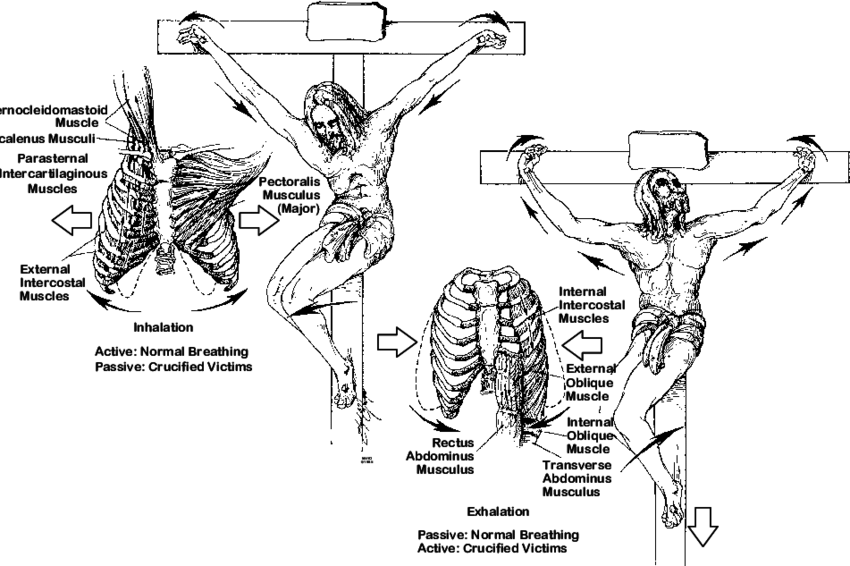
Both Matthew and Mark relate that Yeshua spoke in a ‘great voice’ twice: 1) when “He cried out, ‘Eli, Eli, lemah shavaqtani/My God, My God, why have you forsaken Me?’” Matthew 27:46; Mark 15:34 and, 2) [when] “He breathed His last, He again cried out with|let out a great voice|sound.”Matthew 27:50; Mark 15:37 For his part, Luke records that only, [when] “having cried out in a great voice, Yeshua said, ‘Father, into Your hands I commend My spirit.’ Having said this, He breathed His last.” Luke 23:46
I would suggest that Matthew, Mark, and Luke wrote euphemistically of Yeshua ‘crying out with/letting out/calling out with a great voice’ (ανεβοησεν-κραξας/εβοησεν-αφεις/φωνησας | anehvoyisen-kraxas/evoyisen-afees/fovisas respectively) when actually He roared. A case in point is John, who in his Revelation, chap. 10, relates that “another strong angel…cried out with a great voice/εκραξεν φωνηι μεγαληι like the lion roars (ωσπερ λεων μυκαται),” uses the same phrase ‘a great [translated into English as ‘loud’] voice’ as do Matthew, Mark, and Luke, while John, in the Revelation passage, accentuates exactly how it is to be understood.
Mark relates that the centurion marveled [probably ‘quaking in his sandals’ would be a more accurate depiction of his reaction] and exclaimed that “surely this man was the Son of God”; the curtain separating the Holy of Holies from the Holy Place torn top-to-bottom; the earth quaked [i.e., an earthquake, the only indication as to its Richter scale reading being that] the rocks [πετραι/petray|הַסְלָעִים (haselayim) which could also easily be הַצוּרִים (hatzurim) > all three meaning ‘large standalones’ such as boulders or a cliff] cleaving/breaking apart/exploding; graves opening and “the bodies of many of the saints who had been sleeping were raised…” Matthew writes that “the centurion and those with him who were guarding Yeshua, seeing the earthquake and the [other] happenings feared greatly, saying, “Truly this was God’s Son.” These occurrences were definitely supernatural in their own right; however, I would offer that it was the roar of הָבֶן אֶלֹהִים/ha ben Elohim/The Son of God that effected those supernatural events. The impact on the centurion of the power displayed by Yeshua in the throes of death, witnessed by him firsthand, would undoubtedly remain with him, and, just as the one insurrectionist [he was much more than a ‘thief’; cf. Subject: Regarding Sunday to be “the Lord’s Day,” i.e., the Day on which Jesus Rose from the Grave at https://thedragonisslain.wordpress.com/wp-admin/post.php?post=114&action=edit for a discussion of the word John applies not only to Barabbas but to the two criminals who were crucified with Yeshua], who was being crucified with him, confessed his faith in Yeshua; the centurion also believed as he confessed that this was indeed “θεου υιος”/Theou Yios/God’s Son. This display of power was the last evidence of Yeshua’s being Who He claimed to be that the pagan world would receive. Just as the two angels had told the disciples that Yeshua would “come in the same way you have seen him go into heaven,” as for the pagan world, He also left as He would return – as the Lion of Judah.
As we leave the past behind and look to the future return of Yeshua, it is to the Apostle John, whose writings – more than those of all the other writers of the New Testament – point to His divine character, that we turn to put the nature of that return in perspective. With this in mind, Who is the angel John describes in Revelation 10?
1 Και ειδον αλλον αγγελον ισχυρον καταβαινοντα εκ του ουρανου, περιβεβλημενον νεφελην, και η ιρις επι την κεφαλην αυτου, και το προσωπον αυτου ως ο ηλιος, και οι ποδες αυτου ως στυλοι πυρος, 2 και εχων εν τη χειρι αυτου βιβλαριδιον ηνεωγμενον. Και εθηκεν τον ποδα αυτου τον δεξιον επι της θαλασσης, τον δε ευωνυμον επι της γης, 3 και εκραξεν φωνηι μεγαληι ωσπερ λεων μυκαται. … 5 Και ο αγγελος ον ειδον εστωτα επι της θαλασσης και επι της γης ‘ηρεν την χειρα αυτου την δεξιαν εις τον ουρανον 6 και ωμοσεν εν τωι ζωντι εις τους αιωνας’ verses 5-6 are indicated in the Greek text to be a quote from Deut. 32:40+; Daniel 12:7 των αιωνων, ος εκτισεν τον ουρανον και τα εν αυτωι και την γην και τα εν αυτηι και την θαλασσαν και τα εν αυτηι, οτι χρονος ουκετι εσται, 7 αλλ’ εν ταις ημεραις της φωνης του εβδομου αγγελου, οταν μελληι σαλπιζειν, και ετελεσθη το μυστηριον του θεου, ως ευηγγελισεν τους εαυτου δουλους τους προφητας.
1 “And I saw another strong angel, descending from Heaven, having around about him a cloud, and the rainbow upon his head, and his face like the sun, and his legs like pillars of fire, 2 and having in his hand a small book that was opened. And he placed his right foot upon the sea, and the left upon the land 3 and he cried out with a great voice just as a lion roars. … 5 And the angel whom I saw standing upon the sea and upon the earth ‘raised his right hand to Heaven 6 and swore by the One living forever’ Deut.32:40+; Daniel 12:7 and ever, who created the heaven/sky and the things in it and the earth and the things in it and the sea and the things in it, that there will no longer be time, 7 but in those days of the voice of the seventh angel, whenever he sounds the trumpet, and the mystery of God fulfilled, as He had his servants the prophets proclaim the good news.”
Although John’s description of this angel has led to different opinions as to his identity, I believe that what John sees could be called a future theophany of Yeshua as John had never witnessed Him, even on the Mount of Transfiguration. We are not to forget that the Greek word angelos/αγγελος, just as the Hebrew word mal’akh/מלאך, means not only ‘angel’ but also ‘messenger.’ The appearance of this angel or messenger is reminiscent of Yahwah’s constant presence with His people Israel as they marched from Egypt toward the Promised Land of Canaan, a cloud by day, pillar of fire by night; while the rainbow was Yahwah’s promise to not destroy the earth by flood again. Here, in Revelation 10, John identifies the One by Whom the ‘angel’ swears, as the One Who lives and created [everything that is]. John, in his eponymous gospel, attributed this same statement regarding the created order to the Word, Which, of course, is the Second Person of the Trinity, Yeshua. i.e., I believe that John is cryptically giving us all the information we need to realize that this ‘angel’/messenger is in fact the Risen Lion of Judah Who can swear by no one else but Himself (a paraphrase of Hebrews 6:13).
At the end of time, the defeat of Satan and his minions as well as the introduction of the new heaven and the new earth will be introduced by the roars of the victorious Lion of Judah.
Rev. 11:15 informs that ‘with a great voice,’ i.e. roar, the seventh angel declares, “The kingdom of this world has become that of our Lord and of His Christ and He will rule forever and ever;”
Rev. 14 describes the roars that will occur when the hour of Elohim’s judgment has come, with this announcement itself being a roar. v7 Another roar follows announcing the punishment of all those who have worshipped the beast, to be tortured in the [lake of] fire and brimstone “before the holy angels and before the Lamb forever and ever.” v9-10 Next, the harvest of the earth comes as an angel roars to the “One like a son of man sitting upon the cloud, having a golden crown upon His head and in His hand a sharp sickle” to “send Your sickle and reap, for the hour has come to reap, because the harvest of the earth is ripe.” He does so, and “the earth has been harvested.” v14-16 There is much to be considered here regarding the Eternal Father’s retribution on the world that He created (cf. Jeremiah 25:30-31. Planned is a future post looking further into this cotext as was prophesied by Jeremiah). Let it suffice here, that under the influence of the “prince of the power of the air” (i.e., Satan) Ephesians 2:2, the world rebelled against His gracious gift in the Person of His Eternal Son. It is the latter, “One like the Son of Man,” Who sends forth His sickle to harvest the earth, by the means of which all the wicked will reap what they have sown, an eternal existence apart from the Triune God.
Rev. 18 Another angel, whose glory illuminates the earth, roars (shouts in a strong voice) that “Babylon the great has fallen.” vv1-2 At the same time, John hears another voice, [calling out], “Come out, my people, from her (i.e., the great Babylon), in order that you not be complicit in her sins, and from her plagues, in order that you not experience [them].” v4 On the other hand, seeing the smoke of [Babylon] burning, “kings of the earth, who have worshipped her idols [while] living in luxury, cry and wail in mourning.” v9 Making special mention of those who sail the seas in search of the world’s riches, John decries the businessmen, merchants, and tradesmen who are likewise appalled at their livelihoods’ destruction because all the goods and merchandise that had made them rich no longer exist. Incriminating Babylon as the source, John faults them, the ‘movers and shakers’ of the earth [i.e., world society], with using her [black] magic/sorcery to deceive the nations. [φαρμακεια/pharmakeia, from which English gets ‘pharmacy,’ etc.; in NT Greek, means ‘drugs’, ‘poisoning’; in a spiritual sense, connotes the seductions of idolatry Thayer’s Greek-English Lexicon. Given the state of today’s world, the meaning of ‘drugs’, specifically illicit drugs, but not to rule out the use of prescription narcotics, is apropos. As for ‘poisoning,’ what percentage of the world’s population has poisoned their minds and bodies with the excessive use of alcohol.] vv15-23
Rev. 19 As John winds down his sweeping revelation of Yahwah’s eternal plan to destroy the world that the Morning Star turned Adversary manipulated to turn against its Creator; to create a new world without the limitations of the old and the influence of Satan, whom Yahwah will have banished to eternal torture in the lake of fire and brimstone, together with those who worshipped him; and, to save a people to enjoy eternal life with their Redeemer, Melech Yeshua, in this new world; he shares with us six final roars. First is the roar of “a tremendously great multitude in heaven,” calling out to praise “our God’s salvation and glory and power, because His judgments [on Babylon for] corrupting the world with its idols and vindicating the blood of His servants are true and just.” vv1-2 The second roar is again that of a “great multitude, like the sound of many waters and of loud thunder [as those saved] out of her hand” proclaim the establishment of the kingdom “of our Lord God the Almighty” (Yahwah Eloheynu, Elohey Tsavaoth/יהוה אֱלֹהֵינוּ אֱלֹהֵי צְבָאוֹת) and “the marriage of the Lamb and His bride.” vv2,6-7 The third roar is that of “an angel shouting in a great voice,” inviting “all the birds…of the air” to feast and gorge themselves on the flesh of all those slain by the ‘The Rider on the White Horse,’ “Whose name is The Word of God [and] The King of Kings and Lord of Lords.” vv16-17 The Triune God in the Person of the Lion of Judah has exacted the last full measure of the wrath of Almighty God.
Rev. 16 The fourth roar is from the [heavenly] temple ordering the seven angels to “go and pour out the seven bowls of the wrath of God on the earth.” In verse 17, is heard the fifth roar when the eighth angel has emptied his bowl, “It is done.” And despite the cacophonous and dreadful orchestration of His power that Yahwah Elohim will perform, composed of lightening, thunderous noises, and a great earthquake, the likes of which no man had ever experienced; but it was the huge hail, weighing approximately 65 lbs, that led those upon whom it fell to blaspheme Him.
Rev. 21 Here the new heaven and new earth make their appearance together with the “new, holy city Jerusalem” as a sixth roar comes from the Throne, on which sits [our Salvation Yeshua | יֵשַׁע יֵשׁוּעַ, Who is both the Lion of Judah and the Lamb slaughtered], “Behold the Tabernacle of God with men, and He will dwell with them, and they will be His people and He, God, will be with them/and He will be their God.” [cf. https://wordpress.com/post/the-dragon-is-slain.com/1091 The Hebrew Radical ‘Sook’ (שך/סך) as It Relates to the Birth of Yeshua (ישוע). He then declares, “Behold, I am making all things new…These words are faithful and true. I am the Alpha and the Omega, the Beginning and the End…The one who is victorious will inherit these things and I will be God to him and he will be a son to me.” vv1-7
I invite you to identify with the victorious eternal Son, “Who learned obedience through the things that He suffered.” Hebrews 5:8 In the preceding verse, the writer tells us that “in the days of His flesh He offered up entreaties and supplications with [roars of] wailing and tears to the One being able to save Him from death…” v7a [Cf. Ps. 38:9, specifically, and the entire Psalm for context. David, in this Messianic Psalm, through his own grief, foretells the agony – here conflated- the Lion of Judah suffered at the hands of evil men in the days leading up to as well as on the day of His crucifixion. In the New Testament, we are witnesses together with Peter, James and John to the fulfillment of a portion of David’s prophecy in the Mt. of Olives’ Garden of Gethsemane, when we hear Yeshua tell them, “The pain My soul is experiencing is so great as to be in the throes of death” Matthew 26:36-39; Mark 14:32-36; Luke 22:41. How is it that the three disciples heard Yeshua’s prayer pleading with the Father? While Matthew says that Yeshua went a little ways off, it is Luke, the doctor, trained to be attentive to detail, who tells us via what must have been a first-hand source, that Yeshua “distanced himself approximately a stone’s throw from them, and kneeling, prayed, “Father, if You will [it], take this cup from Me. Nevertheless, not My will, but let Yours be done.” Luke 22:41-42 It is also Luke who notes, according to some manuscripts*, that an angel appeared to Him from heaven strengthening Him. And being in agony, He was praying more fervently and His sweat became as it were large, thick drops of blood dropping onto the ground.” Luke 22:43-44* As an aside: Whichever of the three disciples provided these details to Luke, and to Matthew, for that matter, he had to have been awake long enough to hear the first of Yeshua’s prayers, which, from a stone’s throw’s distance, maybe approximately 50 yards, meant that it was indeed loud; that he was able to see the physical manifestation of His agony points to the size of the drops of sweat that appeared to be blood.] “…and He was heard because He relied on God the Father/אֶלֹהִים הָאָב to calm His fear.” v7b “And having become perfect He is the Source of eternal salvation for all who obey Him.” v9
We have the example of the Victorious, Eternal Son, Who demonstrated what it means to learn obedience to the One Who has called us, even in the face of death. Let us be those who will join with the Lion of Judah when He roars in victory at the end of time by persevering in the faith through obedience to Him.
 The Dragon is Slain
Leave a reply to Flint aka Rocky and the Rock: Peter and Yeshua – The Dragon is Slain Cancel reply