Originally, this post was intended to be a succinct examination of Yeshua’s exchange with Simon Peter, according to Matthew’s gospel in chapter 16 verse 18, “And I say to you that you are Peter, and on this rock I will build my ekklesia, and the gates of Hell will not prevail against it.” However, no statement should be taken in isolation; so, while a look at this verse will serve as the springboard for this post, it has morphed far beyond that into an examination of Peter’s life as seen through the eyes of Matthew, Mark, Luke, John, Paul, and Peter himself.
An examination of Matthew 16:18 necessitates considering the surrounding cotext, which, in my analysis, drives the actual meaning of v18. Yeshua initiates the conversation by asking the 12, “But you who do you say me to be?v15 And Simon Peter said, You are the Christ [the Messiah/haMoshiach הַמָּשִׁיחַ ] the Son of the Living God.v16 And answering [Yeshua] Jesus said to him, Blessed are you, Simon Bar-Jonah, because flesh and blood did not reveal [this] to you, but My Father in heaven.v17 And I say to you that you are Flint/Rocky, but on this Rock I will build my community/assembly/congregation (εκκλησια< קָהָל qahal) [cf. https://the-dragon-is-slain.com/2022/06/11/theoretical-reconstruction-of-the-derivation-of-the-conceptual-word-church/], and the gates of Hell will not prevail against it.”v18
In the Greek of the New Testament, Koine Greek, the first portion reads as follows: καγω δε σοι λεγω οτι συ ει Πετρος, και επι ταυτηι τηι πετραι οικοδομησω μου την εκκλησιαν…v18a It is well-established that the Gospel of Matthew was written for a Jewish audience, which obviously would have included the Jewish religious leaders who had conspired and accomplished the Messiah’s execution. In fact, it is possible that the writer had intentionally directed his book toward the latter. I therefore suggest that the Gospel of Matthew was originally written in Hebrew and/or Aramaic and only later translated into Greek.
In line with this reasoning is the rather crucial point to make concerning my translation of Matthew 16:18 to replace the conjunction ‘and’ with ‘but,’ which is not the quantum leap that some might think it to be. In Hebrew, one conjunction, ‘waw’~ו, serves as both the coordinating conjunction joining similar ideas, ‘and,’ as well as that joining contrasting ideas, the latter, in Hebrew, said to be the adversative conjunction, ‘but.’ I would suggest that the latter is the the proper reading of the verse in question. This means dispensing with the underlying pseudo-theological claim of a ‘papacy’ having the final word on all things ecclesiastical, which, of course, is the whole reason that this verse has generated so much contention as well as confusion.
Using this proposition as a baseline, let’s consider the verse posited on an underlying Hebrew original text. First, we will use John 1:42 as the true representation of the nickname Yeshua assigned Simon Bar-Jonah, the nickname that Paul was also fond of applying to Peter – Cephas (a transliteration of the Koine Greek Κηφας of the Aramaic k’aefah/כֵּיפָא rock, stone < Hebrew כֵף rock and taken directly into English from Latin.) Second, to understand the not-so-apparent dichotomy that Yeshua has introduced in His brief, yet pregnant with promise declaration, it is imperative to acquaint oneself with the Hebrew references in the Old Testament to God’s being The Rock. By doing so, we find that ‘kaef’ כֵף is only used twice in the Bible, in Job 30:6 and Jeremiah 4:29, both times in the plural indicating large rocks, situated individually, in piles, or as outcroppings, in some instances being equivalent to ‘eben’ אֶבֶן ‘stone’; not, however, to a monolith that can serve as a foundation upon which to build a structure, or as a fortress/refuge such as is the case with ‘tzur’ צוּר or ‘sela’ סֶלַע , to both of which Yahwah Elohim is compared.
This dichotomy is unfortunately lost in the Greek, and later, Latin translations of the New Testament, with reference to the verse under examination. That is why it is of utmost importance to remove ourselves from that milieu and be transported back to the Palestine of the first 30 or so years of the 1st century A.D. when the local Jewish population most likely would have conversed among itself in Hebrew or perhaps Aramaic. Greek would only have been used as a lingua franca in conducting business with the non-Jewish population.
The Bible holds clues regarding the languages used at the time of Yeshua’s ministry and beyond. As others have noted, the sign that was placed on the cross on which Yeshua was hanged with the statement, “Iisous the Nazarene, the king of the Jews, was written in Hebrew, Latin and Greek.” I disagree with reputable scholars who translate ‘Evraisti’ as Aramaic rather than Hebrew. Granted, it may not have been the Hebrew of the Old Testament – after all, languages evolve, mutating over time under the influence of other cultures’ languages – but I would argue that while the everyday vocabulary may have changed through borrowings, it retained its basic grammatical structure, so that the language of the Tanakh (the acronym used to refer to the Hebrew Bible, which consists of the Torah/Law, the Nevi’im/Prophets and the Ketuvim/Writings) continued to be used for worship and religious teaching and discourse.
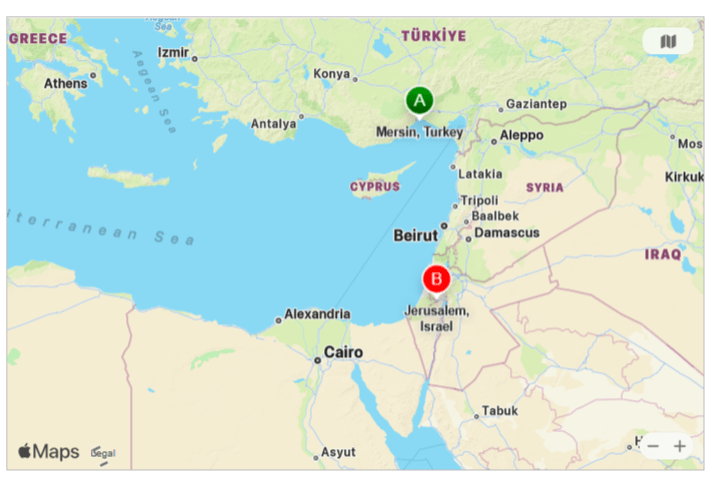
Let’s take a look at other instances in the New Testament where the terms ‘Evrais,’ ‘the Hebrew language,’ and ‘Evraisti‘ – ‘in Hebrew’ – are mentioned, respectively. Luke, in his history of the early ekklesia in the Acts of the Apostles, relates to us Paul’s speaking to a crowd in Jerusalem “in the Hebrew language/tongue ~ τηι Εβραιδι διαλεκτωι.” What is interesting linguistically and culturally concerning this text is that the Roman Legion commander, from whom Paul requested permission to speak to the crowd, was surprised that Paul spoke Greek, the language in which he addressed the commander. Acts 21:40 This tells me that he had not expected Paul to communicate with him in Greek, but rather in the ‘Hebrew language/tongue,’ which in turn intimates that the common language of the Jews residing in 50/60 A.D. Palestine, was Hebrew. Naturally, Paul, being born in Tarsus (present-day Mersin, Türkiye, located on the northeastern shore of the Mediterranean Sea) within a thriving Jewish community, in which Hebrew would have, at the very least, been employed in religious study, would have brushed shoulders with Greek and Latin speakers, and so was most likely conversant in all three languages. It would also seem, given the prevalence of Aramaic throughout the East Mediterranean, Paul was probably proficient in it as well.
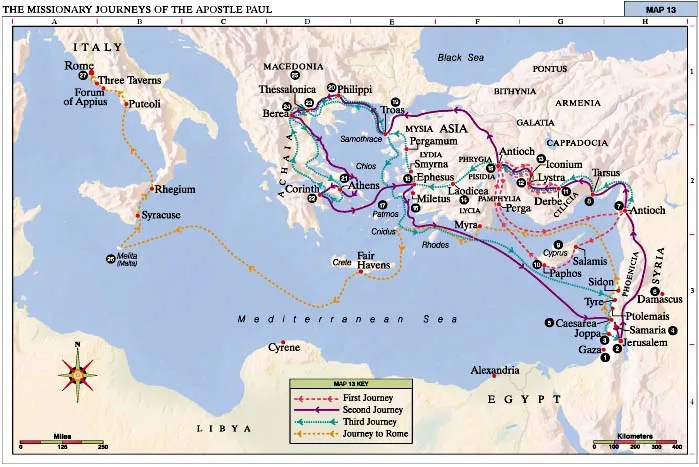
An event of even greater linguistic significance occurred when Paul, at the time still known as Saul, a “zealot of God,” met the Risen Savior on the road to Damascus. Testifying to King Agrippa of his conversion, Paul relates that the call Yeshua put on his life had been delivered in the Hebrew language/tongue[!] Acts 26:14 [Comment: The Greek word from which the English word, ‘dialect,’ is derived, in Koine/NT Greek meant ‘language’ (Thayer’s Greek-English Lexicon of the New Testament) . Thus, it violates the text to translate the phrase any other way than as it has been rendered here. To translate it as ‘Aramaic’ is to allow unwarranted extra-biblical influences to drive one’s understanding of the text.]
However, this does not mean that Yeshua did not at times speak in Aramaic, to whit, on the cross when He cried out “Eli, Eli, lema shavaqtani|שְׁבַקְתָּנִי rather than in the original Hebrew as found in Psalm 22:1 Eli, Eli, lahmah azavtahni|עֲזַבְתָּנִי My God, My God, why have You forsaken Me?” Could it be that by employing Aramaic, Yeshua was demonstrating linguistically that Yahwah Elohim’s plan of redemption would not be defined by a pagan ruler, whose hardened heart could only ridicule the Son of God by declaring Him in jest to be “The King of the Jews,” taking a swipe at the Jewish leaders by posting his placard in Hebrew; in Latin, since it was the language of the Roman administrative powers; and in Greek, since it was a much-used common language among the non-Jewish community as well as a lingua franca among the various ethnic communities occupying the region? By translating into Aramaic David’s lament in Hebrew to Elohim, the greater Jewish community, more versed in the former than the latter language, would have been familiar with it, and together with the religious hierarchy would have been convicted that This One was the “Son of David,” yet Whom, He had exegeted from Psalm 110 (cf. Matthew 22:41-46), David had called “my Lord” and Whom Yahwah had instructed to “sit at My right hand… .” Yeshua, from the Cross, was once again witnessing to his deity to those to whom He had come, but who had not received Him. Their guilt was now manifested to be without excuse.
Now, let’s start examining the initial thesis that there is more behind Matthew 16:18 than meets the eye in the text that has come down to us in Koine Greek. I do not consider it “cheating,” as someone has quipped, to strive to pursue uncovering the autograph which is represented in the infallible and inerrant Word of God as we now possess it. In fact, it is incumbent upon the evangelical Body of Christ to expound as emphatically as possible to the Roman Catholic ecclesiastical behemoth and to the indifferent ecclesiastical conglomeration of mainline Protestant denominations that the claim that Peter is the rock upon which the ‘Church’ is built is an egregious act of sophism. A non sequitur interpretation sine pari of the phrase “You are Peter and on this rock…” is the syllogism which engendered the claim of a ‘papal supremacy,’ seated in Rome, governing the one true ‘Church.’
Perhaps a good starting point, then, would be to pick up Peter’s trail in Joppa and his meeting the Roman centurion, Cornelius, in Caesarea. (For the locations, see map #2 above). But before doing so, a short backstory is in order, as follows:
*Philip preached the Gospel as far as Caesarea.Acts 8:40
*When Hellenists attempted to kill (in today’s vernacular ‘to take out’ ~ αναιρεω) Paul (at this time still ‘Saul’), the brothers took him to Caesarea from where he was sent to Tarsus.Acts 9:30 Luke explains that the ekklesia throughout all of Judah and Galilee and Samaria had peace, being built and walking in the fear of the Lord and was being filled by means of the calling of the Holy Spirit.Acts 9:31
* It is at this point that Luke, the writer of Acts, turns his attention from Saul/Paul to Peter, telling us that Peter had been traveling from congregation to congregation, had arrived in Lydda and visited the saints there. Having an eye for detail, Luke informs that not only those living in Lydda, but also those living in the Sharon, who had “turned to the Lord,” saw Peter. The Sharon – as the word in Hebrew ~ הַשָׁרוֹן, meaning ‘straight,’ indicates – was “a level region extending from Caesarea of Palestine as far as Joppa, a distance of approximately 30 miles. The inhabitants were mostly Greek, with Caesarea serving as the residence of the Roman procurators.”(Thayer’s Greek-English Lexicon)
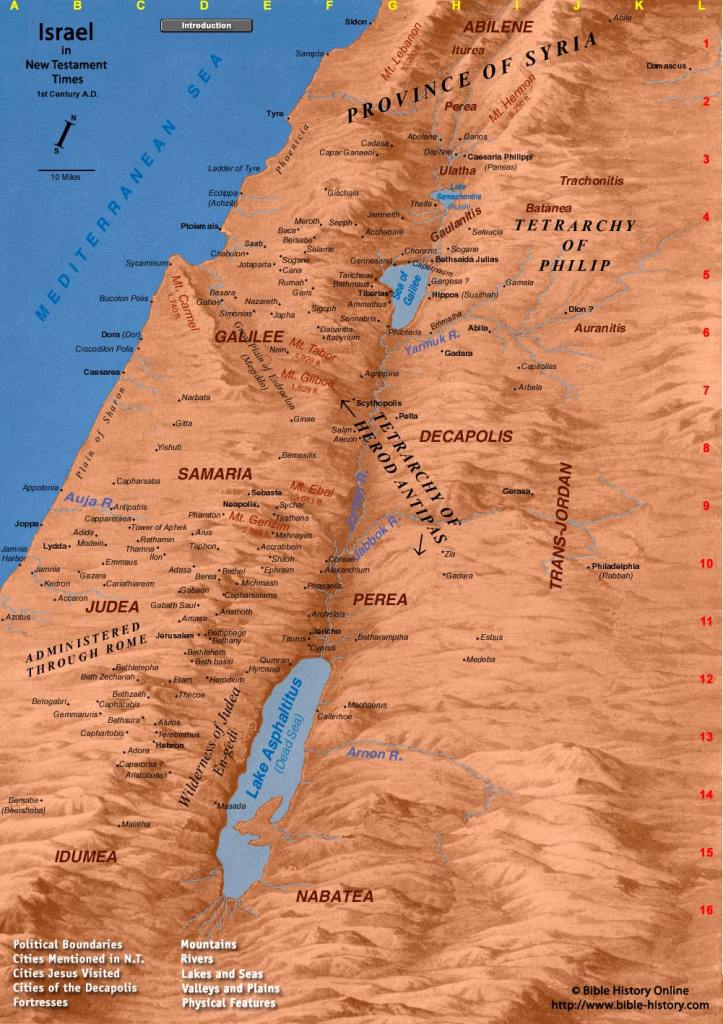
Courtesy of https://www.free-bible.com/geography/ancient-israel/israel-first-century.php.
*As for Cornelius, even though he was attached as a centurion to the Italian cohort in Caesarea, possibly in a peacekeeping role in volatile Palestine, he had gained a reputation as a pious, God-fearing man, who was generous in his beneficence to the people and continually seeking after God.Acts 10:1-2 Referring back to Luke’s parenthetical observation that the assembly of believers in Yeshua was alive and well and flourishing throughout Palestine when Peter preached the Gospel to Cornelius in Caesarea begs the question, why had Cornelius gravitated toward Judaism rather than the local body of Christ that surely existed in Caesarea – was it a ‘closed society’ distrustful of the Romans?
It is now time to start our examination of the life of Peter. We will begin with his sojourn in Joppa, where he went at the behest of the congregation there when they heard that Peter was in Lydda and that while there he had healed a certain Aeneas, who had been paralyzed for eight years. Two disciples were sent to accompany Peter to Joppa so that he might heal Tabitha aka Dorcas, a woman who excelled in good works and benevolences, but who had died before he arrived.
What happened next should remind us of a similar situation, in which Peter, James and John were together with Yeshua when He had healed the ruler of the synagogue, Jairus’s 12-year old daughter. Then a witness of Yeshua’s power over death as He ordered the young girl to ‘rise’ (or in today’s vernacular ‘get up’) – “Talitha koum,”Mark 5:35-43 now he, Peter, would be used to bring back to life Tabitha with the same phrase, ‘Tabitha koum.” [Comment: Mark, who relied on Peter’s reminiscences for his gospel, quotes Yeshua as using Aramaic, the verb of the phrase, for the benefit of the Greek readership, he translates with the Greek verb ‘eyeire’|’εγειρε.’ Luke, on the other hand, has Peter telling Tabitha to ‘arise’/’get up’ in Greek, using a different verb, anistimi|ανιστημι, a synonym for ‘eyeire.’ There is therefore a high probability that Peter used the same Aramaic phrase, especially given that Tabitha is an Aramaic personal name, which would indicate Aramaic as being the preferred language of daily conversation. There are interesting tidbits concerning the name Tabitha that I hope to address in another post.]
We are told that as a result of this [miracle], “many turned to the LORD,” with Peter remaining in Joppa for some time afterward. I might suggest that the Christian community in Joppa may have needed a further infusion of the new life they had found in Christ. On the one hand, Peter’s proximity enabled them to witness one of their own being brought back to life, which would certainly have reinvigorated their faith; while, on the other hand, Peter’s staying in the city would have provided the congregation the opportunity to hear teaching from the very mouth of one of Yeshua’s apostles.
The crux of Peter’s ministry as relates to the ‘binding and loosing’ issue is to be found in Luke’s account of Peter’s being called to preach the gospel to Cornelius.Acts 10 There was no ‘rule of primacy’ standard established when Yeshua gave this directive to Peter personally in the 2nd person singular ~ ‘you.’Matthew 16:19 Yeshua issued the same directive, but in a more explanatory fashion, to the disciples, i.e., including Peter, when He appeared to them after He rose from the dead and at which time He [filled] them with the Holy Spirit, telling them that “just as the Father sent Me, so I am sending you.” Based on the biblical truth that only God has the power to forgive sin only for those who believe in the efficacious, redemptive power of the Blood of the Son, it cannot be that the Son was giving that power to Peter or to the disciples en masse. The implication is clear that the disciples, now apostles ~ those sent|απεσταλμενοι/apestalmenoi, Yeshua is sending to preach this gospel of salvation; the elect will believe and their sins released, i.e. forgiven, while the remaining unregenerate will not believe, thus their sins being bound, i.e., unforgiven.
It does appear, however, that this man, Peter, as hard as flint, who went by the moniker of Rocky, had been appointed to bring the redemptive story of Yeshua haMoshiach to the Gentiles. This, of course, was accomplished through Yahwah’s two-fold plan of having an angel appear to Cornelius with the order to send men to Joppa to bring “Simon who is called Rocky” back with them, while preparing Peter’s heart through a vision to receive these Gentiles whom he had previously considered unclean and to accompany them to Cornelius’ home in Caesarea.
After hearing Cornelius’ explanation, why he had been brought to Caesarea, and recalling his own experience of the vision, Peter exalts Yeshua as being the LORD (Yahwah) of all, through Whom God/Elohim sent “the word” ~ ton logon|τον λογον to the sons of Israel, glad tiding peace through Jesus Christ|Yeshua haMoshiach – this One is LORD of all – you know, the word ~ to rima|το ρημα which appeared throughout all of Judah, which began from the Galilee after the baptism that John [the Baptist] preached, Jesus from Nazareth, as God anointed Him with (literally, by means of) the Holy Spirit and power, He passed through doing good and healing all those oppressed by the devil, because God was with Him. Acts 10:36-38
This portion of scripture requires being dissected, because it seems to me the syntax offers various interpretations. In the sentence “Ο θεος … τον λογον απεστειλεν … ευαγγελιζομενος ειρηνην δια Ιησου Χριστου,” does ευαγγελιζομενος ~ glad tiding refer to Ο θεος ~ God OR τον λογον?
As I read it, Peter intends to equate ‘ton logon’|τον λογον with ‘to rima’|το ρημα, in both cases pointing to Iisous as the Word, but using them with differing connotations. Peter may have preceded the Apostle John with his identification of Yeshua as the preexistent Logos, “Who became flesh and dwelt among us,”John 1:14 when he tells Cornelius that “[God] sent the [W]ord to the sons of Israel…through Jesus Christ,” i.e., that He was the eternal Son and promised Messiah, of Whom Cornelius would have been aware from his study of the Tanakh [assumed]. I take this to be the first reason Peter says ‘you know.’
Peter is also sure that Cornelius knows that “the word|rima appeared throughout Judea…Jesus from Nazareth.” I have conflated these two truncated clausesvv37-38 to show the direct objects governed by the verb ‘you know.’ Although this sentence was far from concisely constructed, Luke purposely arranged it in such a way as to tie together what appear to be disparate phrases with the verb phrase ‘you know:’ the [W]ord|τον λογον, the [W]ord|το ρημα (a neuter noun looks the same in both the nominative and accusative cases; here, it is in the accusative case as the direct object of the verb οιδατε ~ you know), and Yeshua|Ιησουν τον απο Ναζαρεθ.
In order to adequately examine the second word used by Peter for the [W]ord – το ρημα [Comment: My exegesis of this passage has brought me to the conclusion that ρημα is to be understood as a further description of τον λογον Iisous Christos] – it behooves us to consider the Septuagint’s (LXX) translation of Psalm 19, in which David exclaims that the heavens declare the glory of God. Twice the LXX glosses a Hebrew word – once ‘omer’|אֹמֶר ~ ‘word/saying/discourse’ = ρημα and once davarim|דְּבָרִים ~ words/speech = ρηματα (pl.) as David argues that there is a silent witness to the glory of God, using the various words indicating verbal communication figuratively. Rather than by means of verbal proclamation, all of creation communicates God’s glory.
But, beginning at verse 8, the Psalmist turns his attention to the literal words of Yahwah, as he praises His torah, testimony, precepts, commandment, and judgments. His experience has shown that in observing them there is great reward. He ends his adulation of Yahwah’s unspoken and spoken [W]ord by praying that “the words (‘omer’|אֹמֶר)of my mouth and the meditation of my heart be acceptable before You, Yahwah, my Rock|צוּר~tzur and my Redeemer.” David also, following the precedent set by the figurative and literal words that he has recognized to bring glory to God, desires that his words, both spoken and unspoken (i.e., the meditation of his heart) glorify God.
This is exactly the point that Peter is making to Cornelius. The preexistent Word|ο λογος became human as the Word in the flesh|το ρημα in Iisous Christos ~ Iisous from Nazareth, bringing glory to Yahwah, His Father, by the good works and healings He performed, in the same way as the heavens silently glorified God.
There is one more observation that I would like to make regarding Peter’s mention that Yeshua’s ministry throughout the region of the Galilee “began after the baptism which John preached.” There is a temptation to bifurcate John the Baptist’s ministry from that of Jesus, since the one preceded the other, which is linguistically correct. And yes, John the Baptist was continuing the practice of the Old Testament prophets to call for Israel to repent. Still, I would propose that there is a sense in which Jesus’ ministry began with the baptism of John, as follows: Paul met with ‘certain’ disciples in Ephesus, whom he asked if they had received the Holy Spirit when they believed. They responded that they knew no such Holy Spirit, but had been baptized ‘into’ the baptism of John. Paul explained, “John baptized a baptism of repentance, telling the people they should believe in the One coming after him, that is, Iisous.”Acts 19:2-4
In other words, what was happening “from the Galilee” had begun with John’s baptism as he made the people aware of the need to repent, the true expression of which would be to believe in Yeshua, Whom John preceded to pave the way and to plow up the fallow soil of the law’s legalism. The one cannot be separated from the other. The two messages overlapped and dovetailed, just as Peter explained that Yeshua is the Messiah|םוֹשִׁחַ Moshiach, “Whom God anointed (which is the meaning of the Hebrew and the Greek Χριστος~Christos – The Anointed One) with the Holy Spirit (הַרוּחַ הַקֹּדֶשׁ haruch haqodesh) and power [Comment: The NT Greek word δυναμις|dynamis (think ‘dynamite’) is the gloss for the Hebrew/Jewish Aramaic-Galilean traditionKoehler&Baumgartner, The Hebrew and Aramaic Lexicon of the Old Testament word it is assumed Peter used – gevurah~גְבוּרָה = inherent power, strength/heroism/God’s power. It is used in both the contemporary Hebrew translation in the contemporary Russian-Hebrew side-by-side translation and the Delitzsch translation of the New Testament] which He demonstrated “by good works and healing all those being oppressed by the devil, that God was with Him.”
Peter establishes his bona fides as an apostle: he witnessed all that Yeshua did both in the land of the Jews, i.e., Judea, and in Jerusalem [Comment: perhaps alluding to throwing the money changers out of the temple; the Transfiguration; His teaching during the Feast of Tabernacles; the Crucifixion; and, Passover]; the One they hanged on a tree, God raised on the third day and gave Him to become manifest, i.e., caused Him to be seen – not by all the people, rather to witnesses chosen beforehand by God, us, those who ate and drank with Him after His resurrection from the dead. He had commanded ‘us’ to proclaim/preach to the people (i.e., Israel) and He is the One designated by Elohim to be judge of the living and the dead.Acts 10:39-42
Peter presents the gospel as he again appeals to the Old Testament [for Cornelius’ benefit] that all the prophets witnessed to this, to receive forgiveness of sins through His Name, each one who believes in Him.v43
The Holy Spirit רוּח הַקֹּדֶשׁ then fell on those “who heard the word.”v44 [Comment: The theological position that I take is: this was needed as visible evidence to the Jewish Christians, and in particular, to the apostles, that Elohim had indeed called the Gentiles to faith and thereby into fellowship with them. The same is true wherever this phenomenon occurred in Acts, as the Body of Christ – Assembly/Congregation (ekklesia) of believers was being established. This does not teach a doctrine of a ‘second blessing’ or a special filling of the Holy Spirit. This doctrine has also been erroneously taught from a faulty, uninformed reading of Ephesians 1:13 based on the King James Version’s translation – “…after that ye believed, you were sealed with the Holy Spirit of promise.”
Of the first instance are those preachers who base their teaching/exposition on the 16th century English text (after all, that’s the language the Apostle Paul used, right?!) Wrong! The Greek&Hebrew scholars who translated the Greek New Testament into English in the 16th century, among whom was William Tyndale, certainly understood that the Greek construction did not express a sequential process, but one of simultaneity. Let’s examine the construction: pisteusantes esfragisthiteπιστευσαντες εσφραγισθητε is an aorist participle indicating an action in the past followed by an aorist passive, indicating the same. One of the best ways to translate the aorist participle is to use the adverb ‘when’ to modify the verb ‘believed,’ i.e., “when [you] believed -> you were sealed.” The two aorist verbals, next to each other give the sound of a double-barreled shotgun, bam-bam! Believed-sealed! Over & done!
In fact, I would conjecture that the 16th century time expression ‘after that…verb-ed’ meant ‘when.’ Even more telling is that those who promote the ‘second blessing’ theology are committing heresy as well as blasphemy against the very Holy Spirit they claim to adore. They are denying the work of the Holy Spirit to regenerate the hardened heart to believe, by which belief we are justified through the righteousness of Christ alone. I.e., it is at the moment of regeneration that the Holy Spirit indwells the new believer and seals him/her as the “down payment of our inheritance, preserving our redemption [my translation] to the praise of His glory.”v14 We are more and more ‘filled’ with the Holy Spirit as we allow Him to work through His inspired Word for our sanctification, becoming more and more like our Savior Yeshua haMoshiach and evidencing the fruit of the Spirit: love, joy, peace, patience, kindness, goodness, faithfulness, gentleness, self-control.
This is one perspective on what Paul in Ephesians 4:5 means by “one Lord, one faith, one baptism,” that this baptism is the indwelling of the Holy Spirit that occurs at the moment of regeneration. The other perspective understands this baptism as that which is administered with water to those who profess faith in Yeshua haMoshiach. Water baptism for the true believer is the sign both of the indwelling of the Holy SpiritActs 10:47 and of identifying with the Messiah in His death, burial and resurrection to newness of life.Romans 6:4 ]
Continuing our examination of the life of Peter, earlier in Acts 10 we learn that he observed the Law, having always obeyed the dietary dictates.v14 This he repeats while reporting to the apostles in Jerusalem who had confronted him about his contact with Gentiles.Acts 11
Herod attacks the ekklesia, putting James the brother of John to death by the sword and, to further please the Jews, arrested Peter and threw him in jail with the intent to turn him over to the people after Passover. The ekklesia began praying. An angel of the LORD|αγγελος κυριου~angelos kyriou|מַלְאַךְ יהוה malak YHWH leads him out of jail. Peter goes to the house of Mary, the mother of John nicknamed Mark.Acts 12
At a gathering of the apostles and elders in Jerusalem, Peter argues against the Judaizers, testifying that God gave ‘them’ (the Gentiles) the Holy Spirit “just as He did us and made no distinction/discrimination between us and them, cleansing their hearts by faith. So why are you testing God, to place a yoke upon the neck of the disciples that neither our fathers nor we were able to bear? But by the grace of Adonai Yeshua~kyrios Iisous we believe they are saved in the same way.”Acts 15:6ff [Comment: Here Peter shows strength of character and power of conviction to stand up to the Judaizers who were insisting that the believing Gentiles be circumcised.]
Peter had introduced the above presentation with an interesting statement: “You established that from former days among you (OR among us) God chose through my mouth [for] the Gentiles to hear the word of the good news and to believe.”v8
James draws his response, not only to Peter’s testimony regarding the Gentiles, but to that of Barnabas and Paul of the “signs and wonders [awesome deeds] God had done among the Gentiles through them”v12 from Amos 9:11-12 which ties Yahwah’s reestablishing the Davidic dynasty to the rest of mankind seeking out Yahwah, specifically all the nations upon whom He has invoked His Name. James therefore focused his ruling, not on the fact that Peter had been chosen to present the Gospel to the Gentiles first, but that from the first, i.e., from the very beginning, Yahwah~Kyrios had placed His Name upon all the nations.
The Apostle Paul expands this thought in Romans 9:23ff, where, before actually quoting the two passages, he exposits Hosea 2:23 and Hosea 1:10: “…and in order that He might make known the riches of His glory upon vessels of mercy, which He prepared beforehand for glory, whom He also called not only us from the Jews but also from the Gentiles, as He says in Hosea, ‘I will call the not My people (lo-ammi~לֹא־עַמּי|ou laos mou~ου λαος μου), My people ((ammi~עַמּי|laos mou~λαος μου); and the one not loved (lo ruhamah~לֹא רֻחָמָה|ou agapimeni~ου αγαπημενη), loved (ruhamah~רֻחָמָה|agapimeni~αγαπημενη)Hosea 2:23 and in place of which it was said to them ‘you are not My people, there they will be called sons of the Living God.”Hosea 1:10 Paul continues, quoting Isaiah: “And Isaiah cries out concerning Israel, ‘Even if the number of the sons of Israel are as the sand of the sea, the remnant will be saved… .’”Isaiah 10:20-22 What is of interest is that Paul rearranges the Old Testament prophecies and applies what are obviously references to the remnant of the sons of Israel to the Gentiles, within the context of which he changes the verb ‘will return’ to ‘will be saved.’
Without examining his exegesis further, from what we can gather thus far is that Paul, on the basis of what he has witnessed concerning ‘the signs and wonders that God did among the Gentiles through them,’ extrapolates from the Isaiah 10:20-22 passage that together with the remnant of Jacob [that] will return will be included Gentiles, who “did not pursue righteousness, but nevertheless attain righteousness through faith.”Romans 9:30
Peter echos Paul’s application of the Hosea passages, but cites (after a fashion) Hosea 1:6,8. Perhaps to be noted is that both Paul and Peter apparently referred to the LXX translation of these passages, which glossed the same Hebrew verb used in both passages – raham – with the verb’s meaning of ‘being shown mercy/pitied’ in chapter 1, but ‘loved’ in chapter 2. Paul chose the chapter 2 gloss ‘loved,’ while Peter used ‘being shown mercy/pitied.’
Now once again to return to tracing Peter’s steps by starting at the beginning of the Book of Acts, where it appears that, aside from Cornelius sending men to find Simon nicknamed Peter, Peter no longer goes by his given name, Simon, but is referred to as Peter, i.e., Cephas~Rocky, the nickname Yeshua had given him.John 1:42
Acts 1:15-26 Peter takes charge of a meeting back in Jerusalem some days after a prayer meeting, present at which were the [eleven apostles] together with “women and Mary (Mariam), the mother of Yeshua, and His brothers praying together with one mind.” The purpose of Peter’s talk, given to “the brothers (there was also a crowd present of around 120),” [whom he addressed as men (and) brothers] was to choose a man to replace Judas Iscariot. It is to be noted that Peter promotes this charge scripturally. First, he identifies Judas Iscariot’s betrayal of Yeshua to have been the fulfillment of the scripture which the Holy Spirit foretold through the mouth of David concerning Judas, who served as the guide for those seizing Jesus.Psalm 41:9 Next, he acknowledges that Judas was numbered among ‘us’ (i.e., the inner circle of the Twelve) and “allotted his portion of this ministry.” [Comment: This phraseology seems strange as a way of referring to the calling by Yeshua of one of the Twelve. It is almost as if Peter was equating Judas Iscariot’s inclusion the same as that of Matthias, to whom the lot fell to take the former’s place among the Twelve. According to Mark 3:13-15,19, Judas Iscariot was tacked on at the end of the names of the Twelve.] “And they gave lots to them (i.e., Joseph who was called Barsavvas (son of Savvas, who was nicknamed Justus) and the lot fell on Matthias.”Acts 1:26
Peter’s exegesis and application of passages of scripture to support this action are worth spending time on. As noted above, Peter understood the Holy Spirit, through David, to have foretold Judas Iscariot’s betrayal of Yeshua, when David, in Psalm 41:9 writes, “Even the man of my peace | in whom I trusted, the one who ate my bread has lifted his heel against me.” Of course, the Holy Spirit brought this verse to mind and revealed this application of it to Peter; however, did his exegesis of this verse stem from the Passover meal Yeshua shared with the Twelve on the night He was betrayed? Was the interaction still in his mind’s eye and were Yeshua’s words still ringing in his ears as recorded by Mark, “Indeed I say to you that one of you will betray Me, the one who eats with Me.” [Comment: This quote is emboldened in the Greek New Testament to indicate a quote from the Old Testament and footnoted as Psalm 41:9, with only Mark including this quote as having been spoken by Yeshua.Mark 14:18 Matthew, on the other hand, alone has Yeshua confirming that “the one dipping his hand in the bowl with Me, that one will betray Me,” as Judas Iscariot also inquires of Him, “Surely it’s not me, teacher?” To which Yeshua replies, “You said [it].”Matthew 26:23-25 ]
Remembering that Yeshua had posed two questions to the disciples, a) “who do men say that I am?” and b) “who do you say that I am?,” to the second, Peter had responded, “You are the Christ, the Son of the Living God [Comment: Peter’s response would have been in Aramaic/Hebrew, an approximation of which would have been אַתָּה חַמָשִׁיחַ בֶּן־אֱלֹהִים חַיִּים~Attah haMoshiach Ben-Elohim Hayyim.] It can be assumed that all of them, with perhaps the exception of Judas Iscariot, had come to that conclusion; Peter was merely serving as their spokesman.
It can also be imagined that just as two of the disciples who were approached and accompanied by Yeshua on their way to Emmaus, noticed “how their heart burned within them as He opened the Scriptures to us,”Luke 24:32 with one being told earlier in this passage that “beginning from Moses and from all the prophets He interpreted for them in all the scriptures those things concerning Himself,”Luke 24:27 this necessarily had also been the experience of the Twelve during the past three years.
Thus, in further consideration of Yeshua’s betrayal by Judas Iscariot, Peter could quote, after a fashion, i.e., with some textual liberties, Psalm 68/69:25/26: “Let his dwelling be empty and let there not be one who inhabits it.” ~ Γενηθητω η επαυλις αυτου ερμος και μη εστω ο κατοικων εν αυτηι|May his dwelling be desolate and may there be no inhabitant in it (Peter’s version found in Acts 1:20); Γενηθητω η επαυλις αυτων ηρημωμενη, και εν τοις σκηνωμασιν αυτων μη εστω ο κατοικων|May their dwelling be desolate and may there be no inhabitant in their tents (LXX translation of Psalm 68/69:25/26); תְּהִי־טִירָתָם נְשַׁמָּה בְּאָהֳלֵיהֶֹם אַל־יְהִי יֹשֵׁב׃|Their encampment protected by a stone wall will become desolate [and] there will be no one dwelling in their tents (The original Hebrew on which the LXX translation is based, my translation.)
Although not carrying theological significance per se, both the LXX and Peter equated the Hebrew word tirah~טִירה – an [enclosed] stone wall – to a dwelling – epaulis~επαυλις. Peter, though, singularizes the owner – a deviation from both the Hebrew and LXX, a technique he further applies as he drops the phrase “their tents” altogether, thus tying the “dwelling” to the singularized owner.
Peter quotes this verse after giving a synopsis of the last days of Judas Iscariot, from the day that he served as the guide for those who arrested Yeshua to the day that he *hanged* himself at the property he had acquired with [a portion] of the thirty pieces of silver, which had been the high priests’ remuneration for his treachery. Peter intimates that this property had been left vacant, being called the Field of Blood, not so much because the field was bought with blood money but because Judas Iscariot had polluted it with his entrails after [falling] headlong and bursting asunder.
*Matthew, in his Gospel, gives more detail regarding the last actions of Judas Iscariot, spurred by (probably Peter’s account) of having witnessed Yeshua’s interrogation by the high priest, who subsequently demanded the death penalty, and His being led away by the high priests and elders to turn Him over to Pilate the governor. Matthew then proceeds to tell us that [Judas Iscariot], regretting what he had done, returned the 30 pieces of silver to the high priests and elders, saying, “I sinned, betraying innocent blood.” His attempt to redeem himself was met callously by the high priests and elders with the retort, “What is that to us; it’s your concern.” Matthew continues his narration, “And throwing the silver into the temple, he left and went and hanged himself.”Matthew 27:3-10
[Comment: At this point, although not indicated in the Greek New Testament to be the fulfillment of an Old Testament prototype, Thayer’s Greek-English Lexicon, under the word used by Matthew ‘to hang oneself’, apigksato~απηγξατο (3rd person singular, middle voice of apagxo) references 2 Samuel 17:23 as a companion verse, where Ahithophel ends his life by hanging himself. It is Ahithophel, whom David was describing in Psalm 41:9, his close friend and trusted counselor, with whom he broke bread, who betrayed him in favor of David’s son Absalom.]
Is there a way to compare Judas Iscariot’s betrayal with Peter’s denial of Yeshua? It can be said that both disciples turned their backs on their ‘rabbi’ – as the former had greeted Yeshua – and, as Peter had confessed, on the Messiah, the Son of the Living God. Words matter, meaning that when Matthew informs us that Judas Iscariot, ‘regretting/feeling remorse (metamelitheis~μεταμεληθεις), returned the 30 pieces of silver…”throwing the silver into the temple he left and having gone away, he hanged himself.” He did not repent in line with the New Testament teaching of actively changing one’s mindset, abandoning the old nature and entering a new life, turned around by faith in Yeshua haMoshiach, all of which is contained in the Greek word ‘metanoia’~μετανοια.
Peter, on the other hand, is said to have “cried bitterly” when, having just completed his third denial, the rooster crowed and he remembered Yeshua’s forewarning to that effect. [Comment: The Amplified Bible exposits in brackets ‘in repentance,’ which is certainly an acceptable emendation to the text. There are many of us who, without realizing that we were doing so, followed Peter’s example when the Holy Spirit called us to faith and we cried out in repentance, asking for forgiveness, shedding tears in the process.]
We must understand the case of Judas Iscariot to be one of those described in Hebrews 6:4-5, who had been enlightened, tasted of the heavenly gift and shared in the Holy Spirit and tasted the goodness of God’s Word and the powers of the coming age, but who fell away. He experienced these spiritual benefits as one of the Twelve, but never realized them experientially for himself; the Holy Spirit never enabled him to inculcate these free gifts into his life.
Now, returning to Peter’s address to the 120, the second injunction he draws from the Old Testament is “Let another take his office.”Psalm 109/108:8 The entire verse reads, “May his days be short and another occupy his place.” In this Psalm, David personalizes in an individualized manner his imprecations on his enemies. Peter isolates the second half of verse 8 as pertaining to Judas Iscariot and then proceeds to list the requirements of the one to replace him, with the one to do so to be determined by lot. The successor was to have been with the Twelve the whole time of Yeshua’s ministry among them “beginning from the baptism of John until the day of His being taken up from us” and to have been a witness of His resurrection with the Twelve.
It is incumbent upon me at this point to compare the initial time element in Acts 1:22 with that in Acts 10:37, with both verses serving as the bookend delineating the beginning of Yeshua’s ministry. In both instances, it is Peter who establishes it. As we have stipulated above, the time of Yeshua’s ministry, according to Acts 10:37, began from (apo~απο) the baptism of John, which some commentators understand to be Yeshua’s being baptized by John. However, is it not true that Yeshua was beginning His teaching ministry at the same time that John the Baptist was preaching repentance? In fact, some of John’s disciples left him to follow Yeshua; as John stated, “He must increase, but I must decrease.” This is why I insist, given Peter ‘s dual perspective of Yeshua’s beginning His ministry from the baptism of JohnActs 1:22, then, afterActs 10:37 that in a very real sense, both were concomitantly preaching a message of repentance. The two messages overlapped and dovetailed, just as the message of the Old Testament dovetails with that of the New Testament.
So, the question has to be raised – was Peter guided by the Holy Spirit when he called for the place vacated by Judas Iscariot to be filled? It seems that this was yet another instance of Peter jumping the gun and not waiting for God to act. Of course, it is not to say that just because we hear nothing more about Matthias that he did not have some input into the ministry of the apostles. But it is clear from scripture that Yahwah Yeshua had chosen Saul/Paul to fulfill the ministry of a ‘latter-day’ apostle as described by Paul himself as he was on his way to Damascus, at which time the risen Christ appeared to him. The verse comes to mind, “For My thoughts are not your thoughts and your ways are not my ways, declares Yahwah.”Isaiah 55:8
When examining the New Testament writers’ use of the LXX, in addition to referring not only to the LXX, but also to the Old Testament passage(s) being “quoted,” not to be overlooked is the apparatus, which notates other renditions of the passage(s) under consideration.
Such is the case when studying “Peter’s Speech at Pentecost”the title given to Acts 2:14-40 in the UBS Greek NT During his speech, he refers to several Old Testament prophetic scriptures which he interprets to have been fulfilled at that time. First, Peter ‘quotes’ the Old Testament prophet Joel in the context of explaining the fact that he and the other apostles were speaking in languages other than their own in order that the various language groups or dialects represented might hear the Gospel in them as the pouring out of the Holy Spirit both on the speakers and on the hearers. For Peter, this prophecy was fulfilled on that Pentecost. His extra-scriptural addition of the specifying time element in verse 17, ‘in the last days,’ anticipates the similar time element ‘in those days’ in verse 18, both of which point to the pouring out of the Holy Spirit, on whom Peter would naturally include himself as well as the other apostles and disciples (“sons and daughters…My male and female servants.”) Here it must be noted that the apparatus allows for a minority reading of “these days,” which I would suggest was the interpretation that Peter could easily give to this passage. Verses 19-20 (Joel 2:30-32) are more difficult to see from Peter’s perspective, especially v32, of which he quotes the first stanza according to the LXX, but completely ignores the second. The first stanza places the onus on the one whom Yahwah will deliver, those who call on Him; the second stanza, in the Hebrew, is joined to the first with the conjunction ‘kee’~כִי/’for,’ ‘because,’ meaning that the second is an expansion of the first, i.e., for on Mt. Zion and in Jerusalem there will be a remnant as Yahwah said, among those left whom Yahwah calls.” Peter, by disregarding the qualifying 2nd stanza, applied a distant future prophecy [Comment: Contrary to the full preterists’ view that this prophecy was fulfilled in 70 A.D.] to one that was being fulfilled as he spoke. There exists within the canon of Biblical interpretation the concept of near-term vs far-term fulfillment of prophecy. This rule can very easily and in all good conscience be applied here. There is no need to question whether Peter did violence to the text through his application, especially when allowing that the Bible as given by the Holy Spirit is the inspired, inerrant and infallible Word of God. Therefore, it was the Holy Spirit Who directed Peter to use these verses as he did.
Now let’s examine vv19-20, noticing that Peter relates the phrase “And I will give wonders in the heaven [above] and [signs] on the earth [below], blood and fire and columns of smoke” to Yeshua, “Whom Yahwah attested for you by means of powers and wonders and signs, which Yahwah did through Him among you” with the greatest proof being that Yahwah raised Him from the dead. Nor is it out of the realm of possibility that the phenomena as quoted by Peter, described by Joel as happening “before the great day of the Lord coming [and would appear]”Joel 2:31, also occurred at the Crucifixion. We are told that there was darkness over the land from noon to 3 P.M as the sun turned to darkness, while concerning the blood, fire and smoke, the description of events that occurred during the Crucifixion have all the markings of an earthquake [Comment: Please cf. my post https://the-dragon-is-slain.com/2024/12/03/the-roar-of-war-the-roar-of-death-and-the-roar-of-victory-the-eternal-sons-roar-was-heard-once-and-will-be-heard-once-more-are-you-ready/]: the blood, fire and smoke could be a description of a volcano, with the ‘blood’ being symbolic language for lava. The last phrase, “before the great day of the Lord,” is the one that indicates that there will also be a far-term fulfillment. Everything else could have been fulfilled in the near-term.
As a result of Peter’s message, during which he gave proofs from scripture that Yeshua was indeed the Messiah, spoken of by David as quoted by PeterActs 2:34-36, 3,000 souls were added [to the fledgling body of believers], those who had repented of their sins and been baptized, those whom the Lord God will call.
Next, in Acts 3, we see Peter, accompanied by John, invoking the name of Yeshua haMoshiach of Nazareth to heal the man lame from birth, who was begging at the gate of the Temple called Beautiful. The instantaneous and miraculous nature of the healing – the crowd witnessing a man who had never been able to walk suddenly leaping as he praised God – served as another opportunity to preach the Gospel to his fellow Israelites, calling them to repentance. As he had done during his sermon at Pentecost, Peter upbraided them and rebuked in the harshest terms as he reminded them that they had been guilty of handing over the [Son] of God and denying Him to Pilate, who wanted to release Him. “You denied the Holy and Righteous [One] and requested a murderer to be pardoned, but the Ruler of Life you killed.” Peter pulled no punches in his scathing indictment of their actions.
Luke, as the author of the Book of Acts, further develops the significance of the healing of the lame man:
- The priests, the captain of the Temple Guard and the Sadducees, becoming upset at Peter’s and John’s teaching the people and proclaiming Yeshua to have been resurrected from the dead, arrested them and had them imprisoned overnight.
- Many of those hearing the word believed, the number of men being about five thousand.
- The rulers, elders and scribes came together in Jerusalem to inquire of Peter and John by what power or in what name did they [heal the lame man].
- The Holy Spirit filled Peter, thus emboldening him to accuse them of carrying out an inquisition (anakrinometha~ανακρινομεθα) of them for having done a good deed for a sick man by which he had been made whole [Comment: The present perfect passive sesostai~σεσωσται implies spiritual salvation as well as physical healing.]
- Peter proclaims that this deed was done in the name of Yeshua haMoshiach of Nazareth, Whom he accuses them of crucifying and by Whom “this one stands before you healthy,” in that Elohim raised Him from the dead.
- Peter rubs salt in the wound by quoting Psalm 118:22, applying it to those whom he was addressing: “The stone which was rejected by [you] the builders, He has become the Corner Stone.”
The rulers were impressed by the boldness with which Peter and John spoke, since they were illiterate and unlearned men, yet having recognized them as having been with Yeshua. Nor could they deny the healing of the man, who was standing with them, since the miracle was known by all the inhabitants of Jerusalem. So, in order to stem its being spread about any further, they ordered Peter and John to cease preaching and teaching in the name of Yeshua.
Luke then informs us that both Peter and John responded with the well-known rejoinder, “You judge, whether it is right before Elohim to obey you or Elohim, for we are unable to not speak the things we have seen and heard.” As for those who had warned them to cease and desist, they were unable to find how to punish them because of the people, many of whom were praising God for what had happened. As Luke the doctor noted, this sign of healing had been done on a man who was more than 40 years old.
Peter and John were not Lone Rangers; after having been released, they reported back “to their own,” who, after hearing [Peter’s and John’s report], prayed for boldness “to speak Your Word.” We are told that “[while] they were praying, the place in which they were gathered shook and all were filled of the Holy Spirit and were speaking the Word of God with boldness.” Their prayer had been answered immediately.
What happened next I have always found troubling, perhaps one reason being that having grown up during the last 40 years of the Soviet Union’s 70-year experiment with Communism, an economic system completely contrary to and at odds with the capitalistic, modified laissez-faire system of governance of the West, under the influence of which I had been raised, it was anathema to me that the early Christians would have felt compelled to introduce such an arbitrary rule for life within the Community. While somewhat of an oversimplification, in the final analysis Communism failed because a top-heavy, oligarchic system of governance, initiated by the Soviet-era nomenclatura, accumulated for itself the country’s wealth at the expense of the people’s welfare. Secondly, because production controlled by the state defeated initiatives based on self-interest. Entrepreneurial incentive being discouraged, along with the concomitant low standard of living, led to the pool of work-age eligible men seeking escape through alcohol, which engendered a multi-generational pandemic of alcoholism. There was no refuge to be had, overtly at least, under an atheistic government, within the Russian Orthodox Church which has always been an arm of the state, and not a source of spiritual strength and encouragement.
Returning to the Acts 4 account entitled in the United Bible Societies Greek New Testament “All Things in Common,” I have tried to insinuate some context into the text in the following ways: At this point, the early Body of Christ/ekklesia consisted strictly of Jewish believers; anecdotally it seems that the Jews have always maintained a close-knit community. This tendency can be seen in microcosm in the Fellowship of the Twelve, concerning whom we are told that the group kept a common money sack, from which Judas Iscariot pilfered. Remembering the calling of the Twelve, the two most prominent, Peter and John, were fishermen together with their brothers, Andrew and James, respectively. There is a high probability that the brothers, together with their fathers, were partners, which would require sharing all things connected with their enterprise, from equipment to profits. After Yeshua was crucified, the Eleven, with the exception of Thomas, were together with the door locked for fear of the Jews. Again, eight days later, the disciples were inside [Comment: ‘inside’ in Greek eso~εσω : Paul, in I Corinthians 5:12, uses the expression ‘e eso~οι εσω,’ i.e., “those who belong to the Christian brotherhoodThayer’s Greek-English Lexicon; this expression reinforces the tightness of the early ekklesia, even among the Gentiles.]
Then John describes for us in vivid detail Yeshua’s appearing to seven of the disciples on the shore of the Sea of Galilee, where He had prepared breakfast for them, while they were out fishing. This was the incident when Yeshua had directed them to throw their net on the right side of the boat and it was filled with 153 large fish. Peter, who had been naked, threw on his fisherman’s garb and jumped into the water. It was Peter who had decided to go fishing, with the others tagging along. Peter was both an impetuous man and one who resorted to what he felt most comfortable doing – being outside engaged in the hard physical labor of fishing. Yeshua honored the disciples’ activity and their desire to be engaged in active and productive labor by rewarding it with an overabundance of large fish – 153 to be exact. Peter himself dragged the net onto the beach.
According to Luke, it was a scenario similar to the one described in the previous paragraph, during which Yeshua had called Simon Peter, Andrew, James, and John. Because the crowd to which He was preaching had begun pressing on Him, Yeshua had gotten into Simon’s boat and asked him to shove off a bit, from where He continued to teach. Luke tells us that afterward, Yeshua told Simon to put out into deep water to let down the nets to fish. Simon did so, but not before protesting that they had labored to exhaustion (kopiasantes~κοπιασαντες) but had caught nothing. Although Andrew is not mentioned, James and John came to Simon’s rescue because he was unable to handle the abundance of the catch. Luke states it was here that Yeshua specifically called Simon to be a ‘catcher’ of men, but James and John also left their boat and followed Him.Luke 5:1-11 Certainly, this incident reverberated in Peter’s mind upon hearing the post-resurrection Yeshua instructing them to throw the net on the right side of the boat and the ensuing catch. All things were becoming new!
Once the disciples landed their catch, ensued the most touching, intimate interaction recorded between Yeshua and these seven. Kyrios/Adonai~ Yahwah Yeshua had prepared a bed of coals on which were fish and bread and to which He requested more of the fish “that you just caught” [be added] to the fire. I do not think it is going too far afield to draw a scriptural principle from this simple interchange. We will recall that the disciples had been out on the sea all night, but had caught nothing. Then, on the advice of Yeshua, Who appeared on the shore, they threw their net on the right side of the boat, whence accrued the net full of fish. Yet, Yeshua gave the credit for the catch to the disciples. Here is the principle: The disciples understood that catching the fish had had nothing to do with their prowess and everything to do with the Master’s~Adonai’s work on their behalf, in this instance His power over nature, the world He had created. The physical is always a metaphor for the spiritual. The bottom line is obedience based on the underlying belief that Jesus is the Lord of the universe and trust in His ability to save and to then accomplish His purpose for us, which is always for our good. Philippians 2:13 tells us, “For God is the One Who works in you to will and to work, i.e., to exert effort for [His] good pleasure.” This is preceded in v12 that by obeying we are working out our own salvation with fear and trembling [my paraphrase]. As Romans 8:28 informs, “And we know that [He, i.e., the Holy Spirit (the UBS Greek NT has titled chapter 8 “Life in the Spirit)] works everything together with those who love God for good, with those being called according to His purpose.”
One further application of these three verses is to parse out the correlation between obedience, work and salvation: v12 καθως παντοτε υπηκουσατε|obey μεταφοβου και τρομου την εαυτων σωτηριαν κατεργαζεσθε|work out your own salvation. v13 Θεος γαρ εστιν ο ενεργων|the One working εν υμιν και το θελειν και το ενεργειν|both to want and to do υπερ της ευδοκιας. Rom. 8:28 Οιδαμεν δε οτι τοις αγαπωσιν τον Θεον παντα συνεργει εις αγαθον|for those who love God [He, i.e., the Holy Spirit – my translation based on exegetical context] works everything for good. Therefore, it is not the work per se that saves us, rather it is by obeying that we are working out our salvation. In fact, it is not we at all who can take credit for our work, it is the One Who has called us to obedience Who effects it through the Holy Spirit, Who works with us to accomplish His purpose.
For sure, the miraculous take of fish was not lost on Peter nor the love that Yeshua demonstrated by serving breakfast, with the latter setting the stage for His poignant one-on-one conversation with Peter. Yeshua addresses him as Simon [son of] John, dispensing with the nickname with which He Himself had labeled him. Yeshua was deliberately telling Peter, i.e., Rocky, that he was to disassociate himself from his eponymous character – hard, severe, rough, cutting sharp, just as a stone is thrown, so he willingly threw himself impetuously into the fray – because He was reaffirming the calling to the man he had been at the first, a simple fisherman who had responded to the call of the Man Whom he later proclaimed to be “The Christ the Son of the Living God.” Yeshua had responded, “Blessed are you, Simon son of John.”
Gone is the baggage Peter had been carrying with him, beginning with his being rebuked by Yeshua, Who addressed him as Satan in his attempt to keep the Christ from proceeding to Jerusalem to face deathMatthew 16:23. Just imagine the shock, perhaps even shame of being called the adversary by the Son of the Living God, Whom Peter had just earlier confessed Yeshua to be!
Some time later, the week that Peter had wanted to keep Yeshua from experiencing was upon them. It was at this time, just hours before Yeshua would be arrested, tried, and crucified, that Peter was again rebuked for boasting that should all the others “be offended by” Him that night, he would not be. Yeshua brought him up short by foretelling that before the rooster crowed [the following morning] he will have denied Him three times. Such a condemnation no doubt crushed Peter; this would also be the last consequential interaction He would have with Peter and the other disciples. However, the Shepherd Who would shortly be slain as the Perfect Lamb of God and Whose ‘flock’ would be scatteredZechariah 13:7, would not leave His flock in the lurch, He would not abandon them, reassuring them that He would reunite with them in the Galilee after being raised from the dead.
As the night was deepening with the dawn approaching, Yeshua and the disciples head off to the Garden of Gethsemane, where He would pour out his heart in prayer to be relieved of having “to drink this cup.” He took Peter and the two sons of Zebedee to stay awake with Him while He prayed. As we know well, the three were unable to fulfill His request. They had gone without sleep for close to twenty-four hours, so that when Yeshua returned to them after praying and He found that they had nodded off, it was to Peter, as representing the three, whom He remonstrated for not having the strength [perhaps implying spiritual fortitude – iskhio~ισχυω] to watch with Him one hour. What Yeshua says next explains (at least to me) why Matthew, through the eyes of Peter, has Yeshua directing His remark to Peter to watch and pray in order that you not enter into temptation. As we have noted above, Peter, soon after leaving the Garden, would fall into temptation by denying Him three times.
After His remonstration, Yeshua is presented as setting the stage for what is to follow in a Shakespearean soliloquy off to the side for the three to go ahead and sleep, to rest. “See the hour is at hand/the time is coming and the Son of Man is being delivered/betrayed into the hands of sinners. Get up, let’s go. See, the one betraying Me has arrived.”Matthew 26:45-46 What did Peter then observe? A great crowd from the high priests and elders – the religious hierarchy – armed with swords and clubs; he apparently heard Judas Iscariot tell them “whomever I shall kiss (phileo ~ φιλεω), it’s Him; arrest Him!”; he heard and saw Judas Iscariot greet Yeshua, “Greetings, Teacher/Master ~ shalom, rabbi” and then kissed (tenderly|katefilisen ~ κατεφιλησεν), thus accomplishing the purpose for which he had come (ef’ o parei ~ εφ’ ο παρει).
When Peter saw Yeshua being arrested, he drew his sword and cut off the right ear of the high priest’s servant, Malkhos, for which Yeshua again reprimanded him. Then He healed Malkhos’ ear.John 18:10
All the other disciples left Him and fled.
But Peter followed at a distance “as far as the courtyard of the high priest, where he entered and sat with the officers of the Sanhedrin (upiretai ~ υπηρεται) to see the end.”Matthew 26:58 From this vantage point, he served as an eyewitness as Caiaphas the High Priest, as chair of the Council of the Sanhedrin, pronounced the death sentence on Yeshua for blasphemy.
Within the context of this passage (Matthew 26:57-68), as stated in the previous sentence, embedded is cotext that breaks loose the torrent of hate, epitomized by the spit of spite. It is a gripping scene. We are told that those representing the high priests as well as the Sanhedrin, in all their efforts to find “false witnesses,” only two showed up. And their accusations were clearly off the mark. This forced the high priest himself, after trying to manipulate a response worthy of the death penalty, the verdict he had already determined to pronounce, in a fit of frustration, to get at the crux of his inquisition, the answer to which he already knew, but whose heart Satan surely had seared and hardened: “I charge you/Swear by the Living God (kata tou Theou tou Zontos~κατα του Θεου του Ζωντος|חַיִּים בֵאלֹהִים~baylohim Hayyim) that You tell us whether You are the Christ (Χριστος|הַמָשִׁחַ~HaMoshiach), the Son of God (o yios tou Theou~ο υιος του θεου|בֵן־הָָָָאֱלֹהִים~Ben-haelohim).
As He had done when tempted by Satan in the wilderness, Yeshua answered Caiaphas the High Priest with Scripture. Satan had left Yeshua then until an opportune time;Luke 4:13 now that time had arrived. Yeshua had just finished pleading with His Father that if possible “this cup could pass from Me”; now, in the person of the Jewish High Priest, Satan was presenting to the Son of God the ultimate temptation – to escape death by either denying His Deity, or as Satan had challenged Him in the wilderness, to call the angels to extricate Him.Matthew 4:6 Either of which options would have nullified the covenant Yeshua had made with the Father to be the perfect sacrificial Lamb Who would give His Life for His people, chosen from eternity past, to live with the Triune God and to enjoy Him forever.
So, why did the High Priest tear his robe and charge Yeshua with blasphemy? What was so inflammatory in Yeshua’s response? He had not called Himself “the Son of God,” but rather “the Son of Man.” It was the context drawn from the text of the Scripture that He quoted that incensed Caiaphas. This, of course, means that Caiaphas knew the Scriptures and understood the implications to be drawn from Yeshua’s application of them. According to study bibles, Yeshua’s response was a combination of Psalm 110:1 and Daniel 7:13, as rendered by Matthew: “ap’ arti opsesthe ton yion tou anthropou kathemenon ek deksion tis dynameos kai erkhomenon epi ton nefelon tou ouranou~απ’ αρτι οψεσθε τον υιον του ανθρωπου καθημενον εκ δεξιων της δυναμεως και ερχομενον επι των νεφελων του ουρανου|From now on you will see the Son of Man sitting on the right hand of the Power and coming on the clouds of heaven.”
Caiaphas understood that in Psalm 110, David was uttering a Messianic prophecy viewed from the perspective of Yahwah in heaven in covenantal communication with the Son, i.e., the Son of God. The Daniel 7:13 passage is even more apropos given Yeshua’s application of it, because it is here that ‘one like the son of man’ is directly mentioned as approaching the Ancient of Days, Who gave to Him power, honor and dominion and all peoples, nations and tongues will serve/worship Him. His power is an everlasting power which will not pass away and His dominion which will not be destroyed.” Therefore, by combining these two similar passages, separated by hundreds of years, Yeshua was forcing the Jewish religious authorities to face the fact that as much as they claimed to love Yahwah and the Torah, His written word, they were unwilling to accept the Word, but rather to accuse Him of blasphemy and to call for His crucifixion. All of this a physically, emotionally, and spiritually spent Peter had witnessed, culminating in bitterly lamenting his thrice denying of the One Whom he had assured that he would go to the death with Him.Matthew 26:35
Now we come to a critical point in the narrative. Pilot, following the tradition to release a prisoner during the Passover festival, offered to the crowd to release Yeshua, but being incited by the high priests, it demanded the release of Barabbas, who was being held in connection with murder during an insurrection.Mark 15:7
[Comment: Regarding the release of Barabbas, I disagree with those who see in him the scapegoat released into the wilderness on the Day of Atonement. The Day of Atonement (Yom Kippurim~יוֹם־הַכִּפֻּרִים was a separate festival from that of the Passover/Pesach~פֶּסַח and while there were similarities in the two festivals, it does an injustice to the significance of the Passover to apply to it that of the other festival. There was no longer any need for a representative scapegoat (עַזָאזֵֵל~Azazel) to symbolically take away the sins of the people. Yeshua was not going to the Cross as the counterpart pure goat to the ceremoniously defiled scapegoat. Not at all. After all, Pesach remembers Yahwah’s requirement that in order for the first-born to be spared death, the blood of a perfect lamb had to be smeared on the door post and the angel would ‘pass over’ – pasach~פָּסַח ‘to leap’ or ‘pass over’ or ‘by,’ ‘to spare.’ Yeshua, of Whom John the Baptist exclaimed, “Behold the Lamb of God (o amnos tou Theou~ο αμνος του Θεου), Who takes away the sin of the world,”John 1:29 while Peter (on whom this post is focused, lest we forget) pronounced to fellow Jewish believers of the diaspora, “You have been redeemed…by the precious blood of Christ, as a of a lamb without spot and blemish.” Both the atonement for sin when He took it upon Himself as the Perfect Sacrifice as well as the redemption of all those who believe that His blood is efficacious to cover their sins and therefore escaping eternal death, were accomplished by His death on the Cross. There is, of course, a conflation of the two festivals to the extent that all the festivals have their fulfillment in Yeshua.]
So, what about Barabbas? Once again referring to Matthew’s Gospel, what struck me for the first time when reading his account of the crucifixion was the name ‘Yeshua’/’Jesus’ in brackets preceding the name Barabbas ([Ιησους] Βαραββας~ישׁוּע בַּר־אַבָא|Jesus son of Abba/father, master). The author of the Tyndale New Testament Commentary on the Gospel according to St. Matthew, R.V.G. Tasker, has the following footnote in this regard: “There is good textual evidence in favor of reading ‘Jesus’ before Barabbas in these two verses (16-17) (see RSV margin: Other ancient authorities read Jesus Barabbas); and this is supported by internal evidence, for in verse 17 ‘Jesus Bar-Abbas’ (i.e., ‘son of Abbas’) seems to be contrasted with Jesus which is called Christ. Jesus was a common name, but motives of supposed reverence may well have led later scribes to omit the name of the Savior before the name of the criminal who was released instead of Him.” The NET (New English Translation) translators agree with this assessment, albeit in a more technical explanation.
I would suggest that Barabbas was Satan’s insurance policy against there being any chance the crowd would be swayed in favor of releasing Yeshua. For Satan used Yeshua Barabbas as a counterfeit counterbalance to the True Son of the Father – a designation which the Jewish leaders interpolated based on Yeshua haMoshiach’s statements concerning “My Father,” “I and the Father are One,” and “I am the Son of God, Whom the Father sanctified and sent into the world” – based on his (Barabbas’) first name. Yeshua haMoshiach claimed that His kingdom was not of the world, but that was exactly what the Jewish nation was looking for – the One Who would deliver it from the Roman yoke and establish a latter-day Davidic kingdom. Barabbas had already proven his desire to overthrow the Roman rule through his failed insurrection activity that included murder. This was the Yeshua the Jews wanted released to secure for them a temporal salvation on earth, not the Yeshua Who promised eternal salvation in heaven that was conditioned on believing in Him.
We hear nothing more of Peter until after the Resurrection, with each of the four Gospels differing in their accounts regarding those involved in receiving the news that Yeshua had risen from the dead and was alive. Matthew makes no mention of Peter, instead concentrating on Mary Magdalene and “the other Mary” as being the ones to whom the news was delivered and who were assigned the task of informing the disciples. Mark, on the other hand, singles out Peter for special mention when the angel tells the women “to go tell His disciples and Peter that He is going before you to the Galilee; there you will see Him.”Mark 16:7 And again, in the paragraph containing “A Shorter Ending of Mark,” the first sentence once again centers around Peter – why? “And they reported in brief to those around Peter all that had been commanded.”
It seems appropriate that Mark would single Peter out since Peter was the source of his gospel. And for this reason, it may serve us well to spend some time with Mark.
It is debated whether or not Mark was the first of the four gospels to be written. Is its shorter length an indication to that effect? Or, did Mark cut short his narrative for the specific reason that he had accomplished the purpose for which he had written, with the longer Gospel of Matthew (and possibly Luke) to refer to for a more detailed narrative? It has been said that Mark wrote his gospel for the benefit of the Romans. There are those who base their argument on the fact that it was written in Greek. This may be true; however, the sentence structure is quite in line with that of the Hebrew use of the ‘waw’~ו conjunction to connect sentences, rendered in Mark’s Greek by ‘kai’~και, meaning ‘and.’ This is just one indication that an Hebraic mindset was behind the Greek, perhaps that of Peter. This propensity effects the action-packed style of the book.
This first mention of Simon [Peter] by Mark is in chapter 1:16+, introducing him simply as ‘Simon,’ when Yeshua called the four to “follow Me and I will make you fishers of men’ as they were working at their trade as fishermen on the Sea of Galilee. Later in chapter 1, after leaving the synagogue in Capernaum, Yeshua went to the house of Simon and Andrew with James and John, where Yeshua heals Simon’s mother-in-law of a fever. We are told that “Simon and those with him went in search of Him [for] He had gone out while it was still night to a deserted place to pray.”vv35-36
It appears that Yeshua had set up a base of operations of sorts at the house of Simon’s mother-in-law, seemingly to which He [and the four] returned after having gone throughout the Galilee to the surrounding towns to the synagogues to preach. So, guess to whose house the four men brought the paralytic, the roof of which was dismantled in order to lower him into the presence of Yeshua. I would conjecture that Simon and Andrew’s family was fairly well-to-do, since their house was able to accommodate a large number of people, as well as being respected within their community, since there were some of the Jewish legal scholars “sitting there.”
What we know so far about Simon is that vicariously through his brother, Andrew, who, the Apostle John informs, was a disciple of John the Baptist together with him (if applying the rule that John never identifies himself in his gospel),John 1:35-42 was aware of both John the Baptist’s witness concerning “the One stronger than me coming after me…[Who] will baptize you with the Holy Spirit” and his baptism of Yeshua, which was accompanied by the witnesses from heaven.
Some time after being introduced to Yeshua by Andrew, Simon, together with Andrew and partners, James and John, were called by Yeshua to follow Him. And at that moment, Simon and the others ceased being fishermen on the Sea of Galilee, exchanging that life for one in which they would be engaged in a labor of love, to witness to God’s love through the Messiah, immediately becoming involved in Yeshua’s ministry as He traveled from town to town preaching, teaching and healing. It was during this initial period that Simon first heard Yeshua refer to Himself as “the Son of Man” (ο υιος του ανθρωπου~o yios tou anthropou|בֵן־הָאָדָמ~ben-ha adam, Who had the power not only to heal but also to forgive sins, insinuating that He was indeed God, as the Jewish scholars understood well.
Since this is an in-depth look at Simon Peter as reflected in the New Testament, primarily in Mark, whose only source was Peter, and applying the subsequent analysis to Matthew 16:18, I think it important to note that it is Mark who first identifies Yeshua as being “the Son of God.”Mark 3:11 What struck me is that this specific episode of unclean spirits recognizing Yeshua as the Son of God as He was healing along the shoreline of the Sea of Galilee, is not to be found in the books of Matthew and Luke. On the other hand, all three of the Synoptic Gospels record demons being exorcised by Yeshua at the house of Simon Peter’s mother-in-law crying out, “You are the Son of God” [Comment: the Jewish scholars who were in attendance would have witnessed this]; this was also the confession of the demoniac in the region of the Gadarenes.
Then, in verse 13ff of chapter 3 of Mark, we have Simon Peter’s account, as recorded by Mark, of Yeshua’s calling of the Twelve to be with Him, to send them out to preach and to have power to cast out demons: Simon Peter; the sons of Zebedee, James and John; Andrew and Philip and Bartholomew and Matthew and Thomas and James (literally, ‘Jacob’), son of Alpheus; Judas, son of James (literally, Jacob)~Thaddeus; Simon the Zealot; and, Judas Iscariot.
Just as the brothers, James and John, were nicknamed ‘Sons of Thunder’; Thomas, ‘Twin’; Jude, ‘Thaddeus/Levvaios (possibly meaning, ‘strong of heart, courageous’); Simon, ‘Zealot’; and, *Judas Iscariot*, so Yeshua had pinned the nickname ‘Rocky|Flint’ [~ Peter] on Simon. What we need to remember is that these were young men, probably in their mid- to late twenties, full of strength and dreams, who found themselves living at the most consequential turning point in history. I would suggest that these nicknames reflected their personalities or some distinguishing characteristic, such as Thomas being a twin.
*I have reassessed my previous conclusion that the nickname Iscariot meant “the man|i’sh~אִישְ of Kerioth~קְרִיּוֹת a town in southern Judah. The writers of the four gospels transliterated the Hebrew phrase as Ισκαριοτ. The ‘s’ phoneme ‘sigma|σ’ stands in place of the ‘sh’ phoneme, which Greek does not have. As noted in the paragraph above, and as is generally the case, nicknames are given to accentuate some personal trait or tendency by which an individual is readily identified – sometimes complimentary, sometimes to the contrary. I believe Iscariot falls into the latter category.
So far, in the course of this post, we have noted two things about Judas Iscariot: 1) he pilfered from the common moneybag, which he was in charge of keeping; and, 2) the personal observation that he was the last of the Twelve to be mentioned, as if tacked on at the end, just because, well, he was one of us, after all. However, while the nicknames noted above seem to have been attached to those disciples early on, I would suggest that Judas earned his as a result of his treachery, and therefore it was necessary to distinguish the other Judas from him.cf. John 14:22 The question naturally arises, is there a Hebrew triliteral (a 3-consonant cluster morpheme) describing Judas as being the betrayer of Christ, which would mean fulfilling the requirements of phonetic representation and lexical meaning? Yes, there is! It is the triliteral שָקַר sheqr = to act falsely, lie, deceive [i.e., to betray.] A hypothetical construct state of the noun-noun phrase, meaning ‘man of lies,’ i.e., liar – and by extension, ‘deceiver,’ ‘betrayer’ – אִישׁ שְקָרִיוֹת ~ i’sh sheqarioth. To follow the Greek pattern of joining the two words together, there would be an assimilation of one ‘sh’~שׁ and the probable eliding of the accompanying vowel, so that the outcome would replicate the existing form. A caveat is whether a variant plural ‘-yoth’~יוֹת would have been used by 1st century speakers of Hebrew/Aramaic, which this hypothetical construction would require.
We next hear about Peter from Paul in his letter to the Galatians, in which he refers to Peter by his Aramaic nickname Kifas~Cephas|Κηφας~כֵיףא (Kayfa) saying that he went up to Jerusalem to meet Cephas personally. Then, fourteen years later, Paul again went up to Jerusalem with Barnabas, at which time he met with James (who, we read earlier in chapter 1, was “the brother of the Lord,”) Cephas, and John. In that audience, “the pillars of repute” gave Paul and Barnabas the right hand of fellowship, it being agreed that Paul was to be considered the [apostle] to the Gentiles (literally, ‘the uncircumcision’) and Peter, to the Jews (literally, ‘the circumcised’).Galatians 2:8 Paul also relates in his letter to the Galatians that when he and Cephas were in Antioch, he had opposed Cephas to his face, that he was accused, i.e., “a charge had been laid against him” (Luther’s German translation), that “he had incurred the censure of the Gentile Christians”Thayer’s Greek-English Lexicon-kategnosmenos een~κατεγνωσμενος ην because of his duplicitous behavior.
Paul paints the picture as follows: “Before certain [men] coming from James, he was eating with the Gentiles. But when they had come, he shied away and separated himself, fearing those of the circumcision. The remaining Jews followed suit with him, so that even Barnabas was led away by their hypocrisy. But when I saw that they were not acting in line with the truth of the gospel, I said to Cephas in front of everyone, ‘If you, being a Jew, live as a Gentile not as a Jew, how [can] you compel the Gentiles to be Jews?”Galatians 2:11-14
Paul mentions Cephas in his first letter to the Corinthians as someone whom they apparently held in esteem, perhaps because he as well as Apollos may have preached there at some point prior to Paul’s ministry in that city.
We are finally approaching the conclusion of our study of the man Simon nicknamed Peter – Cephas<Κηφας<כֵיףָא, a man as hard as Flint, but whose life can only be described as Rocky. To say that Rome erred in its interpretation of Matthew 16:18 would be to render a gentle reprimand to what actually is an heretical teaching with the attending charges of blasphemy and apostasy. But this teaching that the “church” is founded on Peter is the tip of the iceberg. Rome claims that faith in the finished work of Christ is not sufficient for salvation. Among the various extra-biblical teachings of the Romish church [Comment: Please cf. my post https://the-dragon-is-slain.com/2022/06/11/theoretical-reconstruction-of-the-derivation-of-the-conceptual-word-church/ in which I argue that only the Romish – and perhaps the Eastern Orthodox – ecclesiastical structures should be called a ‘church’] is the necessity to follow patristic traditions.
Listen to what the Apostle Peter himself says, “And if you call ‘father’ the One Who judges impartially according to the work of each, live the time of your sojourn in fear, knowing that not with corruptible silver or gold you have been redeemed from/out of your futile manner of life handed down by the Fathers [i.e., patristic traditions to include that of indulgences], but with the precious blood of Christ, as of a lamb without spot and blemish.1 Peter 1:17-19 Identifying as “Peter, apostle of Jesus Christ” (Πετρος αποστολος Ιησου Χριστου<Kayfa sheliach Yeshua haMoshiach ~ כֵיףָא שְׁלִִיחַ יֵשׁוּעַ הַַמָשִׁיחַ), he greets his intended readership as the elect who find themselves as a diaspora living in Pontas, Galatia, Cappadocia, Asia, and Bithynia. As suggested in Thayer’s Greek-English Lexicon as well as by Alfred Edersheim in his tome, The Life and Times of Jesus the Messiah, I understand this diaspora to be the actual relocation of Jewish Christians throughout the centuries from ancient Palestine to the regions as diverse as those listed by Peter, not as a metaphor for the time that (mostly Gentile) Christians live in this world.
There are at least three reasons for assuming that Peter had in mind fellow Jewish believers:
1) It was decided at Jerusalem that Peter would be the apostle to the Jews and Paul, to the Gentiles;
2) His mention that his readers had been living their lives in the past according to the traditions handed down by the fathers, obviously meaning the Law (Torah);
3) The number of times in his first letter that he refers to the Old Testament, especially regarding the Christ, Who was rejected by men but was God’s elect. Of special interest is Peter’s interpretation of the Cornerstone described by Isaiah to be Jesus Christ|Yeshua haMoshiach:
The Hebrew text reads: Thus says the Almighty Yahwah, See I have set a stone in Zion, a stone of proof (a touchstone בֹּחַן) of the corner, precious, a foundation that has been laid, the one who believes will not be confounded.
The New Testament Greek reads: See I am placing in Zion a stone, choice/elect cornerstone, precious and the one believing on Him in no way will be ashamed. (Ιδου τιθημαι εν Σιων λιθον εκλεκτον ακρογωνιαιον εντιμον, και ο πιστευων επ’ αυτωι καταισχυνθηι.)
The Septuagint’s (LXX) Greek translation of the Hebrew text reads: See I am laying (literally, ‘casting’) for the foundations of Sion a stone expensive, choice/elect בָחַר cornerstone, precious for its (i.e., Zion’s) foundations and the one believing in no way is ashamed. (Ιδου εγω εμβαλλω εις τα θεμελια Σιων λιθον πολυτελη, εκλεκτον, ακρογωνιαιον, εντιμον, εις τα θεμελια αυτης, και ο πιστευων ου μη καταισχυνθηι.)
There are a couple of problems with the Greek translation of the Hebrew. The first has to do with how the stone is described. Though not word-for-word, Peter is obviously quoting from the LXX when, in his exegesis of Isaiah 28:16, which precedes his quoting the verse, he says that the “stone, on the one hand rejected by man, but with/in the judgment of God chosen/elect (εκλεκτον)…” I consider this translation troublesome. Clearly, the translators of the LXX felt it necessary to make an ’emendation’ to the Isaiah text, with the reasoning that the scribe had miscopied the triliteral בָחַר by replacing the ‘ר’ (‘r’) with ‘ן’ (‘n’). I enclosed ’emendation’ in quotes because, while the LXX translators indeed made a correction to the text, it did not improve it, but in fact distorted the underlying meaning of the text as well as its accompanying implications. True, there is some overlap in the meanings of the two words with the meaning ‘to examine,’ but the underlying meaning of בָחַר ~ bahhar is that of ‘choice,’ ‘chosen/elect,’ whereas that of בָחַן bahhan is ‘tried and tested,’ with the extrapolated meaning of ‘touchstone,’ used for assaying gold and silver. The attending implication is huge, given that Hebrews tells us that this “living Stone”1 Peter 2:4 was tried and tested in the days of His flesh, becoming the Touchstone for the salvation of all who obey Him.Hebrews 5:7-10 (my paraphrase) The question then presents itself – how would Peter have altered his exegesis based on the original reading of the Isaiah passage? Perhaps “choice/elect” are implied, but the true message goes much deeper with greater significance. It speaks to the supremacy of Christ, Who paved the way for His brothers (and sisters) by the things He suffered, but without sin, with His righteousness transferred to us through believing in Him, accepting Him as our Touchstone.
The next contentious issue created by the translators of the LXX concerning the Isaiah 28:16 passage is their replacing the Hebrew triliteral חוּשׁ ~ hoosh = ‘confounded’ with the triliteral בוֹשׁ bosh ‘put to shame.’ Isaiah had presented a conundrum – how could a stone that was rejected by the builders turn out to be the Cornerstone? He then assures those who believe in this Cornerstone that they will not be confounded/perplexed by this apparent discrepancy. There will be no doubt to those who believe that this Cornerstone is also the Touchstone of their faith, while to those who do not believe Peter adds that this Cornerstone has become a stone of stumbling (lithos proskommatos~λιθος προσκομματος|eben negef~אֶבֶן נֶגֶף) and a rock of offense/a stumbling block (petros skandalou~πετρος σκανδαλου|tzur mikshol~צוּר מִכְשׁוֹל).
This brings us to a discussion of these two descriptions of this Cornerstone/Touchstone. Unfortunately, there are English translations that make a distinguishing factor the size of the two obstacles that are the cause for stumbling. In my opinion, this is sloppy exegesis based entirely on assumption and speculation at the expense of ignoring the fact that the Bible is a work of literature, making use of various literary devices to emphasize key sections within a given passage of scripture.
One such device is synonymous parallelism, which is exactly what we find in Isaiah 8:14. It may be a clever expositional tack to differentiate between the little and big things in life that may cause someone to stumble. But this is not the point being made. The two phrases are essentially equivalents. Let’s first look at the verbal nouns proskomma~προσκομμα and skandalon~σκανδαλον, both meaning ‘stumbling block.’ So why would Isaiah use two different words for the objects causing the stumbling? I would suggest that in the case of ‘lithos’ (‘stone’), it is being used in a technical sense, while ‘petros’ (‘rock’) carries theological significance.
As for ‘lithos,’ “ancient cornerstones were not the same as modern western ones. They were the largest and most determinative stone in the foundation of a building. Builders oriented the rest of the foundation in reference to this stone, and it supported the major portion of the superstructure.”Constable’s Notes included as a resource of the NET2 translation at netbible.org. Petra, on the other hand, is the monolithic rock, with which Yahwah is often compared. Also to be taken into consideration is that both of these words are reduced in Aramaic to just one, kayfa, meaning that any distinction in the meaning of the two words, whether λιθος ~ ‘lithos’ ~ אֶבֶן ~ ehvehn (stone) or πετρ(ος/α) ~ ‘petr(os/a) ~ צוּר ~ tzur (rock), is lost.
Therefore, drawing on the information provided in the preceding three paragraphs, I would suggest a double entendre, strictly in the sense of a double/dual meaning, can honestly be extracted from the synonymous parallelism ‘stone OR rock of stumbling.’ There is no reason to attempt to break them apart; in fact, to do so is to disturb, upset, even ruin the theological implications behind this parallelism and the attending double entendre.
It is clear that Peter is not only connecting the stone, etc., of Isaiah 28:16 and Psalm 118:22 with the stone/rock of Isaiah 8:14, but is attributing these material characteristics to Jesus Christ. This is what we might call the first, superficial, obvious meaning. For the second meaning, we must recall that the purpose for this Stone is to establish a foundation and the purpose of a foundation is to provide a sound base upon which a structure is to be erected. Peter has already established that those who believe on it (i.e., Him) “are being built up as living stones [into] a spiritual house for a holy priesthood,”1 Peter 2:5 whom He called ([ο] καλεσα[ς] υμας~[o] kalesa[s] emas). In other words, this spiritual house is the ekklesia, which, together with the Cornerstone itself will be the source of stumbling to the unbelievers! Thus Yeshua, in Matthew 16:18, was not telling Peter that he would be the rock; rather, “on this Rock” – haTzur ~ הָצוּר, on Himself would this edifice be erected.
 The Dragon is Slain
Leave a reply to The Rock: The Ecclesia’s Immovable yet Advancing Foundation – The Dragon is Slain Cancel reply