This post is a follow-up to my post Flint aka Rocky and the Rock: Peter and Yeshua (https://thedragonisslain.wordpress.com/wp-admin/post.php?post=2662&action=edit ), in which I found it necessary to deal with the person of Judas Iscariot as one of the Twelve and as the counterbalance to Peter aka Rocky. Both had been accused by Yeshua, either of being a devil (~ diavolos/διαβολος), referring to Judas Iscariot, into whose heart Satan had entered, John tells us later; 13:2 or of being Satan himself, so Yeshua rebukes Peter. Matthew 16:23 Also, as I mention in the aforementioned post, both denied the Moshia (~ Savior); Judas displayed regret for his treachery, but Peter, true repentance for his thrice denying his Lord (~ Kyrios/Κυριος).
Just recently, a closer reading of the texts containing the mention of ‘Judas Iscariot’ has brought to my attention that I had overlooked three references, of which, frankly, I had never been aware. John, in his gospel, three times mentions that Judas was the son of Simon, apparently to distinguish Judas Iscariot from the other Judas, the son of James (literally, Yaakov ~ Jacob). What is of interest about these particular references is that there is a discrepancy as expressed in the codices – the earliest, extant manuscripts of the now-extinct autographs of the books of the New Testament, on which a given translation is based – as to whether the identifier ‘Iscariot’ refers to Simon or to Judas. This becomes readily apparent, before referring to various translations of the Bible, from the critical/textual apparatus of the United Bible Societies’ (UBS) 2nd edition of the Greek New Testament, found below the text, but above the footnotes, for 6:71, 13:2, 26, which are the verses under consideration. Without delving into its technical nature, this particular critical apparatus indicates the manuscripts that favor ‘Iscariot’ describing Simon vice those that favor Judas.
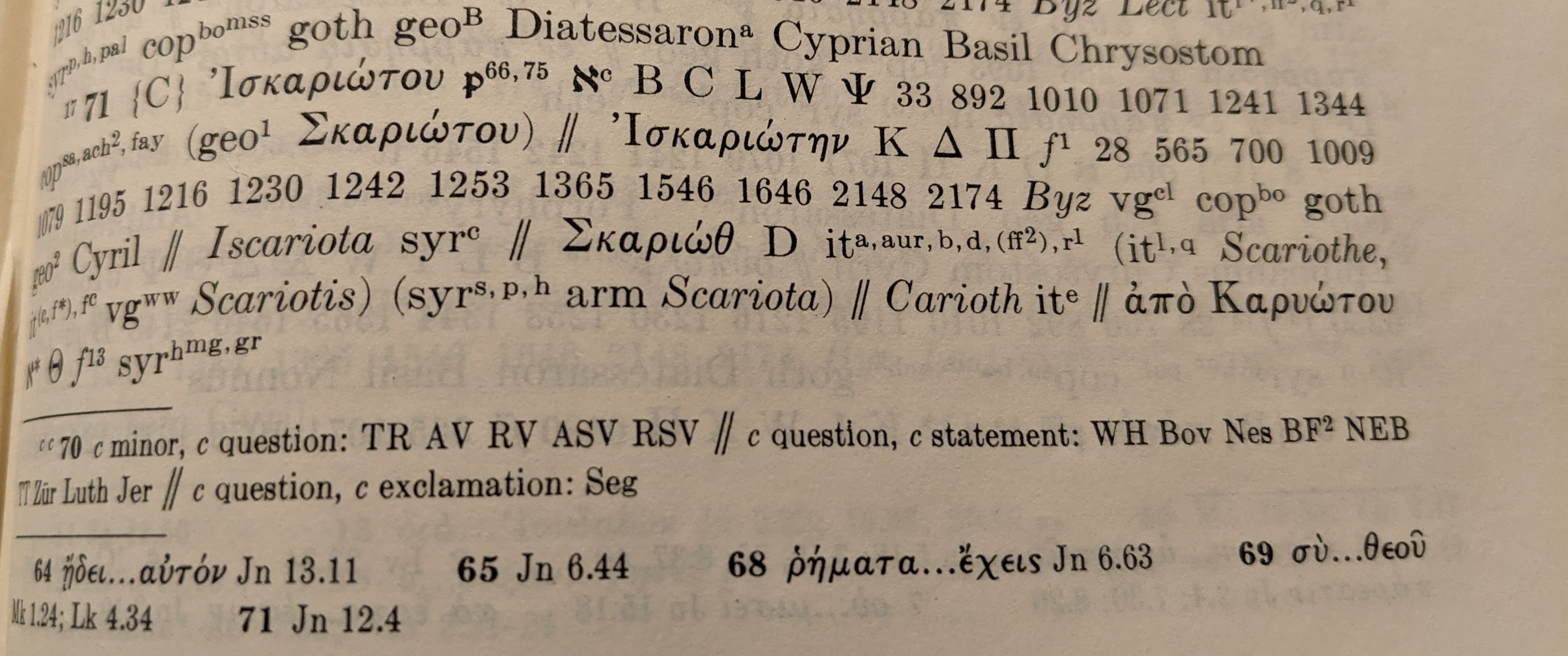
Perhaps the most instructive, and hopefully, most interesting method to explain what I am talking about is to demonstrate by inserting the Greek text chosen by the UBS (assumed to be based on the Westcott & Hort ‘critical text,’ “on the basis of preponderant external evidence” Bruce M. Metzger, A Textual Commentary on the Greek New Testament, p. 215 in reference to John 6:71 ) as well as that of the Byzantine Text Version (BTV), shown in the UBS critical apparatus as an alternative translation. Next are the English translations of what are probably the four most-used translations of the Bible: New American Standard Bible (NASB), New International Version (NIV), English Standard Version (ESV), and the King James Bible (KJB). I am coupling with the KJB the Modern English Version (MEV), because, while both are based on the Textus Receptus [Comment: Most simply put, the Greek New Testament compiled by Erasmus which laid the foundation for William Tyndale’s English translation of the New Testament], the MEV, as its title indicates, is the most modern translation produced in the King James tradition in 30 years, having been begun in 2005 and completed in 2013. https://www.logos.com/product/43990/modern-english-version I am including as well the corresponding texts as translated by Martin Luther, found in the Luther Bible (LB).
Let’s commence with comparing and analyzing the various translations as noted above.
John 6:71 Westcott & Hort ‘critical text’ > ἔλεγεν δὲ τὸν Ἰούδαν Σίμωνος Ἰσκαριώτου. οὗτος γὰρ ἔμελλεν παραδιδόναι αὐτόν, εἷς [ὧν] ἐκ τῶν δώδεκα. UBS 2nd ed. Here ‘Judas’ is in the accusative case as the direct object of the verb ἔλεγεν (he spoke), while Simon is in the genitive case (~of) and Iscariot is juxtaposed in agreement grammatically, as an adjectival noun, with Simon. This is the text chosen by the NASB, NIV, and ESV, which are not the only translations using this text; rather, the three that I perceive to be the most popular:
NASB Now He meant Judas [the son] of Simon Iscariot; for he, one of the twelve, was going to betray Him.
NIV (He meant Judas, the son of Simon Iscariot, who, though one of the Twelve, was later to betray him.)
ESV He spoke of Judas the son of Simon Iscariot, for he, one of the twelve, was going to betray him.
Byzantine Text Version (BTV) Ἔλεγε δὲ τὸν Ἰούδαν Σίμωνος ᾿Ισκαριώτην: οὗτος γὰρ ἔμελλεν αὐτὸν παραδιδόναι, εἷς ὧν ἐκ τῶν δώδεκα.Byz(antine) Here, as in the ‘critical text’ version, ‘Judas’ is in the accusative case as the direct object of the verb ἔλεγεν (he spoke) and Simon is in the genitive case (~of), but Iscariot is in agreement grammatically, as an adjectival noun, with Judas.
KJB He spake of Judas Iscariot [the son] of Simon: for he it was that should betray him, being one of the twelve.
MEV He spoke of Judas Iscariot, the son of Simon. For it was he who would betray Him, being one of the twelve.
The KJB/MEV translations are based on the BTV, thereby reflecting the Textus Receptus reading of the New Testament.
LB Er redete aber von dem Judas, Simons Sohn, Ischariot; der verriet ihn hernach, und war der Zwölfe einer. Die Bibel nach der deutschen Übersetzung D. Martin Luthers/The Bible according to Dr. Martin Luther’s German Translation But He was speaking of Judas, Simon’s son, Iscariot; afterward, he betrayed [H]im, and was one of the Twelve. translation of the German by LOC Unlike Koine Greek, which, as a highly-inflected language, shows relationships between words in a sentence by using corresponding noun-adjective suffixes, German relies to greater degree on sentence syntax, arranging words in a certain order, which, in turn, is dictated by that language’s grammar rules. Therefore, Luther, in his translation, indicates by punctuation and syntax (putting the two names, ‘Judas Iscariot,’ in apposition by setting the possessive noun clause, ‘Simon’s son,’ off with commas) that his reading of the original agrees with the Byzantine Version.
John 13:1-4a Westcott & Hort ‘critical text’ “1 Πρὸ δὲ τῆς ἑορτῆς τοῦ πάσχα εἰδὼς ὁ Ἰησοῦς ὅτι ἦλθεν αὐτοῦ ἡ ὥρα ἵνα μεταβῇ ἐκ τοῦ κόσμου τούτου πρὸς τὸν πατέρα,α ἀγαπήσας τοὺς ἰδίους τοὺς ἐν τῷ κόσμῳ, εἰς τέλος ἠγάπησεν αὐτούς.α 2 καὶ δείπνου γινομένου, τοῦ διαβόλου ἤδη βεβληκότος εἰς τὴν καρδίαν ἵνα παραδοῖ αὐτὸν Ἰούδας Σίμωνος Ἰσκαριώτου2, 3 εἰδὼς ὅτι πάντα ἔδωκεν αὐτῷ ὁ πατὴρ εἰς τὰς χεῖρας καὶ ὅτι ἀπὸ θεοῦ ἐξῆλθεν καὶ πρὸς τὸν θεὸν ὑπάγει, 4 ἐγείρεται ἐκ τοῦ δείπνου…”UBS 2nd ed.
The phrase set off by commas is most certainly a parenthetical statement (treated as such by the 1599 Geneva Βible and the Douay-Rheims 1899 American Edition), but that still does not explain its syntax. The rule concerning a critical analysis of Scripture is as follows: the more difficult a passage is, the more probable that it is the original text, whereas, the easier, the more likely the passage as been massaged at some later date during a retransmission of the text. By applying this rule, it is possible to identify the above emboldened phrase as being the more difficult model based on its syntactic arrangement that has the name ‘Judas son of Simon Iscariot’ as the final element, as if attached as an afterthought (and oh yes, by the way, that is …). ‘Judas’ is in the nominative case as if he were the subject, when, in fact, if properly arranged syntactically, ‘Judas’ should be in the genitive/possessive case to indicate ‘the heart of whom OR whose heart.’ This is the first of two main problems for me in connection with the parenthetical statement. The other problem, of course, is the identification of Judas as the son of Simon Iscariot. What is most disturbing to me is that the UBS chose this syntax, although, according to the critical apparatus, it is one of the lesser authenticated versions, while the Byzantine Version appears to be the most authenticated, i.e, the majority text.
Byzantine Text Version (BTV) In addition to a couple of other minor textual differences, the phrase under consideration is rendered as τοῦ διαβόλου ἤδη βεβληκότος εἰς τὴν καρδίαν Ἰούδα Σίμωνος Ἰσκαριώτου ἵνα παραδῷ αὐτὸν. What needs to be discussed here is that, according to the BTV, which represents the majority text for the translation of the New Testament, the phrase reads syntactically as one would expect, i.e., with Judas in the genitive case following ‘heart’ ~ “the heart of Judas.” Now we come to the crux of the matter, which concerns who Judas is. First, he is definitely the son of Simon (‘Simon’ following ‘Judas’ in the genitive case, semantically meaning ‘the father of’). But what about ‘Iscariot’? To which of the two genitives preceding this identifier does it pertain? The academic answer would be that it is ambiguous, since the adjectival noun Iscariot is also in the genitive case and therefore could be modifying either Judas or Simon.
The curious thing is that only the NIV, of those translations that I propose to be the most popular, chose to use the Westcott & Hort critical text version, perhaps to align with Wycliffe’s translation as well as to be consistent.
NIV and the devil had already prompted Judas, the son of Simon Iscariot, to betray Jesus.
On the other hand, as just stated and as seen below, the other popular translations aligned themselves with the Byzantine text, as did the overwhelming majority of the various translations reviewed on the Biblegateway.com website. https://www.biblegateway.com/, to include Luther’s translation.
ESV when the devil had already put it into the heart of Judas Iscariot, Simon’s son, to betray him,
NASB the devil having already put into the heart of Judas Iscariot, the son of Simon, to betray Him,
KJV/MEV the devil having now put into the heart of Judas Iscariot, Simon’s son, to betray him;
LB “Und bei dem Abendessen, da schon der Teufel hatte dem Judas, Simons Sohn, dem Ischariot, ins Herz gegeben, daß er ihn verriete… And at the evening meal, and since the devil had already put in the heart of Judas, Simon’s son, the Ischariot, that he would betray him…” translation of the German by LOC The syntax of Luther’s translation makes clear that, regardless of the ambiguity of the Greek in this instance, he considered Ischariot to define Judas, and not Simon, since the definite article, here in the dative case as required by German grammar, governs Judas and Ischariot. Luther remains true to the Greek synatx, however, by putting Judas in apposition with Ischariot by separating them from ‘Simon’s son’ with commas.
Later in chapter 13, in verse 26, the Westcott & Hort ‘critical text,’ as represented by the UBS translation, reads, “ἀποκρίνεται Ἰησοῦς, Ἐκεῖνός ἐστιν ᾧ ἐγὼ βάψω τὸ ψωμίον καὶ δώσω αὐτῷ. βάψας οὖν τὸ ψωμίον [λαμβάνει και ] δίδωσιν Ἰούδᾳ Σίμωνος Ἰσκαριώτου.” In this instance, as represented by the NIV translation, which, we noted above, sides with the Westcott & Hort ‘critical text,’ the reading is “Jesus answered, ‘It is the one to whom I will give this piece of bread when I have dipped it in the dish.’ Then, dipping the piece of bread, he gave it to Judas, the son of Simon Iscariot.” The syntax here is quite clear: ‘Judas’ is in the dative case, indicating ‘to whom’ Yeshua gave the piece of bread, while ‘Simon’ is in the genitive case, as usual, showing that he is the father of Judas. It is the adjectival noun, Iscariotou, that once again concerns us because true to form the Westcott & Hort ‘critical text’ favors the lesser verified version of ‘Simon Iscariot,’ i.e., that Iscariot agrees with Simon, both being in the genitive case. Surprisingly, the ESV and NASB also opted to follow the W&H text, despite having used the BTV text for verse 2. Opposed to this reading is that of the Byzantine Text Version, which follows:
Byzantine Text Version (BTV)᾿Aποκρίνεται ὁ Ἰησοῦς, Ἐκεῖνός ἐστιν ᾧ ἐγὼ βάψας τὸ ψωμίον ἐπιδώσω. Καὶ ἐμβάψας τὸ ψωμίον, δίδωσιν Ἰούδᾳ Σίμωνος Ἰσκαριώτῃ. As can be seen, according to the Byzantine text, Judas is in the dative case, as it is in W&H, but contrary to that reading, the Byzantine text has the adjectival noun Iscarioti agreeing with Judas in the dative case. Of those versions that I proposed to be the most read, only the KJV and its modern translation, the MEV, remained true to the BTV.
Martin Luther also remained true to the BTV with his translation of John 13:26 “Jesus antwortete: Der ist’s, dem ich den Bissen eintauche und gebe. Und er tauchte den Bissen ein und gab ihn Judas, Simons Sohn, dem Ischariot.” “Jesus answered, ‘He it is, to whom I give the morsel [that] I dip.’ And He dipped the morsel and gave it [to] Judas, Simon’s son, Ischariot.” translation of the German by LOC Here we see that just as he had shown in John 13:2 that it was Judas who was to be identified as Ischariot and not Simon by setting the phrase ‘Simon’s son’ apart with commas and using the dative case of the definite article, meaning that it was to Judas Ischariot, the son of Simon, to whom Yeshua gave the morsel, Luther remains consistent with that same syntax-driven translation here.
Let’s make an attempt at getting into the mind of Martin Luther as regards the consistancy, the seeming adamantcy with which he translated according to the Byzantine text – being germane to Erasmus’ 1519 Greek/Latin New Testament, as it were – the three verses we have just examined. I would suggest that Luther used as his ‘proof text’ John 12:4, where even Westcott & Hort [Comment: It should be clarified that ‘Westcott & Hort’ is being used as a shorthand identifier for the UBS 2nd edition Greek text, since its committee explains that it “carried out its work…on the basis of Westcott & Hort’s edition of the Greek New Testament…,” in other words, with a bias toward the ‘critical text’] found it necessary to identify Judas as the Ischariot (1), although even here, their ‘critical text’ is based on a series of minority readings, for which the common denominator is Ιούδας ὁ Ἰσκαριώτης (1), not as the Byzantine text reads, Ἰούδας Σίμωνος Ισκαριώτης|Iudas Simonis Iscariotes (Latin) ~ ‘Judas Ischariot son of Simon.’
In four of the eight instances in which John refers to Judas Iscariot, he further identifies the latter as being the son of Simon (6:71, 12:4 (BTV), 13:2, 26), while in the other four references to Judas [Iscariot] (13:29, 18:2, 3, 5), in two of them John specifies “Judas the one betraying Yeshua.” (vv 3,5)
It is to Luther’s credit that he considered consistency of translation his top priority, and as such, eschewed minority readings, which, while perhaps being older, showed differences among themselves; and, instead, based his translation on the congruity of the majority Byzantine text. In my opinion, this congruity demonstrates an integrity of the text that is lacking in ‘critical text.’
Further, this bias on the part of Westcott and Hort, and of other espousers of the ‘critical text,’ against the Byzantine text should elicit reasonable doubt as to the desire of these translators to render a translation free of guile. Regarding this particular study, was there an ulterior motive behind the insistance on connecting Iscariot with Simon rather than with Judas?
The only alternative reading in the three synoptic gospels to that of Judas being identified as Iscariot is found in the apparatus related to Matthew 10:4, the verse that concludes the list of the Twelve whom Yeshua called to be with Him for the duration of His three years of ministry on earth. The apparatus indicates that Origen alone held to the original text identifying Judas as the son of Simon Iscariot. However, even the editors of the UBS 2nd edition refused to make this their final translation. Only at this single point can the accusation of bias perhaps be mitigated – to a certain degree.
In conclusion, could it be that the translators/editors of those versions, based entirely or in part on the ‘critical text,’ have been aware of the alternative hypothesis of the meaning of ‘Iscariot’? As I suggested in the post referenced at the beginning of this post, rather than ‘man of Kerioth’ ~ ish Kerioth/אִשׁ קְרִיּוֹת, i.e., that Judas hailed from Judea, where the city of Kerioth was located, rather than from the Galilee, as did the other disciples, and as such, was an outlier, it was a nickname attached to him because of the character of his person. [Please refer to that post for a detailed discussion of this possibility.] To insist that Ischariot was part of his father’s identity would have taken much of the onus of guilt and shame as a liar, thief as well as a deceiver and ultimately, the betrayer of the Son of God, off of him. I, for one, cannot rule out this being the reason for deliberately choosing minority texts on which these translators/editors based their translations.
 The Dragon is Slain
Leave a comment